

Ch.8 - Reactions of Alkenes
Wade - Organic Chemistry 9th Edition
Wade9th EditionOrganic ChemistryISBN: 9780135213728Non è quello che usi tu?Cambia libro di testo
Capitolo 8, Problema 51c

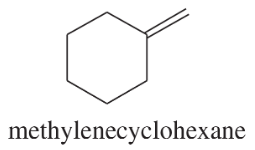
Show how you would synthesize each compound using methylenecyclohexane as your starting material.

(c)

Guida verificata passo dopo passo
1
Step 1: Begin with methylenecyclohexane as the starting material. This compound contains a double bond, which can be used for electrophilic addition reactions.
Step 2: Perform hydroboration-oxidation to convert the double bond into an alcohol. Use BH₃ (borane) in THF (tetrahydrofuran) for hydroboration, followed by oxidation with H₂O₂ (hydrogen peroxide) in a basic solution (NaOH). This reaction adds an -OH group to the less substituted carbon of the double bond, following anti-Markovnikov regioselectivity.
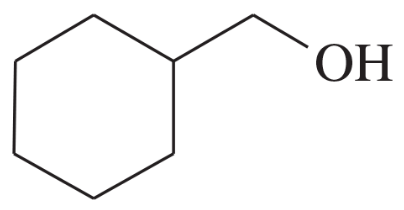
Step 3: The product of the hydroboration-oxidation will be cyclohexylmethanol, where the hydroxyl group (-OH) is attached to the carbon adjacent to the cyclohexane ring.
Step 4: Ensure stereochemistry is considered if the reaction produces stereoisomers. Hydroboration-oxidation typically results in syn addition, meaning the hydrogen and hydroxyl group are added to the same face of the double bond.
Step 5: Verify the structure of the final product to ensure it matches the target compound, cyclohexylmethanol, with the hydroxyl group attached to the correct carbon.

Risposta video verificata per un problema simile:

Questa soluzione video è stata consigliata dai nostri tutor come utile per risolvere questo problema.
Durata del video:
1m

Concetti chiave

Ecco i concetti essenziali che devi comprendere per rispondere correttamente alla domanda.

Reactivity of Alkenes

Methylenecyclohexane contains a double bond, making it an alkene. Alkenes are reactive due to the presence of π bonds, which can undergo various reactions such as electrophilic addition, oxidation, and polymerization. Understanding these reactions is crucial for synthesizing compounds from methylenecyclohexane, as the double bond can be targeted for functional group transformations.
Video consigliato:
Percorso guidato
2:09
Alkene Metathesis Concept 1

Functional Group Transformations

In organic synthesis, functional group transformations involve converting one functional group into another. For example, the addition of a hydroxyl group (OH) to methylenecyclohexane can be achieved through hydration reactions. Recognizing how to manipulate functional groups is essential for designing synthetic pathways to create desired compounds from a given starting material.
Video consigliato:
02:36
Identifying Functional Groups

Synthesis Pathways

Synthesis pathways outline the step-by-step reactions needed to convert a starting material into a target compound. This includes identifying intermediates, reagents, and conditions required for each transformation. A clear understanding of synthesis pathways is vital for effectively planning the synthesis of compounds from methylenecyclohexane, ensuring that each step is feasible and efficient.
Video consigliato:
Percorso guidato
2:13
Energy Production In Biochemical Pathways Concept 1