

When 2,2-dibromo-1-phenylpropane is heated overnight with sodium amide at 150°C, the major product (after addition of water) is a different foul-smelling compound of formula C9H8. Propose a structure for this product, and give a mechanism to account for its formation.
Ch.9 - Alkynes
Capitolo 9, Problema 12a,b
Show how you would convert
a. oct-3-yne to cis-oct-3-ene.
b. pent-2-yne to trans-pent-2-ene.
Guida verificata passo dopo passo1
Step 1: Recognize that the conversion of an alkyne to an alkene involves a reduction reaction. The type of reduction (cis or trans) depends on the reagents used.
Step 2: For part (a), to convert oct-3-yne to cis-oct-3-ene, use Lindlar's catalyst. Lindlar's catalyst is a poisoned palladium catalyst that selectively reduces alkynes to cis-alkenes by adding hydrogen (H₂) in a syn-addition manner.
Step 3: Write the reaction for part (a): (cis configuration).
Step 4: For part (b), to convert pent-2-yne to trans-pent-2-ene, use sodium (Na) in liquid ammonia (NH₃). This is a dissolving metal reduction that selectively reduces alkynes to trans-alkenes by adding hydrogen (H₂) in an anti-addition manner.
Step 5: Write the reaction for part (b): (trans configuration).

Risposta video verificata per un problema simile:
Questa soluzione video è stata consigliata dai nostri tutor come utile per risolvere questo problema.
Durata del video:
3mConcetti chiave
Ecco i concetti essenziali che devi comprendere per rispondere correttamente alla domanda.
Alkyne to Alkene Conversion
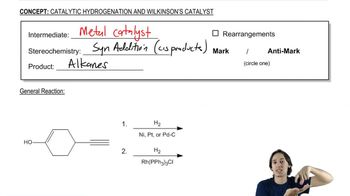
The conversion of alkynes to alkenes typically involves a process called hydrogenation, where hydrogen gas is added to the alkyne in the presence of a catalyst. This reaction reduces the triple bond of the alkyne to a double bond, forming an alkene. The stereochemistry of the resulting alkene can be controlled by the choice of catalyst and reaction conditions.
Video consigliato:
How to name alkenes and alkynes
Stereochemistry of Alkenes
Stereochemistry refers to the spatial arrangement of atoms in molecules and is crucial for understanding the properties of alkenes. In the case of cis and trans isomers, the terms describe the relative positioning of substituents around the double bond. Cis isomers have substituents on the same side, while trans isomers have them on opposite sides, affecting the physical properties and reactivity of the compounds.
Video consigliato:
Percorso guidato
Polymer Stereochemistry Concept 1
Reagents for Selective Hydrogenation
Selective hydrogenation is a technique used to convert alkynes to specific alkenes while controlling the stereochemistry. Common reagents include Lindlar's catalyst, which allows for the formation of cis alkenes, and sodium in liquid ammonia, which can yield trans alkenes. Understanding the choice of reagents is essential for achieving the desired product in organic synthesis.
Video consigliato:
General properties of catalytic hydrogenation.
Pratica correlata
Domanda del libro di testo
1416
views
Domanda del libro di testo
When 2,2-dibromo-1-phenylpropane is heated overnight in fused KOH at 200 C, the major product is a foul-smelling compound of formula C9H8. Propose a structure for this product, and give a mechanism to account for its formation.
Problem-Solving Hint:
1685
views
Domanda del libro di testo
Show how you would convert
c. cis-cyclodecene to trans-cyclodecene.
1223
views
Domanda del libro di testo
Show how you would convert
d. but-1-yne to cis-hex-3-ene.
1166
views
Domanda del libro di testo
The fragrance of (Z)-1-phenylhex-2-en-1-ol resembles that of roses, with a delicate citrus edge. Show how you would synthesize this compound from benzaldehyde (PhCHO) and any other reagents you need.
1078
views
Domanda del libro di testo
Show how you would synthesize 2-phenylhex-3-yn-2-ol, starting with acetophenone (PhCOCH3) and any other reagents you need. ("2-ol" means there is an OH group on C2.)
1287
views
