Ch.9 - Alkynes
Wade - Organic Chemistry 9th Edition
Wade9th EditionOrganic ChemistryISBN: 9780135213728Non è quello che usi tu?Cambia libro di testo
Capitolo 9, Problema 41c

The following functional-group interchange is a useful synthesis of aldehydes.
Reaction diagram showing the conversion of a terminal alkyne to an aldehyde with structural formulas labeled.
(c) Explain why a nucleophilic reagent such as ethoxide adds to an alkyne more easily than it adds to an alkene.

Guida verificata passo dopo passo
1
Step 1: Recognize the structural difference between alkynes and alkenes. Alkynes contain a triple bond (C≡C), while alkenes contain a double bond (C=C). The triple bond in alkynes is more polarized due to the higher s-character of the sp-hybridized carbon atoms, making the π-electrons more accessible to nucleophiles.
Step 2: Understand the role of ethoxide (CH3CH2O−) as a nucleophile. Ethoxide is negatively charged and seeks regions of electron deficiency. The terminal alkyne (R-C≡C-H) has a hydrogen atom attached to the sp-hybridized carbon, which is more acidic compared to the hydrogen on an alkene due to the increased electronegativity of the sp-hybridized carbon.
Step 3: Explain why nucleophilic addition is easier for alkynes. The increased acidity of the terminal alkyne allows the formation of an acetylide ion (R-C≡C−) upon deprotonation by ethoxide. This acetylide ion is highly nucleophilic and can readily react with electrophiles, facilitating addition reactions.
Step 4: Compare this behavior to alkenes. Alkenes are less acidic because their sp2-hybridized carbons have lower electronegativity compared to sp-hybridized carbons. This makes it harder for ethoxide to deprotonate an alkene and initiate nucleophilic addition.
Step 5: Relate this to the synthesis of aldehydes. The nucleophilic addition of ethoxide to the terminal alkyne sets the stage for subsequent reactions that convert the alkyne into an aldehyde, as shown in the provided image. This transformation leverages the unique reactivity of alkynes compared to alkenes.

Risposta video verificata per un problema simile:

Questa soluzione video è stata consigliata dai nostri tutor come utile per risolvere questo problema.
Durata del video:
2m

Concetti chiave

Ecco i concetti essenziali che devi comprendere per rispondere correttamente alla domanda.

Nucleophilicity

Nucleophilicity refers to the ability of a nucleophile to donate an electron pair to an electrophile. In organic reactions, nucleophiles are species that are attracted to positively charged or electron-deficient centers. Ethoxide, being a strong nucleophile, can effectively attack electrophilic sites, such as those found in alkynes, due to their higher electron density compared to alkenes.
Video consigliato:
08:27
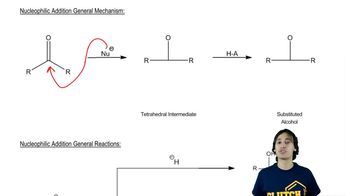
Nucleophilic Addition

Alkynes vs. Alkenes

Alkynes are hydrocarbons that contain at least one carbon-carbon triple bond, while alkenes contain a carbon-carbon double bond. The triple bond in alkynes is more reactive than the double bond in alkenes because it has a higher degree of electron density and can stabilize additional negative charge better, making them more susceptible to nucleophilic attack.
Video consigliato:
01:55
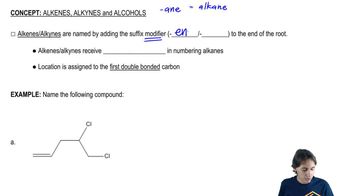
How to name alkenes and alkynes

Electrophilic Sites

Electrophilic sites are regions in a molecule that are electron-deficient and can accept electron pairs from nucleophiles. In the context of alkynes and alkenes, the sp-hybridized carbon in alkynes is more electronegative than the sp2-hybridized carbon in alkenes, making the former a more favorable site for nucleophilic addition due to its greater ability to stabilize the resulting negative charge.
Video consigliato:
03:
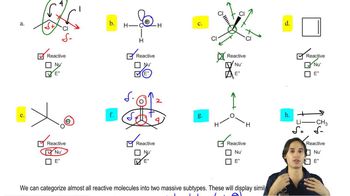
Nucleophile or Electrophile
Pratica correlata
Domanda del libro di testo

Using any necessary inorganic reagents, show how you would convert acetylene and isobutyl bromide to

(b) (±)-2,7-dimethyloctane-4,5-diol.

854
views

Domanda del libro di testo

Deduce the structure of each compound from the information given. All unknowns in this problem have molecular formula C8H12.

(a) Upon catalytic hydrogenation, unknown W gives cyclooctane. Ozonolysis of W, followed by reduction with dimethyl sulfide, gives octanedioic acid, HOOC–(CH2)6–COOH. Draw the structure of W.

819
views
Domanda del libro di testo

Show how you would convert the following starting materials into the target compound. You may use any additional reagents you need.

1085
views
Domanda del libro di testo

The following functional-group interchange is a useful synthesis of aldehydes.

(a) What reagents were used in this chapter for this transformation? Give an example to illustrate this method.

(b) This functional-group interchange can also be accomplished using the following sequence.

Propose mechanisms for these steps.

667
views
Domanda del libro di testo

When compound Z is treated with ozone, followed by dimethyl sulfide and washing with water, the products are formic acid, 3-oxobutanoic acid, and hexanal.

Propose a structure for compound Z. What uncertainty is there in the structure you have proposed?

2124
views
1
rank
Domanda del libro di testo

Using any necessary inorganic reagents, show how you would convert acetylene and isobutyl bromide to

(a) meso-2,7-dimethyloctane-4,5-diol, (CH3)2CHCH2CH(OH)CH(OH)CH2CH(CH3)2.

1111
views