Ch.6 - Alkyl Halides; Nucleophilic Substitution
Wade - Organic Chemistry 9th Edition
Wade9th EditionOrganic ChemistryISBN: 9780135213728Non è quello che usi tu?Cambia libro di testo
Capitolo 6, Problema 1a,b,c

Classify each compound as an alkyl halide, a vinyl halide, or an aryl halide.
(a) CH3CHCFCH3
(b) (CH3)3CBr
(c) CH3CCl3

Guida verificata passo dopo passo
1
Step 1: Understand the definitions of alkyl halides, vinyl halides, and aryl halides. An alkyl halide contains a halogen atom (Cl, Br, I, or F) bonded to an sp³-hybridized carbon atom. A vinyl halide contains a halogen atom bonded to an sp²-hybridized carbon atom in a double bond. An aryl halide contains a halogen atom bonded directly to a benzene ring or aromatic system.
Step 2: Analyze compound (a) CH3CHCFCH3. Identify the halogen atom (F) and determine the hybridization of the carbon it is bonded to. The halogen is bonded to a carbon that is part of a double bond, making it sp²-hybridized. This classifies the compound as a vinyl halide.
Step 3: Analyze compound (b) (CH3)3CBr. Identify the halogen atom (Br) and determine the hybridization of the carbon it is bonded to. The halogen is bonded to a tertiary carbon (sp³-hybridized), which classifies the compound as an alkyl halide.
Step 4: Analyze compound (c) CH3CCl3. Identify the halogen atoms (Cl) and determine the hybridization of the carbon they are bonded to. The halogens are bonded to a single sp³-hybridized carbon atom, which classifies the compound as an alkyl halide.
Step 5: Summarize the classifications: (a) is a vinyl halide, (b) is an alkyl halide, and (c) is an alkyl halide. This classification is based on the hybridization of the carbon atoms bonded to the halogens.

Risposta video verificata per un problema simile:

Questa soluzione video è stata consigliata dai nostri tutor come utile per risolvere questo problema.
Durata del video:
3m

Concetti chiave

Ecco i concetti essenziali che devi comprendere per rispondere correttamente alla domanda.

Alkyl Halides

Alkyl halides are organic compounds where a halogen atom (F, Cl, Br, I) is bonded to an sp3 hybridized carbon atom. They are derived from alkanes by replacing one or more hydrogen atoms with halogen atoms. Common examples include bromoethane and chloropropane, which are used in various chemical reactions and applications.
Video consigliato:
01:52
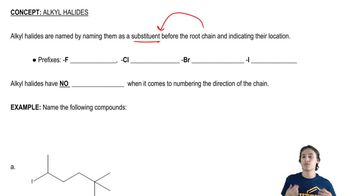
How to name alkyl halides

Vinyl Halides

Vinyl halides are compounds in which a halogen atom is bonded to a carbon atom that is part of a carbon-carbon double bond (C=C). This structure gives vinyl halides unique reactivity compared to alkyl halides. An example is vinyl chloride, which is used in the production of PVC (polyvinyl chloride).
Video consigliato:
01:52
How to name alkyl halides

Aryl Halides

Aryl halides are organic compounds where a halogen atom is attached to an aromatic ring, such as benzene. The halogen is bonded to a carbon atom that is part of the aromatic system, influencing the compound's reactivity and stability. Examples include chlorobenzene and bromobenzene, which are important in organic synthesis and industrial applications.
Video consigliato:
01:52
How to name alkyl halides