
Ch.6 - Alkyl Halides; Nucleophilic Substitution
Wade - Organic Chemistry 9th Edition
Wade9th EditionOrganic ChemistryISBN: 9780135213728Non è quello che usi tu?Cambia libro di testo
Capitolo 6, Problema 11b

Classify each reaction as a substitution, an elimination, or neither. Identify the leaving group in each reaction, and the nucleophile in substitutions.
b.

Guida verificata passo dopo passo
1
Identify the type of reaction: The reaction involves the conversion of an alcohol to an alkene, which is characteristic of an elimination reaction. Specifically, this is an E1 elimination reaction where the alcohol is protonated to form a good leaving group.
Determine the leaving group: In the presence of sulfuric acid (H2SO4), the hydroxyl group (OH) of the alcohol is protonated to form water (H2O), which is a good leaving group.
Identify the nucleophile: In elimination reactions, the nucleophile is not directly involved in the reaction mechanism. Instead, the base (in this case, the bisulfate ion, HSO4-) abstracts a proton from the beta-carbon, facilitating the formation of the double bond.
Describe the mechanism: The reaction proceeds via a two-step E1 mechanism. First, the alcohol is protonated by H2SO4, forming a carbocation intermediate after the loss of water. Then, the bisulfate ion abstracts a proton from the adjacent carbon, leading to the formation of the double bond and the alkene product.
Summarize the reaction: The overall reaction is an acid-catalyzed dehydration of an alcohol to form an alkene, with water and bisulfate ion as byproducts. The reaction is driven by the formation of a stable carbocation and the subsequent elimination of a proton to form the double bond.

Risposta video verificata per un problema simile:

Questa soluzione video è stata consigliata dai nostri tutor come utile per risolvere questo problema.
Durata del video:
4m

Concetti chiave

Ecco i concetti essenziali che devi comprendere per rispondere correttamente alla domanda.

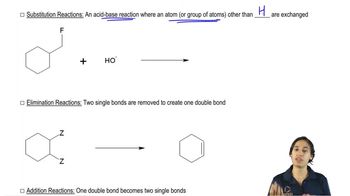
Substitution Reactions

Substitution reactions involve the replacement of one functional group in a molecule with another. In organic chemistry, this often occurs when a nucleophile attacks an electrophile, leading to the displacement of a leaving group. Understanding the nature of the nucleophile and the leaving group is crucial for classifying the reaction correctly.
Video consigliato:
01:34
Recognizing Substitution Reactions.

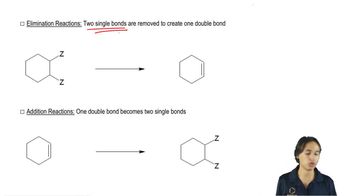
Elimination Reactions

Elimination reactions involve the removal of a small molecule from a larger one, typically resulting in the formation of a double bond. In these reactions, a leaving group departs along with a hydrogen atom from an adjacent carbon, leading to the creation of alkenes. Recognizing the conditions and products of elimination reactions is essential for proper classification.
Video consigliato:
00:40
Recognizing Elimination Reactions.

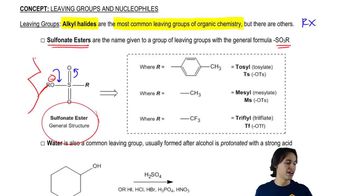
Leaving Groups

Leaving groups are atoms or groups that can depart from a molecule during a chemical reaction, often facilitating substitution or elimination processes. A good leaving group is typically stable after departure, such as halides or sulfonate groups. Identifying the leaving group in a reaction is vital for understanding the mechanism and predicting the reaction's outcome.
Video consigliato:
07:22
The 3 important leaving groups to know.