Ch.6 - Alkyl Halides; Nucleophilic Substitution
Wade - Organic Chemistry 9th Edition
Wade9th EditionOrganic ChemistryISBN: 9780135213728Non è quello che usi tu?Cambia libro di testo
Capitolo 6, Problema 33a,b

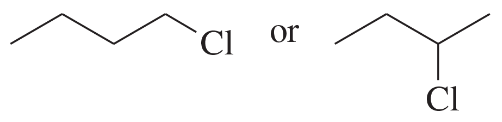
Predict the compound in each pair that will undergo the SN2 reaction faster.
(a)
(b)

Guida verificata passo dopo passo
1
Step 1: Understand the SN2 reaction mechanism. SN2 reactions are bimolecular nucleophilic substitution reactions where the rate depends on both the nucleophile and the substrate. The reaction occurs in a single step with a backside attack, leading to inversion of configuration.
Step 2: Evaluate steric hindrance in the substrates. In SN2 reactions, less sterically hindered substrates react faster because the nucleophile needs access to the electrophilic carbon. Primary alkyl halides are preferred over secondary or tertiary alkyl halides.
Step 3: Analyze the leaving group. A better leaving group facilitates the SN2 reaction. Halides such as I⁻ are better leaving groups than Br⁻, which in turn are better than Cl⁻. This is due to their ability to stabilize the negative charge after leaving.
Step 4: Compare the compounds in pair (a). The first compound has a bromine attached to a tertiary carbon, which is highly sterically hindered, while the second compound has bromine attached to a primary carbon, which is less hindered. The second compound will undergo the SN2 reaction faster.
Step 5: Compare the compounds in pair (b). The first compound has chlorine as the leaving group, while the second compound has iodine. Since iodine is a better leaving group than chlorine, the second compound will undergo the SN2 reaction faster.

Risposta video verificata per un problema simile:

Questa soluzione video è stata consigliata dai nostri tutor come utile per risolvere questo problema.
Durata del video:
3m

Concetti chiave

Ecco i concetti essenziali che devi comprendere per rispondere correttamente alla domanda.

S<sub>N</sub>2 Reaction Mechanism

The S<sub>N</sub>2 reaction is a bimolecular nucleophilic substitution process where a nucleophile attacks an electrophile, resulting in the simultaneous displacement of a leaving group. This mechanism is characterized by a single concerted step, leading to the inversion of configuration at the carbon center. The rate of the reaction depends on both the concentration of the nucleophile and the substrate.
Video consigliato:
02:16
Heck Reaction Mechanism

Steric Hindrance

Steric hindrance refers to the prevention of chemical reactions due to the spatial arrangement of atoms within a molecule. In S<sub>N</sub>2 reactions, steric hindrance can significantly affect the reaction rate; less hindered substrates (like primary alkyl halides) react faster than more hindered ones (like tertiary alkyl halides). This is because bulky groups around the reactive center can obstruct the nucleophile's approach.
Video consigliato:
02:53
Understanding steric effects.

Leaving Group Ability

The ability of a leaving group to depart from a substrate is crucial in determining the rate of S<sub>N</sub>2 reactions. Good leaving groups, such as halides (e.g., Cl<sup>-</sup>, Br<sup>-</sup>), stabilize the transition state and facilitate the reaction. The better the leaving group, the faster the reaction will proceed, as it can more readily dissociate from the substrate during the nucleophilic attack.
Video consigliato:
03:06
How to use the factors affecting acidity to predict leaving group ability.