


Ch.6 - Alkyl Halides; Nucleophilic Substitution
Wade - Organic Chemistry 9th Edition
Wade9th EditionOrganic ChemistryISBN: 9780135213728Non è quello che usi tu?Cambia libro di testo
Capitolo 6, Problema 14a

Predict the major products of the following substitutions.
a.

Guida verificata passo dopo passo
1
Identify the type of reaction: Potassium tert-butoxide ((CH3)3CO⁻ K⁺) is a strong, bulky base. This suggests that the reaction will likely proceed via an E2 elimination mechanism rather than a substitution, as bulky bases favor elimination over substitution.
Analyze the substrate: Ethyl bromide (CH3CH2Br) is a primary alkyl halide. Primary alkyl halides typically undergo elimination with strong, bulky bases like tert-butoxide.
Determine the elimination product: In an E2 elimination, the base abstracts a proton (H⁺) from the β-carbon (the carbon adjacent to the carbon bonded to the leaving group, Br⁻). The electrons from the C-H bond form a double bond between the α-carbon (the carbon bonded to the leaving group) and the β-carbon, while the leaving group (Br⁻) departs.
Draw the product: The elimination of HBr from ethyl bromide results in the formation of ethene (CH2=CH2) as the major product. This is because ethene is the simplest alkene that can form from this reaction.
Verify the reaction conditions: Confirm that the reaction conditions (strong, bulky base and primary alkyl halide) are consistent with the E2 mechanism and that no competing SN2 reaction occurs due to steric hindrance from the bulky base.

Risposta video verificata per un problema simile:

Questa soluzione video è stata consigliata dai nostri tutor come utile per risolvere questo problema.
Durata del video:
3m

Concetti chiave

Ecco i concetti essenziali che devi comprendere per rispondere correttamente alla domanda.

Nucleophilic Substitution Reactions

Nucleophilic substitution reactions involve the replacement of a leaving group in a molecule by a nucleophile. In this context, potassium tert-butoxide acts as a strong nucleophile that can attack the electrophilic carbon in ethyl bromide, leading to the formation of a new bond and the release of bromide ion as a leaving group.
Video consigliato:
01:47
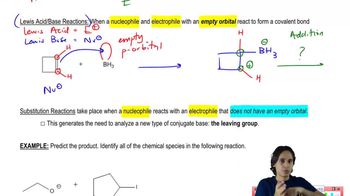
Nucleophiles and Electrophiles can react in Substitution Reactions.

Sterics and Nucleophilicity

Sterics refers to the spatial arrangement of atoms in a molecule and can significantly influence reaction pathways. Potassium tert-butoxide is a bulky nucleophile, which favors elimination reactions over substitution due to steric hindrance. Understanding how sterics affects nucleophilicity is crucial for predicting the major products in this reaction.
Video consigliato:
08:27
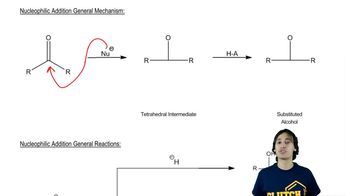
Nucleophilic Addition

E2 Elimination Mechanism

The E2 elimination mechanism is a concerted reaction where a base removes a proton from a β-carbon while the leaving group departs from the α-carbon, resulting in the formation of a double bond. In the presence of a strong base like potassium tert-butoxide, the reaction with ethyl bromide is likely to proceed via E2, leading to the formation of an alkene as the major product.
Video consigliato:
09:36
Drawing the E2 Mechanism.