
Ch.6 - Alkyl Halides; Nucleophilic Substitution
Wade - Organic Chemistry 9th Edition
Wade9th EditionOrganic ChemistryISBN: 9780135213728Non è quello che usi tu?Cambia libro di testo
Capitolo 6, Problema 58c

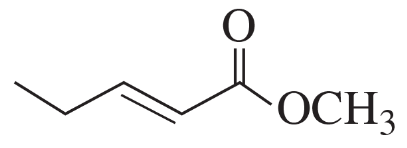
Show the products you expect when each compound reacts with NBS with light shining on the reaction.
(c)

Guida verificata passo dopo passo
1
Step 1: Recognize that NBS (N-Bromosuccinimide) in the presence of light is used for allylic bromination. This reaction selectively replaces a hydrogen atom at the allylic position (the carbon adjacent to a double bond) with a bromine atom.
Step 2: Identify the allylic positions in the given compound. The compound contains a double bond, and the carbons adjacent to this double bond are the allylic positions. These are the carbons directly connected to the double bond but not part of it.
Step 3: Determine the most stable allylic radical that can form during the reaction. When the allylic hydrogen is abstracted, the resulting radical is stabilized by resonance. Draw resonance structures to confirm the stability of the allylic radical.
Step 4: Add a bromine atom to the allylic radical to form the brominated product. The bromine will attach to the carbon where the radical was formed.
Step 5: Consider regioselectivity and stereochemistry if applicable. If multiple allylic positions are available, the major product will typically form at the position that leads to the most stable radical intermediate. Draw the expected product(s) based on this analysis.

Risposta video verificata per un problema simile:

Questa soluzione video è stata consigliata dai nostri tutor come utile per risolvere questo problema.
Durata del video:
3m

Concetti chiave

Ecco i concetti essenziali che devi comprendere per rispondere correttamente alla domanda.

NBS (N-Bromosuccinimide) Reactivity

NBS is a reagent commonly used in organic chemistry for bromination reactions, particularly in the presence of light. It generates bromine radicals upon photolysis, which can abstract hydrogen atoms from alkenes or allylic positions, leading to the formation of brominated products. Understanding how NBS interacts with different functional groups is crucial for predicting the products of the reaction.
Video consigliato:
01:17
Reactivity of Molecules

Radical Mechanism

The reaction mechanism involving NBS and light typically follows a radical pathway. This includes initiation (formation of radicals), propagation (reaction of radicals with substrates), and termination (recombination of radicals). Recognizing the steps of radical mechanisms helps in predicting the outcome of reactions, especially in terms of regioselectivity and stereochemistry.
Video consigliato:
03:28
The mechanism of Radical Polymerization.

Allylic Bromination

Allylic bromination refers to the substitution of hydrogen atoms at the allylic position (the carbon adjacent to a double bond) with bromine. This process is favored in reactions involving NBS and light, as the formation of a stable allylic radical intermediate allows for selective bromination. Understanding this concept is essential for determining the expected products when the compound in the question reacts with NBS.
Video consigliato:
00:54
Mechanism of Allylic Bromination.
Pratica correlata
Domanda del libro di testo

A student adds NBS to a solution of 1-methylcyclohexene and irradiates the mixture with a sunlamp until all the NBS has reacted. After a careful distillation, the product mixture contains two major products of formula C7H11Br.

a. Draw the resonance forms of the three possible allylic free radical intermediates.

2475
views
Domanda del libro di testo

Propose mechanisms to account for the observed products in the following reactions.

(b)

674
views
Domanda del libro di testo

Show the products you expect when each compound reacts with NBS with light shining on the reaction.

(a)

(b)

706
views
Domanda del libro di testo

A student adds NBS to a solution of 1-methylcyclohexene and irradiates the mixture with a sunlamp until all the NBS has reacted. After a careful distillation, the product mixture contains two major products of formula C7H11Br.

b. Rank these three intermediates from most stable to least stable.

1429
views
Domanda del libro di testo

Propose mechanisms to account for the observed products in the following reactions.

(a)

936
views
Domanda del libro di testo

A student adds NBS to a solution of 1-methylcyclohexene and irradiates the mixture with a sunlamp until all the NBS has reacted. After a careful distillation, the product mixture contains two major products of formula C7H11Br.

(a) Draw the resonance forms of the three possible allylic free radical intermediates.

(b) Rank these three intermediates from most stable to least stable.

(c) Draw the products obtained from each free-radical intermediate.

948
views