
Ch.6 - Alkyl Halides; Nucleophilic Substitution
Wade - Organic Chemistry 9th Edition
Wade9th EditionOrganic ChemistryISBN: 9780135213728Non è quello che usi tu?Cambia libro di testo
Capitolo 6, Problema 56

The following reaction takes place under second-order conditions (strong nucleophile), yet the structure of the product shows rearrangement. Also, the rate of this reaction is several thousand times faster than the rate of substitution of ­hydroxide ion on 2-chlorobutane under similar conditions. Propose a mechanism to explain the enhanced rate and ­rearrangement observed in this unusual reaction. (“Et” is the abbreviation for ethyl.)
Reaction diagram showing ethyl amine reacting with 2-chlorobutane to form an alcohol and ethyl amine, highlighting rearrangement.

Guida verificata passo dopo passo
1
Step 1: Analyze the reaction conditions. The reaction occurs under second-order conditions with a strong nucleophile (Et₂N:), which suggests an SN2 mechanism. However, the product shows rearrangement, indicating that the reaction may involve additional steps beyond a simple SN2 substitution.
Step 2: Consider the structure of the substrate. The substrate contains a β-chlorine atom attached to a secondary carbon, which is adjacent to a tertiary carbon. This arrangement makes the molecule prone to rearrangement due to the formation of a more stable carbocation intermediate.
Step 3: Propose the mechanism. The reaction likely begins with the nucleophile (Et₂N:) attacking the β-carbon, displacing the chloride ion (Cl⁻). This step forms a carbocation intermediate at the tertiary carbon, which is stabilized by hyperconjugation and inductive effects.
Step 4: Explain the rearrangement. The carbocation intermediate undergoes a hydride shift or alkyl shift to form a more stable carbocation. This rearrangement accounts for the structural change observed in the product.
Step 5: Final substitution step. The hydroxide ion (OH⁻) then attacks the rearranged carbocation, leading to the formation of the final product with the hydroxyl group (-OH) attached to the tertiary carbon. The chloride ion (Cl⁻) is released as a byproduct.

Risposta video verificata per un problema simile:

Questa soluzione video è stata consigliata dai nostri tutor come utile per risolvere questo problema.
Durata del video:
7m

Concetti chiave

Ecco i concetti essenziali che devi comprendere per rispondere correttamente alla domanda.

Nucleophilic Substitution Mechanisms

Nucleophilic substitution reactions involve the replacement of a leaving group (like Cl) by a nucleophile (like ethyl amine). In this case, the reaction proceeds under second-order kinetics, indicating that both the nucleophile and the substrate are involved in the rate-determining step. Understanding the mechanism, whether it follows an SN1 or SN2 pathway, is crucial for explaining the rearrangement and the reaction's rate.
Video consigliato:
01:47
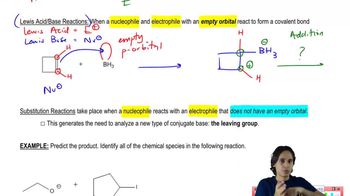
Nucleophiles and Electrophiles can react in Substitution Reactions.

Carbocation Rearrangement

Carbocation rearrangement occurs when a carbocation intermediate can shift to a more stable configuration during a reaction. In this case, the formation of a more stable carbocation from 2-chlorobutane can lead to the observed rearrangement in the product. Recognizing the stability of different carbocation structures (primary, secondary, tertiary) is essential for predicting the outcome of the reaction.
Video consigliato:
00:47
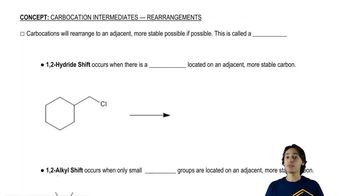
Understanding why carbocations shift.

Reaction Rate Factors

The rate of a chemical reaction can be influenced by several factors, including the nature of the nucleophile, the leaving group, and the solvent. In this reaction, the strong nucleophile (ethyl amine) and the good leaving group (Cl) contribute to the significantly enhanced reaction rate compared to hydroxide ion substitution. Understanding these factors helps explain why this reaction occurs much faster than typical nucleophilic substitutions.
Video consigliato:
Percorso guidato
5:07
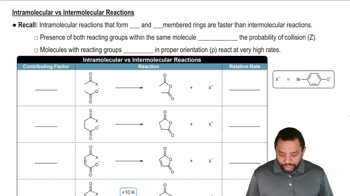
Rates of Intramolecular Reactions Concept 2
Pratica correlata
Domanda del libro di testo

Triethyloxonium tetrafluoroborate, (CH3CH2)3O+ BF4–, is a solid with melting point 91–92°C. Show how this reagent can transfer an ethyl group to a nucleophile (Nuc:−) in an SN2 reaction. What is the leaving group? Why might this reagent be preferred to using an ethyl halide? (Consult Table 6-2)

1209
views
Domanda del libro di testo

Propose mechanisms to account for the observed products in the following reactions.

(b)

674
views
Domanda del libro di testo

Show the products you expect when each compound reacts with NBS with light shining on the reaction.

(a)

(b)

706
views
Domanda del libro di testo

Propose mechanisms to account for the observed products in the following reactions.

(a)

936
views
Domanda del libro di testo

Because the SN1 reaction goes through a flat carbocation, we might expect an optically active starting material to give a completely racemized product. In most cases, however, SN1 reactions actually give more of the inversion product. In general, as the stability of the carbocation increases, the excess inversion product decreases. Extremely stable carbocations give completely racemic products. Explain these observations.

1764
views
Domanda del libro di testo

Furfuryl chloride can undergo substitution by both SN2 and SN1 mechanisms. Because it is a 1° alkyl halide, we expect SN2 but not SN1 reactions. Draw a mechanism for the SN1 reaction shown below, paying careful attention to the structure of the intermediate. How can this primary halide undergo SN1 reactions?

1793
views
1
rank