 Indietro
Chapter 1: Motion in One Dimension – Study Notes for Physics with Algebra
Guida di studio - Note intelligenti
 Appunti personalizzati basati sui tuoi materiali, ampliati con definizioni chiave, esempi e contesto.
Chapter 1: Motion in One Dimension
Types of Motion
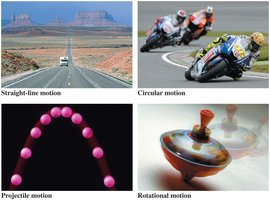
Motion refers to the change of an object’s position or orientation with time. There are several fundamental types of motion encountered in physics:
Straight-line motion: Movement along a straight path.
Circular motion: Movement along a circular path.
Projectile motion: Curved path under the influence of gravity.
Rotational motion: Spinning around an axis.
Making a Motion Diagram
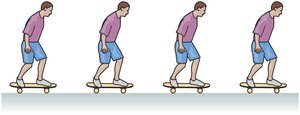
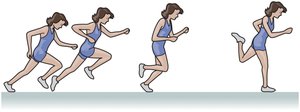
A motion diagram is a sequence of images showing an object’s position at equal time intervals. It helps visualize the type of motion:
Constant speed: Equal spacing between positions.
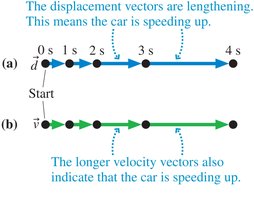
Speeding up: Increasing spacing between positions.
Slowing down: Decreasing spacing between positions.

Position, Displacement, and Coordinate Systems
Position and Coordinate Systems
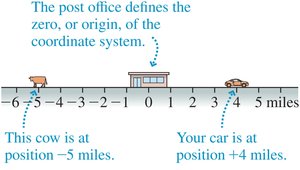
To specify an object’s position, a reference point (origin), a distance from the origin, and a direction are required. The combination of an origin and an axis marked in both positive and negative directions forms a coordinate system. The position along an axis is called a coordinate.
Change in Time (Time Intervals)
To quantify motion, we use time intervals (Δt), which measure the elapsed time as an object moves from an initial position at time ti to a final position at time tf:
Time intervals are always positive.
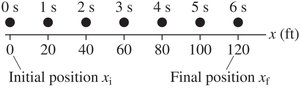
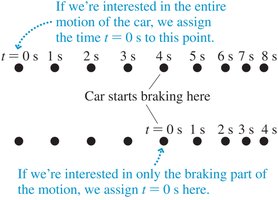
Assigning Time in Motion Diagrams
Each frame in a motion diagram should be labeled with its corresponding time (t), as read from a clock. The choice of t = 0 is arbitrary and can be set for convenience, such as at the start of motion or at a significant event (e.g., when braking begins).
Displacement
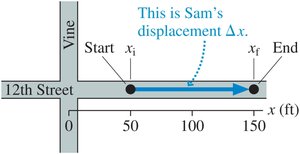
A displacement is the change in position of an object, defined as the difference between the final and initial positions:
Displacement is a vector quantity, having both magnitude and direction.
Mathematically, displacement Δx is given by:
Distance vs. Displacement
Distance is the total length of the path traveled, regardless of direction, while displacement is the straight-line change from the initial to the final position. Displacement can be zero or negative, but distance is always positive.
Velocity and Speed
Uniform Motion
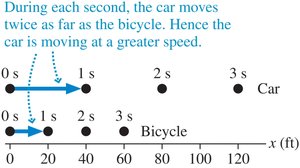
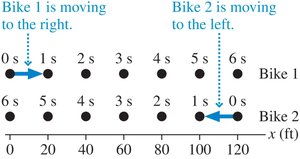
Motion at a constant speed in a straight line is called uniform motion. The path is straight, and the object covers equal distances in equal time intervals.
Speed vs. Velocity
Speed: Scalar quantity; measures how fast an object moves (distance per unit time).
Velocity: Vector quantity; measures both the speed and direction of motion.
The average velocity is defined as:
Example: Calculating Velocity
Suppose at t = 12 s, Frank is at x = 25 m. Five seconds later, he is at x = 20 m. His average velocity is:
The negative sign indicates motion in the negative direction.
Vectors and Motion: A First Look
Scalars and Vectors
Scalar quantity: Described by a single number with units (e.g., mass, temperature).
Vector quantity: Has both magnitude and direction (e.g., displacement, velocity).
The magnitude of a vector is its size or length.
Vectors are represented graphically as arrows.

Displacement Vectors
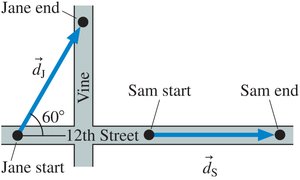
The displacement vector represents the straight-line distance and direction from the initial to the final position, regardless of the path taken.
Adding Vectors
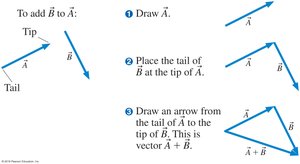
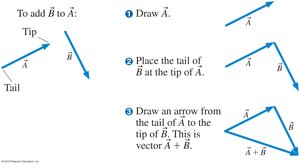
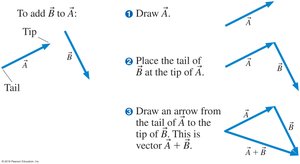
To find the net displacement for a trip with multiple legs, add the displacement vectors:
Draw the first vector.
Place the tail of the next vector at the tip of the previous one.
Draw the resultant vector from the tail of the first to the tip of the last.
Vectors and Trigonometry
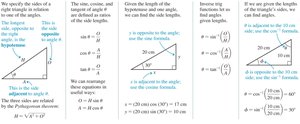
Trigonometry is used to calculate the lengths and angles of triangles formed by vectors. For a right triangle:
Pythagorean theorem:
Sine, cosine, and tangent relate angles to side lengths:
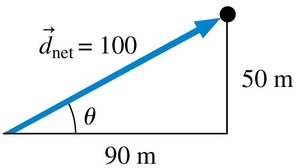
Example: How Far Away Is Anna?
Anna walks 90 m east, then 50 m north. Her net displacement is the hypotenuse of a right triangle with sides 90 m and 50 m:
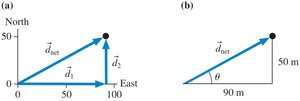
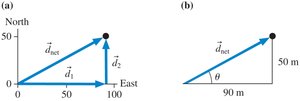
Magnitude of displacement:
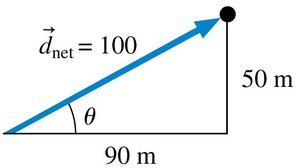
Direction (angle north of east):
Velocity Vectors
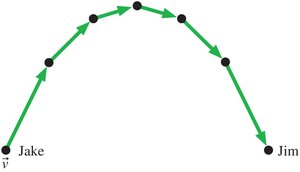
The velocity of an object is represented by a vector pointing in the direction of motion, with magnitude equal to the speed. Both the length and direction of the velocity vector can change as the object moves.
Significant Figures, Scientific Notation, and Units
Using Scientific Notation
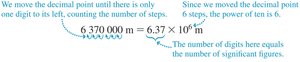
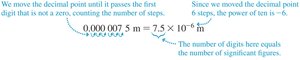
Scientific notation expresses numbers as a product of a number between 1 and 10 and a power of ten. This is useful for very large or very small numbers.
For numbers > 10, move the decimal left and count the steps as the exponent.
For numbers < 1, move the decimal right and use a negative exponent.
Measurements and Significant Figures
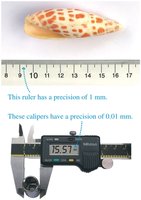
Significant figures reflect the precision of a measurement. The number of significant figures in a value is determined by the measuring instrument’s precision.
Rules for Significant Figures
When multiplying or dividing, the answer should have the same number of significant figures as the least precise measurement.
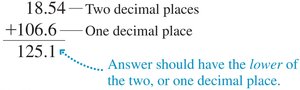
When adding or subtracting, the answer should have the same number of decimal places as the measurement with the fewest decimal places.

Units and Unit Conversion
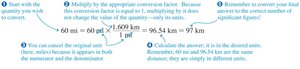
Scientists use the International System of Units (SI). Unit conversion is essential for translating between different measurement systems. The conversion process involves multiplying by appropriate conversion factors and ensuring the correct number of significant figures in the result.
Summary Table: Common SI Units
Quantity | SI Unit | Symbol |
|---|---|---|
Length | meter | m |
Mass | kilogram | kg |
Time | second | s |
Electric current | ampere | A |
Temperature | kelvin | K |
Amount of substance | mole | mol |
Luminous intensity | candela | cd |
Additional info: Mastery of these foundational concepts is essential for success in all subsequent topics in Physics with Algebra, including forces, energy, and motion in multiple dimensions.
