 Indietro
Chapter 1: Representing Motion – Study Notes for Physics with Algebra
Guida di studio - Note intelligenti
 Appunti personalizzati basati sui tuoi materiali, ampliati con definizioni chiave, esempi e contesto.
Chapter 1: Representing Motion
Introduction to Motion
Understanding motion is fundamental to physics. This chapter introduces the basic concepts of motion, including how to represent and analyze the movement of objects using diagrams, models, and mathematical tools.
Types of Motion
Motion is the change of an object’s position or orientation with time.
The trajectory is the path along which an object moves.
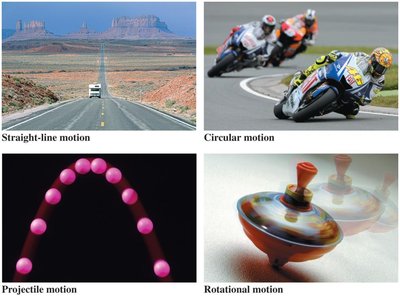
Common types of motion include straight-line (linear), circular, projectile, and rotational motion.
Motion Diagrams
One-Dimensional Motion Diagrams
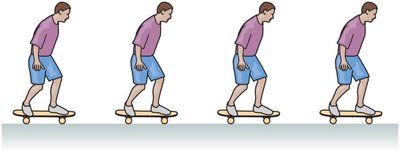
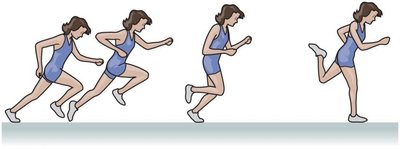
Motion diagrams visually represent an object's position at equal time intervals. They help distinguish between constant speed, speeding up, and slowing down.
Constant speed: Equal spacing between positions.
Speeding up: Increasing spacing between positions.
Slowing down: Decreasing spacing between positions.

Two-Dimensional Motion Diagrams
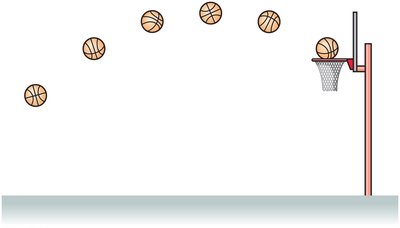
Motion in two dimensions involves changes in both speed and direction, such as the path of a basketball toward a hoop.
Models and Modeling in Physics
Purpose of Models
Descriptive models: Simplify and describe properties in the simplest terms.
Explanatory models: Predict outcomes based on physical laws.
The Particle Model
The particle model treats a moving object as if all its mass is concentrated at a single point. This simplification is useful for analyzing motion without considering the object's size or shape.
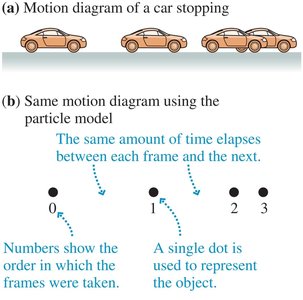
Position, Displacement, and Time
Position and Coordinate Systems
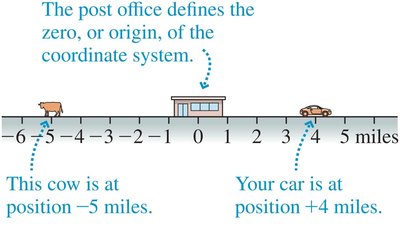
To specify an object's position, a reference point (origin), a distance from the origin, and a direction are needed. The combination of an origin and an axis forms a coordinate system.
Time and Motion Diagrams
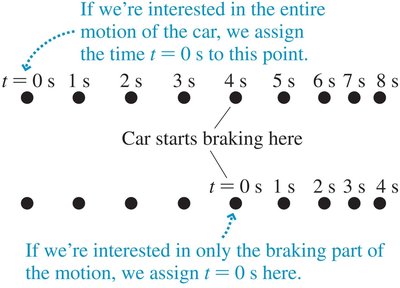
Each position in a motion diagram is labeled with a time value, typically denoted as t.
Displacement
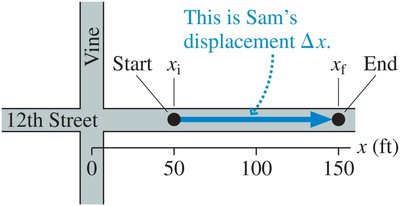
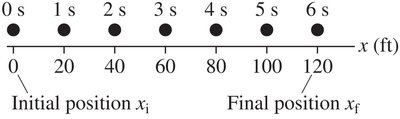
Displacement is the change in position, calculated as the difference between the final and initial positions:
Time Interval
The time interval is the elapsed time between two events:
Distance vs. Displacement
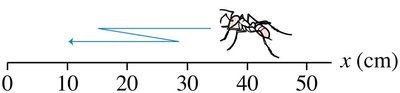
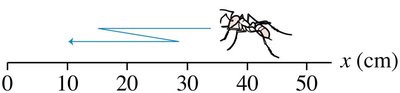
Distance is the total length of the path traveled, while displacement is the straight-line change in position from start to end.
Velocity and Speed
Uniform Motion
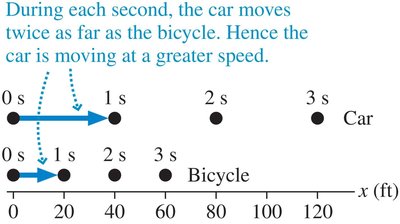
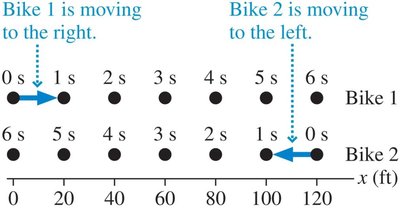
Motion at a constant speed in a straight line is called uniform motion.
Average Velocity
Speed measures how fast an object moves, while velocity includes both speed and direction. The average velocity is defined as:
Significant Figures, Scientific Notation, and Units
Significant Figures
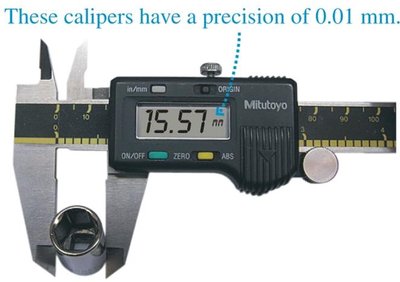
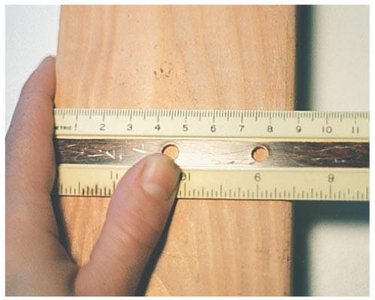
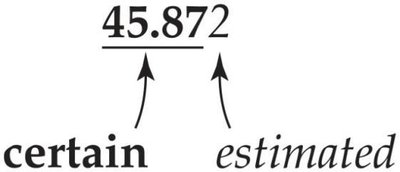
Significant figures reflect the precision of a measurement. The rules for counting significant figures are:
All nonzero digits are significant.
Interior zeros are significant.
Trailing zeros after a decimal point are significant.
Leading zeros are not significant.
Significant Figures in Calculations
For multiplication/division: The result has as many significant figures as the factor with the fewest significant figures.
For addition/subtraction: The result has as many decimal places as the value with the fewest decimal places.

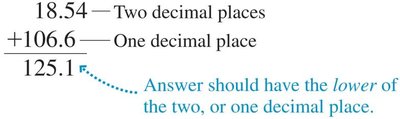
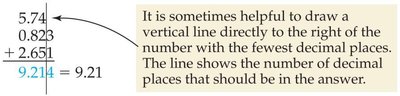
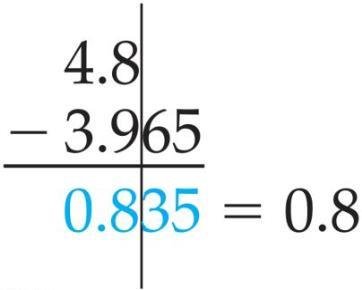
Scientific Notation
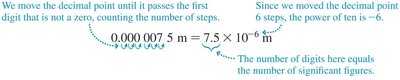
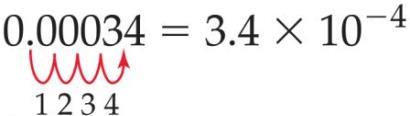
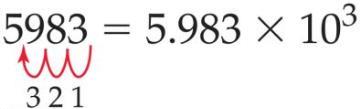
Scientific notation expresses numbers as a product of a decimal and a power of ten, making it easier to handle very large or small values and to show significant figures clearly.
For numbers > 1, move the decimal left and use a positive exponent.
For numbers < 1, move the decimal right and use a negative exponent.
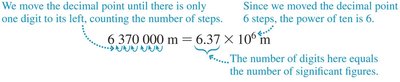
Units and SI System
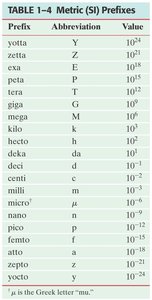
All measurements must include units. The International System of Units (SI) is the standard in science.
Quantity | Unit | Abbreviation |
|---|---|---|
Time | second | s |
Length | meter | m |
Mass | kilogram | kg |
Unit Conversions
Unit conversions use conversion factors to change from one unit to another. For example, to convert inches to centimeters:
Vectors and Motion
Scalars and Vectors
Scalar: Quantity described by a single number (e.g., temperature, mass).
Vector: Quantity with both magnitude and direction (e.g., velocity, displacement).
Displacement Vectors
The displacement vector points from the initial to the final position, regardless of the path taken.
Adding Vectors
Vectors are added graphically by placing the tail of one at the head of the other. The resultant vector is drawn from the tail of the first to the head of the last.
Summary of Key Concepts
Motion is described using diagrams, models, and mathematical relationships.
Displacement and velocity are vector quantities; distance and speed are scalars.
Significant figures and scientific notation are essential for reporting measurements accurately.
SI units and unit conversions are fundamental for consistency in physics calculations.
