 Indietro
CH 16
Guida di studio - Note intelligenti
 Appunti personalizzati basati sui tuoi materiali, ampliati con definizioni chiave, esempi e contesto.
Electric Charge and Electric Fields
History of Electric Charge
Electricity has been observed since ancient times, notably by the Greeks who noticed that rubbing amber with fur caused it to attract small objects. The term electric comes from the Greek word elektron for amber. Early experiments involved rubbing various materials to generate electric charge.
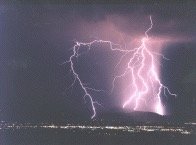
Electricity is a fundamental property observed in nature, such as lightning.
Rubbing materials together can transfer electric charge.
Types of Electric Charge
There are two kinds of electric charge: positive and negative. Benjamin Franklin named these charges. An object with equal numbers of positive and negative charges is neutral.
Rubbing glass with silk or neoprene imparts one type of charge; rubbing plastic with fur imparts another.
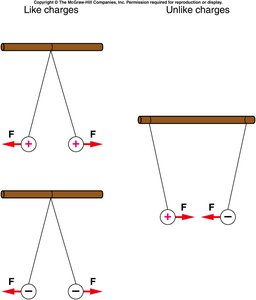
Like charges repel and unlike charges attract.
The force between charges increases with greater charge or decreased distance.
Quantization and Conservation of Charge
Electric charge is quantized, meaning it exists in discrete units. The smallest unit is the charge of a single electron or proton, denoted by e:
C (Coulomb)
Charge is measured in coulombs (C), millicoulombs (mC), microcoulombs (μC), or nanocoulombs (nC).
Atoms that gain or lose electrons become ions.
Charge is conserved in all processes:
The total charge remains constant; it can move or redistribute but cannot be created or destroyed without balancing positive and negative charges.
Neutral objects have equal numbers of protons and electrons; charged objects have an imbalance.
Conductors, Insulators, and Semiconductors
Materials differ in their ability to conduct electric charge:
Conductors: Allow electrons to flow easily (e.g., metals).
Insulators: Do not allow electrons to flow easily (e.g., plastic, rubber, wood).
Semiconductors: Intermediate properties; used in electronics.
Both conductors and insulators can be charged.
Polarization of Electric Charge
Objects can be polarized, meaning one part has more positive charge and another more negative. Both conductors and insulators can be polarized, though the mechanism differs:
Conductors: Charge moves within the object.
Insulators: Atoms reorient themselves.
Polarization allows a charged object to attract a neutral object.
Charging Methods
There are two main ways to charge a neutral object:
Conduction: Direct contact transfers charge (works for conductors and insulators).
Induction: No contact; charge is redistributed by influence (works for conductors only).
Electroscope: Detecting Electric Charge
An electroscope is a device used to detect electric charge. It consists of a metal ball and foil leaves. When charged, the leaves spread apart due to repulsion.
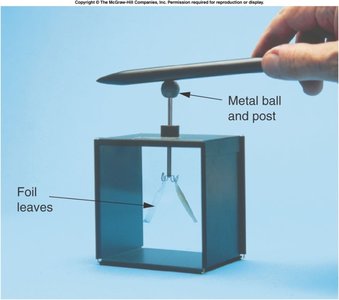
If the leaves are uncharged, they hang straight down.
Charged leaves spread apart; the degree of separation indicates the amount of charge.
Electric Fields
Definition and Properties
An electric field describes how a charged object can affect another object at a distance. Electric fields are vectors with both magnitude and direction. The direction is the force a positive charge would experience at that point.
Electric fields can exist even where no charges are present.
Field lines illustrate electric fields:
Point in the direction a positive charge would move.
Density of lines indicates field strength.
Begin and end on charges; number of lines proportional to charge magnitude.
Field lines are drawn in 2D but exist in 3D.
Electric Field of a Point Charge
The electric field from a point charge or spherically symmetric charge distribution is given by:
N·m2/C2
, where C2/(N·m2)
Direction: Away from positive charges, toward negative charges.
Superposition Principle
To find the electric field from multiple point charges, calculate the field from each charge separately and add them using vector addition.
Electric Force and Coulomb's Law
Electric Force from Electric Field
If a charge q is placed in an electric field E, the force experienced is:
Coulomb's Law
Coulomb's law describes the force between two point charges:
Direction: Attraction for opposite charges, repulsion for like charges.
Force is a vector; direction depends on the sign of the charges.
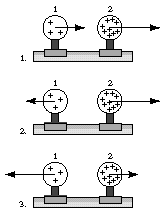
Example: Two spheres with different charges exert forces on each other; the direction and magnitude depend on the charge values.
Electrostatic Force in Multiple Charge Systems
When multiple charges are present, calculate the force on each using Coulomb's law and vector addition. For example, three charges arranged in a triangle require calculation of forces along each axis.
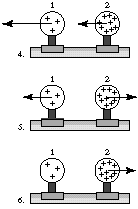
Electric Fields and Newton's Second Law
Motion of Charged Particles in Electric Fields
Charged particles accelerate in electric fields according to Newton's second law:
Acceleration depends on charge sign, magnitude, mass, and field strength.
Particles with no charge do not experience electric force.
Dipoles in Electric Fields
An electrically neutral dipole in a nonuniform electric field will experience a net force and torque, causing it to move or rotate depending on the field configuration.
Summary Table: Properties of Electric Charge
Property | Description |
|---|---|
Type | Positive or Negative |
Quantization | Discrete units (e.g., electron charge) |
Conservation | Total charge remains constant |
Conductors | Allow charge to move freely |
Insulators | Do not allow charge to move freely |
Polarization | Charge distribution within object |
Charging Methods | Conduction, Induction |
Key Equations
C
Additional info: Academic context and examples have been expanded for clarity and completeness. Images included are directly relevant to the explanation of electric charge, electric force, and electric field concepts.
