 Indietro
Electric Potential and Potential Energy: Study Notes
Guida di studio - Note intelligenti
 Appunti personalizzati basati sui tuoi materiali, ampliati con definizioni chiave, esempi e contesto.
Electric Potential and Potential Difference
Introduction to Electric Potential
Electric potential is a fundamental concept in electromagnetism, linking the study of electric fields to energy. It allows us to analyze problems using energy methods, which can be more powerful than force-based approaches for certain scenarios. The concept of electric potential energy is central to understanding how charges interact in electric fields.
Electric potential energy is the energy a charge has due to its position in an electric field.
The electrostatic force is conservative, meaning the work done does not depend on the path taken.
Electric potential (V) is defined as the potential energy per unit charge:
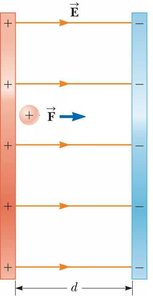
The potential difference (ΔV) between two points is the work done per unit charge to move a test charge between those points.
Mathematical Formulation
The work done by the electric field when moving a charge q from point A to B is:
The change in potential energy is:
The potential difference is:
Units: 1 volt (V) = 1 joule/coulomb (J/C)
Potential Difference in a Uniform Electric Field
Uniform Field Equations
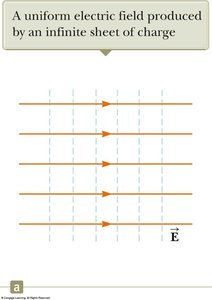
In a uniform electric field, the potential difference between two points separated by a distance d (parallel to the field) is given by:
The electric field points in the direction of decreasing potential.
Comparison with Gravitational Potential Energy
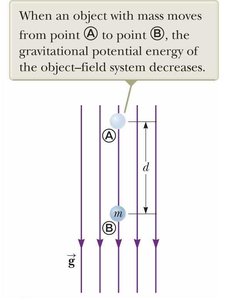
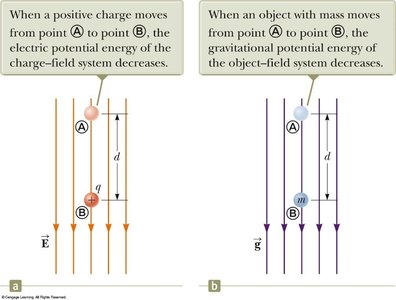
Electric potential energy is analogous to gravitational potential energy. In both cases, moving in the direction of the field (electric or gravitational) decreases the potential energy of the system.
For a positive charge moving in the direction of the electric field, potential energy decreases.
For an object moving downward in a gravitational field, gravitational potential energy decreases.
Equipotential Surfaces
Definition and Properties
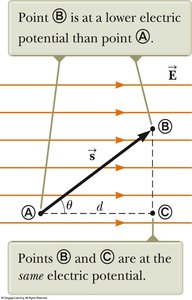
An equipotential surface is a surface on which the electric potential is the same at every point. No work is required to move a charge along an equipotential surface.
Equipotential surfaces are always perpendicular to electric field lines.
Points B and C on the same equipotential surface have the same potential:
Electric Potential Due to Point Charges
Single Point Charge
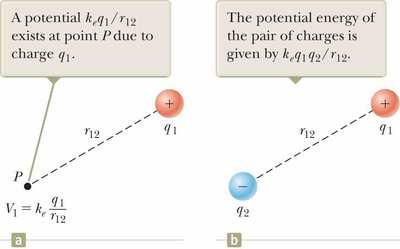
The electric potential at a distance r from a point charge q is:
, where N·m2/C2
The reference point is usually taken at infinity, where .
Multiple Point Charges
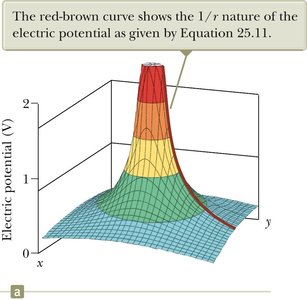
The total electric potential at a point due to several point charges is the algebraic sum of the potentials due to each charge:
Electric Dipole
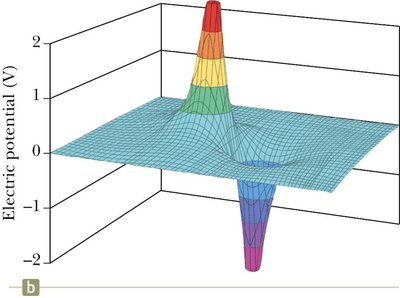
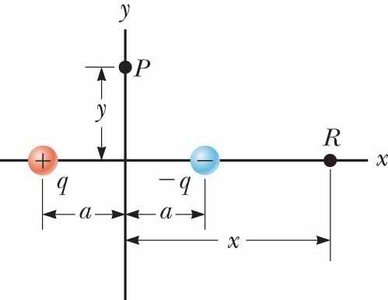
An electric dipole consists of two equal and opposite charges separated by a distance. The potential due to a dipole varies with position and is zero along the perpendicular bisector of the dipole.
Electric Potential Energy of Systems of Charges
Two Charges
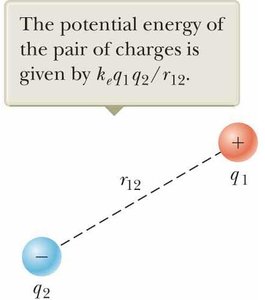
The potential energy of a system of two point charges is:
Three or More Charges
The total potential energy is the sum over all unique pairs:
Electric Field from Electric Potential
Relationship Between E and V
The electric field is related to the spatial rate of change of the electric potential:
In one dimension:
In three dimensions:
Conductors in Electrostatic Equilibrium
Properties of Conductors
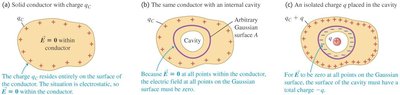
The electric field is zero everywhere inside a conductor in electrostatic equilibrium.
Any excess charge resides on the surface of the conductor.
The electric field just outside the surface is perpendicular to the surface and has magnitude , where is the surface charge density.
The surface of a conductor in equilibrium is an equipotential surface (constant V).
Surface Charge Density and Curvature
Surface charge density is greatest where the radius of curvature is smallest (sharp points).
This explains phenomena such as corona discharge at sharp points.
Electric Potential Due to Continuous Charge Distributions
General Formula
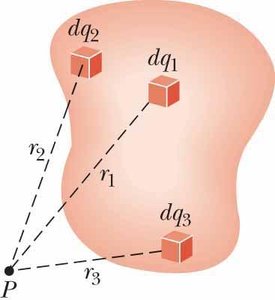
For a continuous charge distribution, the electric potential at a point P is given by:
Summary Table: Key Equations and Concepts
Concept | Equation | Notes |
|---|---|---|
Electric Potential (V) | Potential energy per unit charge | |
Potential Difference (ΔV) | Work per unit charge | |
Uniform Field | For parallel plates | |
Point Charge | Reference at infinity | |
Multiple Charges | Superposition principle | |
Potential Energy (2 charges) | Pairwise interaction | |
Electric Field from V | Gradient of potential |
Additional info:
Electron-volt (eV) is a common energy unit:
Voltage is another term for potential difference.
Equipotential surfaces and field lines are always perpendicular.
