 Indietro
Energy, Work, and Power: Foundations of Mechanical Energy
Guida di studio - Note intelligenti
 Appunti personalizzati basati sui tuoi materiali, ampliati con definizioni chiave, esempi e contesto.
Energy, Work, and Power
Introduction to Energy
Energy is a fundamental concept in physics, describing the capacity of a system to perform work or produce change. It is a conserved quantity, meaning it cannot be created or destroyed, only transformed from one form to another. Energy is observed when it is transferred or transformed, and it is essential for all physical processes in the universe.
Energy is both a thing (a property of a system) and a process (when it is transferred or transformed).
It is measured by the changes it produces in matter, such as motion or heat.
Examples include electromagnetic waves from the Sun and the energy stored in chemical bonds.
Work
Definition and Calculation of Work
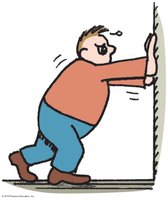
Work is done when a force causes an object to move in the direction of the force. It is a measure of energy transfer and is calculated as the product of force and displacement in the direction of the force.
Work involves both the application of force and the movement of an object by that force.
Mathematically, work is given by:
Where W is work, F is the applied force, and d is the displacement in the direction of the force.
If there is no displacement, no work is done, even if a force is applied.
Examples of Work
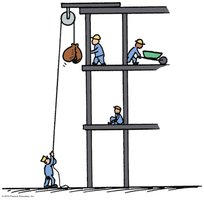
Lifting two loads one story high requires twice as much work as lifting one load the same distance, because the force is doubled.
Lifting a load two stories high requires twice as much work as lifting it one story, because the distance is doubled.

The unit of work is the joule (J), which is equivalent to a newton-meter (Nm).

Power
Definition and Calculation of Power
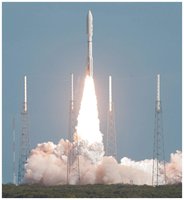
Power measures how quickly work is done or how fast energy is transferred. It is the rate at which work is performed.
Mathematically, power is given by:
Where P is power, W is work, and t is the time taken to do the work.
The unit of power is the watt (W), where 1 watt = 1 joule/second.
1 kilowatt (kW) = 1000 watts (W).
Example: Running up stairs quickly requires more power than walking up slowly, even if the work done is the same.
Mechanical Energy
Forms of Mechanical Energy
Mechanical energy is the energy associated with the motion and position of an object. It exists in two main forms: potential energy and kinetic energy.
Potential Energy (PE): Stored energy due to position or configuration.
Kinetic Energy (KE): Energy of motion, dependent on mass and velocity.
Potential Energy
Potential energy is energy stored in an object due to its position or state. The most common form is gravitational potential energy, which depends on an object's height above the ground.
Gravitational potential energy is calculated as:
Where m is mass, g is acceleration due to gravity, and h is height above a reference point.
Examples: Water in an elevated reservoir, a stretched bow, or a raised pile driver.
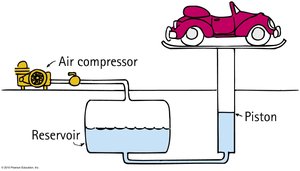
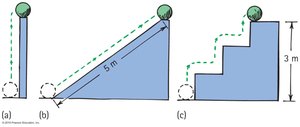
The work done to elevate an object is equal to its increase in potential energy, regardless of the path taken.
Kinetic Energy
Kinetic energy is the energy of motion. It depends on the mass of the object and the square of its speed.
Kinetic energy is calculated as:
Where m is mass and v is velocity.
If the speed of an object is doubled, its kinetic energy increases by a factor of four.
Work-Energy Theorem
Relationship Between Work and Energy
The work-energy theorem states that the net work done on an object is equal to its change in kinetic energy. This principle applies to both increasing and decreasing the speed of an object.
Mathematically, the work-energy theorem is expressed as:
Where W is the net work done and \Delta KE is the change in kinetic energy.
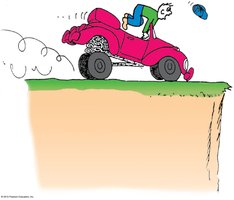
Example: Applying brakes to a moving car does negative work, reducing its kinetic energy and bringing it to a stop.
Conservation of Energy
Law of Conservation of Energy
The law of conservation of energy states that energy cannot be created or destroyed; it can only be transformed from one form to another. The total energy of an isolated system remains constant.
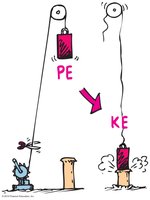
Example: In a pile driver, potential energy is converted to kinetic energy as the weight falls, and then to other forms (such as heat and sound) upon impact.
In real systems, some energy is always transformed into heat due to friction or deformation.
Example: Drawing a bow stores potential energy, which is mostly transferred to the arrow as kinetic energy when released, with some energy lost as heat.

Kinetic Energy and Momentum Compared
Comparison of Kinetic Energy and Momentum
Both kinetic energy and momentum are properties of moving objects, but they have important differences:
Momentum is a vector quantity (depends on direction), while kinetic energy is a scalar (depends only on magnitude).
Momentum can be canceled by equal and opposite momenta; kinetic energy cannot be canceled.
Momentum depends linearly on velocity (), while kinetic energy depends on the square of velocity ().
Example: An object moving twice as fast as another with the same mass has twice the momentum but four times the kinetic energy.
