 Indietro
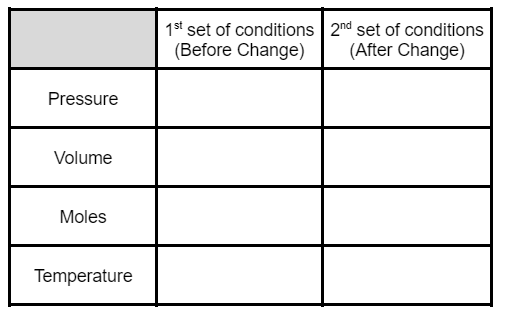
Guidance for Using the Gas Law Information Matrix
Guida di studio - Note intelligenti
 Appunti personalizzati basati sui tuoi materiali, ampliati con definizioni chiave, esempi e contesto.
Q1. How do you use the Gas Law Information Matrix to solve gas law problems?
Background
Topic: Gas Laws (Ideal Gas Law, Combined Gas Law)
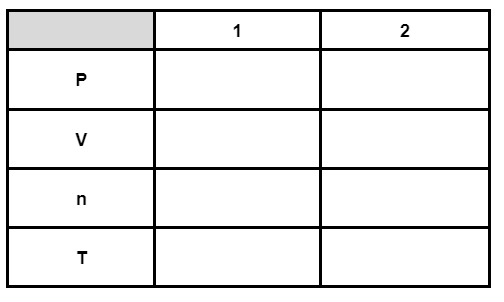
This question is about organizing the known and unknown variables for gas law problems. The matrix helps you keep track of the initial and final conditions for pressure (P), volume (V), moles (n), and temperature (T) when a gas undergoes a change.
Key Terms and Formulas:
Pressure (): The force exerted by the gas per unit area, usually measured in atm, torr, or Pa.
Volume (): The space occupied by the gas, measured in liters (L).
Moles (): The amount of gas, measured in moles (mol).
Temperature (): The temperature of the gas, measured in Kelvin (K).
Key Formulas:
Ideal Gas Law:
Combined Gas Law (when n is constant):
Step-by-Step Guidance
Identify the variables for the initial state (before change): , , , . Write these values in the first column of the matrix.
Identify the variables for the final state (after change): , , , . Write these values in the second column of the matrix.
Determine which variables are changing and which are constant. For example, if the number of moles stays the same, .
Choose the appropriate gas law formula based on the information you have. If moles are constant, use the Combined Gas Law. If not, use the Ideal Gas Law.
Set up the equation using the values from your matrix. Substitute the known values into the formula, but do not solve for the unknown yet.
Try solving on your own before revealing the answer!
Final Answer:
The Gas Law Information Matrix is a tool to organize the initial and final values for pressure, volume, moles, and temperature. By filling in the matrix, you can easily see which variables are known and which are unknown, making it easier to select and apply the correct gas law formula. Substitute the values into the formula and solve for the unknown variable as needed.
This approach helps prevent errors and ensures all relevant information is considered when solving gas law problems.
