 Indietro
Kinematics: Sandbag Released from Ascending Balloon
Guida di studio - Note intelligenti
 Appunti personalizzati basati sui tuoi materiali, ampliati con definizioni chiave, esempi e contesto.
Q1. A small bag of sand is released from an ascending hot air balloon whose constant, upward velocity is 4.25 m/s. If the balloon is 220 m above the ground when the sandbag is released, how much time does it take for the sandbag to reach the ground?
Background
Topic: Kinematics in One Dimension (Vertical Motion)
This question tests your understanding of vertical motion under gravity, specifically how to analyze the motion of an object released from a moving platform. The sandbag starts with an initial upward velocity and then falls under the influence of gravity.
Key Terms and Formulas
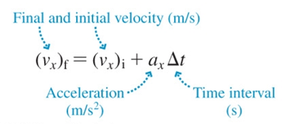
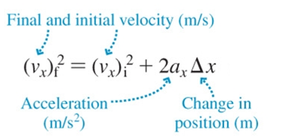
Initial velocity (): The velocity of the sandbag at the moment it is released (upward, 4.25 m/s).
Initial height (): The height above the ground where the sandbag is released (220 m).
Acceleration due to gravity (): m/s2, acting downward.
Time interval (): The time it takes for the sandbag to reach the ground.
Kinematic equation for vertical displacement:
Since the sandbag lands on the ground, .
Step-by-Step Guidance
Identify the known values: m, m/s (upward), m/s2 (downward), and m (ground level).
Set up the kinematic equation for vertical motion: .
Substitute the known values into the equation: .
Rearrange the equation to standard quadratic form: .
To solve for , use the quadratic formula: , where , , and .
Try solving on your own before revealing the answer!
Final Answer: 6.87 s
Using the quadratic formula:
Only the positive root is physically meaningful:
s
This is the time it takes for the sandbag to reach the ground after being released from the ascending balloon.
