 Indietro
Motion in One Dimension: Physics with Algebra Study Notes
Guida di studio - Note intelligenti
 Appunti personalizzati basati sui tuoi materiali, ampliati con definizioni chiave, esempi e contesto.
Motion in One Dimension
Introduction to Linear Motion
Motion in one dimension refers to the movement of objects along a straight line, either horizontally or vertically. This chapter focuses on describing, representing, and analyzing such motion using position, velocity, and acceleration.
Representing Position
Coordinate Axes and Position
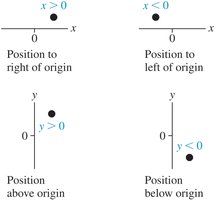
To analyze motion, we use coordinate axes:
x-axis: Used for horizontal motion; positive direction is to the right.
y-axis: Used for vertical motion; positive direction is upward.
Position is specified relative to the origin (0 point) on the axis.
Motion Diagrams
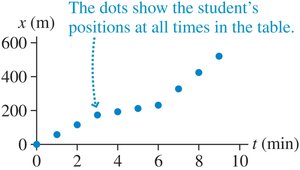
Motion diagrams use dots to represent an object's position at successive times. These diagrams help visualize how an object moves over time.

Describing Motion with Graphs
Position-Versus-Time Graphs
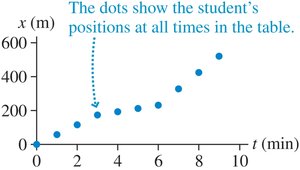
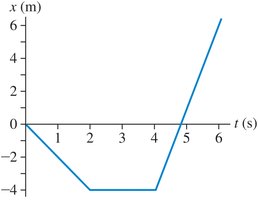
Position-versus-time graphs (x vs t) plot an object's location over time. Key information can be extracted:
Position at time t: Read directly from the graph.
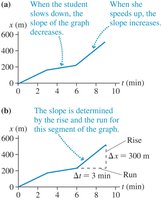
Velocity at time t: Determined by the slope of the graph at that point.
Direction of motion: Positive slope means motion to the right/up; negative slope means motion to the left/down.
Velocity-Versus-Time Graphs
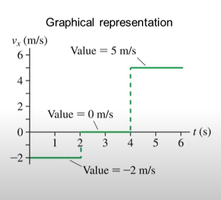
Velocity-versus-time graphs (v vs t) show how an object's speed changes over time. The slope of this graph gives the object's acceleration.
Steeper slope: Faster speed.
Zero slope: Object at rest.
Negative slope: Object moving in the opposite direction.
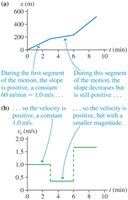
Converting Between Graphs
The slope of the position-versus-time graph gives velocity, and the slope of the velocity-versus-time graph gives acceleration.
Uniform Motion
Definition and Representation
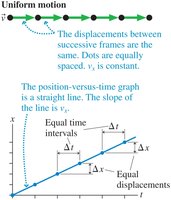
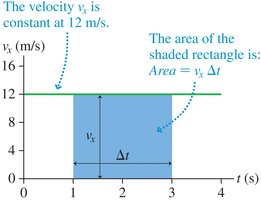
Uniform motion, or constant-velocity motion, occurs when equal displacements happen during equal time intervals. The position-versus-time graph for uniform motion is a straight line.
Displacement: Change in position over time.
Velocity: Constant for uniform motion.
Equations of Uniform Motion
The velocity of an object in uniform motion tells us how much its position changes each second:
Displacement formula:
Instantaneous Velocity
Definition and Calculation
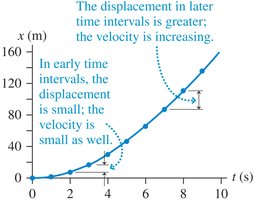
Instantaneous velocity is the speed and direction of an object at a specific instant. If velocity changes, the position graph is curved, and the slope at a point (tangent) gives the instantaneous velocity.
Instantaneous velocity:
Acceleration
Definition and Units
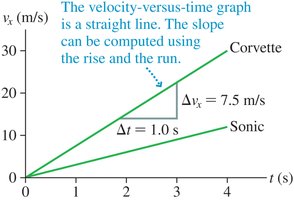
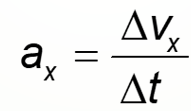
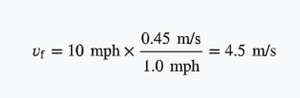
Acceleration describes how velocity changes over time. It is the slope of the velocity-versus-time graph.
Acceleration formula:
SI unit: meters per second squared (m/s2)
Sign of Acceleration
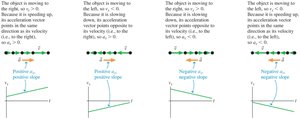
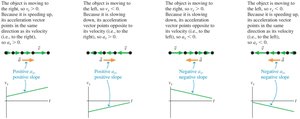
The sign of acceleration depends on the direction of motion and whether the object is speeding up or slowing down.
Positive acceleration: Speeding up in positive direction or slowing down in negative direction.
Negative acceleration: Speeding up in negative direction or slowing down in positive direction.
Motion with Constant Acceleration
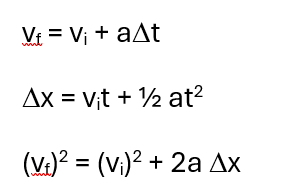
Kinematic Equations
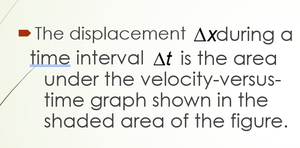
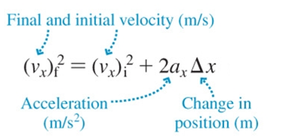
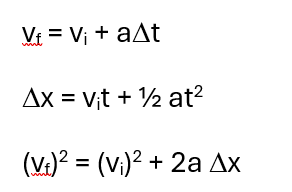
For motion with constant acceleration, several equations relate position, velocity, acceleration, and time:
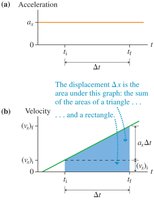
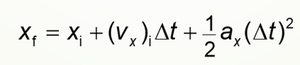
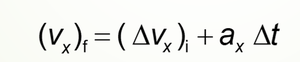
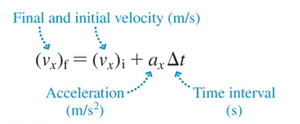
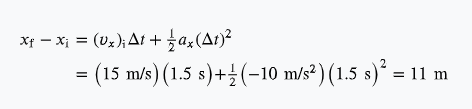
Example: Braking to a Stop
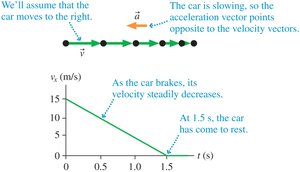
When a car brakes to a stop, its velocity decreases steadily. The kinematic equations can be used to find acceleration and displacement.
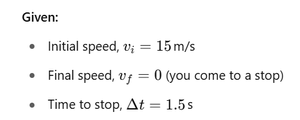
Initial speed:
Final speed:
Time to stop:
Example: Minimum Runway Length for Takeoff
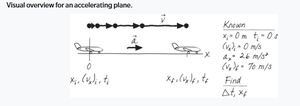
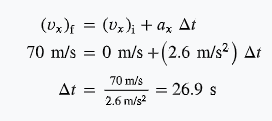
A plane accelerates to reach takeoff speed. The minimum runway length and time required can be calculated using kinematic equations.
Initial velocity:
Acceleration:
Final velocity:
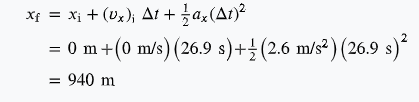
Free Fall
Definition and Properties
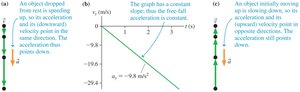
Free fall occurs when an object moves under the influence of gravity alone. All objects in free fall have the same acceleration, regardless of mass, if air resistance is negligible.
Free-fall acceleration: (downward)
g is always positive in calculations; direction is indicated by sign in equations.
Example: Analyzing a Rock's Fall
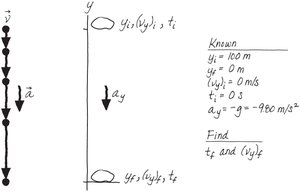
A rock dropped from rest falls 100 m. The time to fall and velocity upon impact can be found using kinematic equations for constant acceleration.
Initial position:
Initial velocity:
Acceleration:
Summary Table: Kinematic Equations for One-Dimensional Motion
Equation | Variables | Use |
|---|---|---|
Position, initial velocity, acceleration, time | Find final position | |
Initial/final velocity, acceleration, time | Find final velocity | |
Initial/final velocity, acceleration, displacement | Find velocity or displacement |
Example: Use these equations to solve problems involving cars braking, planes taking off, or objects in free fall.
