 Indietro
Vectors and Motion in Two Dimensions: Study Guide
Guida di studio - Note intelligenti
 Appunti personalizzati basati sui tuoi materiali, ampliati con definizioni chiave, esempi e contesto.
Vectors and Motion in Two Dimensions
Introduction
This chapter explores the fundamental concepts of vectors and their application to motion in two dimensions. Understanding vectors is essential for analyzing physical phenomena such as projectile motion, circular motion, and motion on inclined planes.
Vectors: Definitions and Properties
What is a Vector?
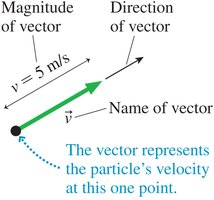
A vector is a quantity that has both magnitude (size) and direction. Common examples include displacement, velocity, and acceleration. Vectors are represented graphically by arrows, where the length indicates magnitude and the arrow points in the direction.
Magnitude: The size or length of the vector, always a positive value.
Direction: The orientation of the vector in space.
Notation: Vectors are often denoted with an arrow above the letter, e.g., \( \vec{v} \).
Scalar: A quantity with only magnitude, such as speed or mass.
Vector Equality and Displacement
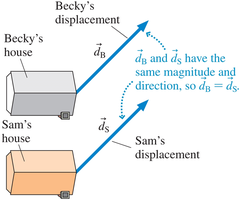
Two vectors are equal if they have the same magnitude and direction, regardless of their initial points. The displacement vector connects the initial and final positions directly, ignoring the actual path taken.
Vector Operations
Vector Addition
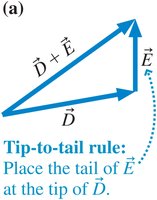
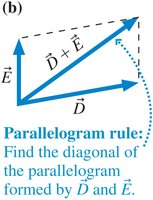
Vectors can be added using graphical methods:
Tip-to-Tail Rule: Place the tail of the second vector at the tip of the first.
Parallelogram Rule: Draw both vectors from a common origin; the diagonal represents the sum.
Resultant Vector: The sum of two or more vectors.
Commutative Property: \( \vec{A} + \vec{B} = \vec{B} + \vec{A} \)
Multiplication by a Scalar
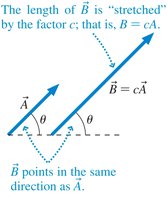
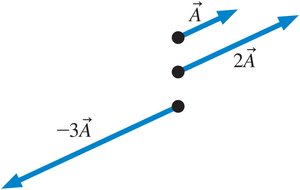
Multiplying a vector by a scalar changes its magnitude but not its direction (unless the scalar is negative, which reverses the direction).
\( \vec{B} = c \vec{A} \) where \( c \) is a scalar.
If \( c = 0 \), the result is the zero vector.
If \( c < 0 \), the direction is reversed.
Vector Subtraction
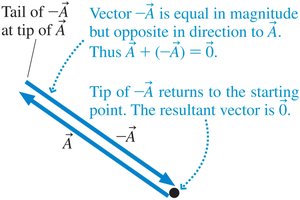
Subtracting vectors involves reversing the direction of the vector to be subtracted and then adding.
\( \vec{A} - \vec{B} = \vec{A} + (-\vec{B}) \)
Coordinate Systems and Vector Components
Cartesian Coordinate System
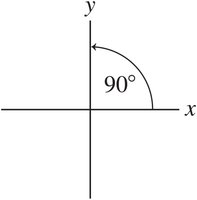
A coordinate system is a grid used to describe positions and directions. The most common is the Cartesian system, with x and y axes intersecting at the origin.
Vector Components
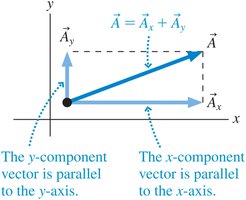
Any vector can be decomposed into components parallel to the axes:
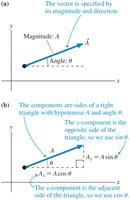
\( \vec{A} = \vec{A}_x + \vec{A}_y \)
\( A_x = A \cos \theta \), \( A_y = A \sin \theta \)
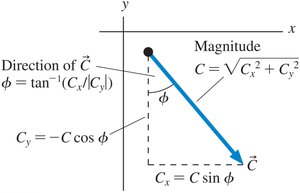
The sign of each component depends on the direction.
Magnitude and Direction from Components
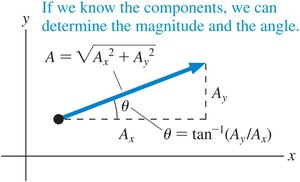
If the x- and y-components are known, the magnitude and direction can be found:
Magnitude:
Direction:
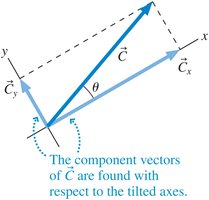
Tilted Axes
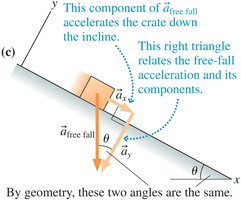
For motion on a slope, it is often convenient to align the axes with the slope. Components are found using the same trigonometric relationships.
Motion on a Ramp
Constant-Velocity Motion
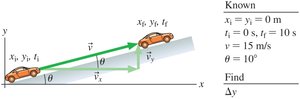
When an object moves up or down a ramp at constant velocity, its vertical displacement is determined by the vertical component of its velocity.
Example: A car moving up a slope gains height according to
Accelerated Motion on a Ramp
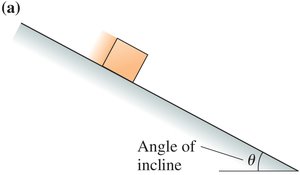
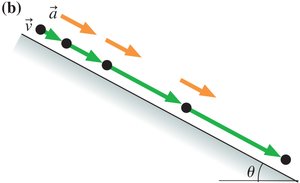
On a frictionless ramp, the acceleration is a component of the free-fall acceleration:
Acceleration parallel to ramp:
All motion is along the x-axis (parallel to ramp).
Motion in Two Dimensions
General Two-Dimensional Motion
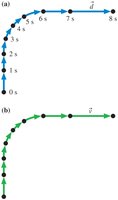
Objects can move in a plane, not just along a line. Displacement, velocity, and acceleration are all vectors that may change in both magnitude and direction.
Acceleration in Two Dimensions
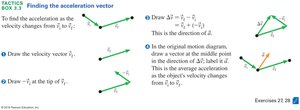
Acceleration occurs whenever velocity changes, either in magnitude (speed) or direction. The vector definition is:
Projectile Motion
Definition and Characteristics
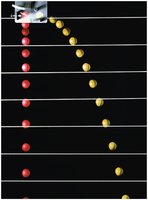
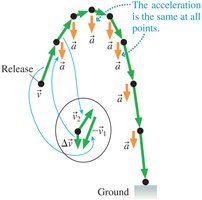
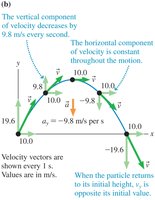
Projectile motion is the two-dimensional motion of an object under the influence of gravity alone. The path is a parabola, and the horizontal and vertical motions are independent.
Vertical motion: free-fall acceleration,
Horizontal motion: constant velocity,
Kinematic Equations for Projectile Motion
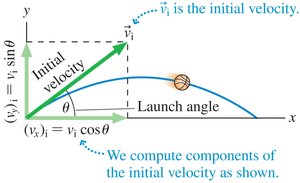
Horizontal:
Vertical:
Circular Motion
Uniform Circular Motion
In uniform circular motion, an object moves at constant speed along a circular path. The velocity vector is tangent to the path, and the acceleration vector (centripetal acceleration) points toward the center.
Centripetal acceleration:
Velocity is always tangent to the circle.
Relative Motion
Relative Velocity
The velocity of an object can be different depending on the observer's frame of reference. Relative velocities are added using vector addition.
\( \vec{v}_{AB} = \vec{v}_{AC} + \vec{v}_{CB} \)
Example: The speed of a plane relative to the ground is the sum of its speed relative to the air and the air's speed relative to the ground.
Summary Table: Vector Operations
Operation | Equation | Description |
|---|---|---|
Addition | Tip-to-tail or parallelogram rule | |
Subtraction | Reverse direction of subtracted vector | |
Scalar Multiplication | Changes magnitude, reverses direction if c < 0 | |
Component Form | Expresses vector in terms of x and y components |
Summary Table: Kinematic Equations for Projectile Motion
Component | Equation | Description |
|---|---|---|
Horizontal | Constant velocity | |
Vertical | Constant acceleration |
Additional info: Academic context and examples have been expanded for clarity and completeness. Only images directly relevant to the explanation have been included.
