 Indietro
Vectors and Motion in Two Dimensions: Study Notes for Physics with Algebra
Guida di studio - Note intelligenti
 Appunti personalizzati basati sui tuoi materiali, ampliati con definizioni chiave, esempi e contesto.
Vectors and Motion in Two Dimensions
Section 3.1: Using Vectors
Vectors are fundamental in physics for describing quantities that have both magnitude and direction. Understanding how to represent, add, and manipulate vectors is essential for analyzing motion in two dimensions.
Definition and Representation of Vectors
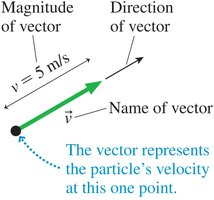
Vector: A quantity with both magnitude (size) and direction.
Magnitude: The length of the vector, always a non-negative scalar.
Direction: The orientation of the vector in space, indicated by an arrow.
Notation: Vectors are typically denoted with an arrow above the letter (e.g., ), while the magnitude is written without the arrow (e.g., ).
Example: A particle moving at 5 m/s in a specific direction is represented by a velocity vector with magnitude m/s.
Equality and Displacement Vectors
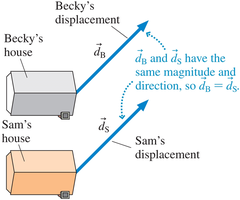
Displacement Vector: Represents the straight-line distance and direction from an initial to a final position, regardless of the path taken.
Equality of Vectors: Two vectors are equal if they have the same magnitude and direction, regardless of their initial points.
Example: Displacement vectors from different starting points can be equal if their magnitude and direction match.
Vector Addition
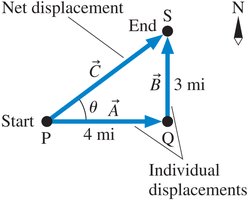
Resultant Vector: The sum of two or more vectors, representing the net effect.
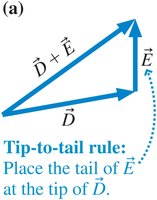
Commutative Property: Vector addition is commutative: .
Tip-to-Tail Rule: Place the tail of the second vector at the tip of the first to find the resultant.
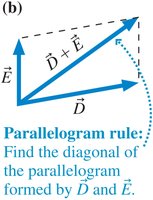
Parallelogram Rule: Place both vectors at a common origin; the diagonal of the parallelogram they form is the resultant.
Example: A hiker's net displacement after two consecutive walks is the vector sum of the individual displacements.
Multiplication by a Scalar
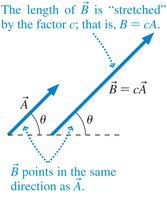
Scalar Multiplication: Multiplying a vector by a positive scalar changes its magnitude but not its direction.
Zero Vector: Multiplying by zero yields the zero vector, which has no direction or magnitude.
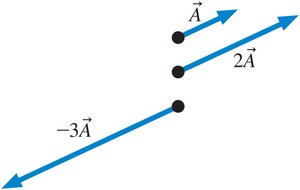
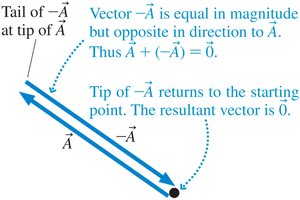
Negative Scalar: Multiplying by a negative scalar reverses the vector's direction but keeps the magnitude positive.
Example: is twice as long as in the same direction; is three times as long but in the opposite direction.
Subtracting Vectors
Vector Subtraction: To subtract from , add $\vec{A}$ to (the vector with the same magnitude as $\vec{B}$ but opposite direction).
Procedure: Draw , then place the tail of at the tip of $\vec{A}$; the resultant from the tail of $\vec{A}$ to the tip of $-\vec{B}$ is .
Section 3.2: Coordinate Systems and Vector Components
Coordinate systems allow us to describe vectors quantitatively. Most problems use Cartesian (xy) coordinates, where vectors can be broken into perpendicular components.
Coordinate Systems
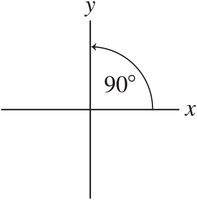
Cartesian Coordinates: Consist of perpendicular x- and y-axes intersecting at the origin (0,0).
Axes: Each axis has positive and negative directions, separated by the origin.
Component Vectors
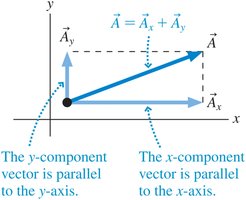
Component Vectors: Any vector can be expressed as the sum of two perpendicular vectors: (along x-axis) and (along y-axis).
Vector Sum:
Finding the Components of a Vector
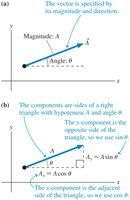
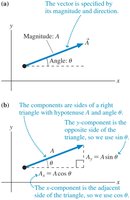
Trigonometric Relationships: For a vector at an angle from the x-axis:
Magnitude and Direction from Components
Pythagorean Theorem: The magnitude of is found by:
Angle: The direction is given by:
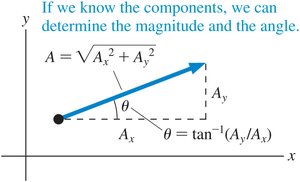
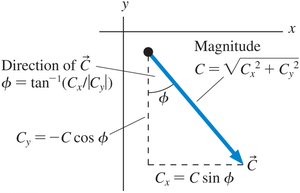
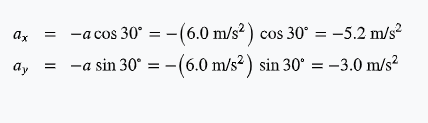
Example: Finding Components of an Acceleration Vector
Given: at below the x-axis.
Components:
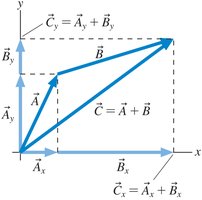
Adding Vectors Using Components
Component Method: Add the x-components and y-components separately:
The resultant vector is then:
Section 3.4: Motion in Two Dimensions
Motion in two dimensions involves objects moving in a plane, requiring vector analysis for displacement, velocity, and acceleration.
Motion Diagrams
Displacement: The vector from one position to the next.
Velocity: The displacement vector divided by the time interval; points in the direction of motion.
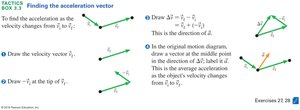
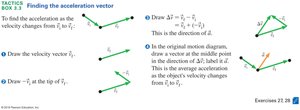
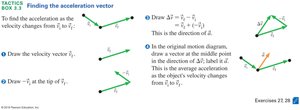
Acceleration: The change in velocity vector over time; can result from changes in speed, direction, or both.
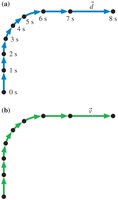
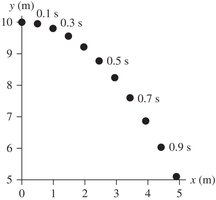
Example: Kayaker Over a Waterfall
Application: Estimating velocity from a motion diagram by measuring displacement over a time interval.

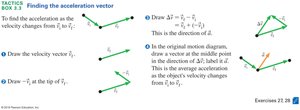
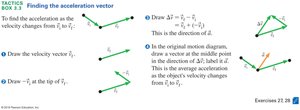
Acceleration in Two Dimensions
Definition: Acceleration occurs when velocity changes in magnitude, direction, or both.
Vector Form:
Finding Acceleration: Draw the initial and final velocity vectors, then the change in velocity vector from tip-to-tail.
Section 3.5: Projectile Motion
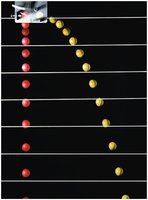
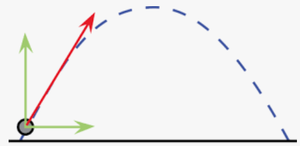
Projectile motion describes the two-dimensional motion of objects under the influence of gravity alone, with no air resistance. The horizontal and vertical motions are independent.
Characteristics of Projectile Motion
Projectile: An object moving under the influence of gravity only.
Path: The trajectory is a parabola.
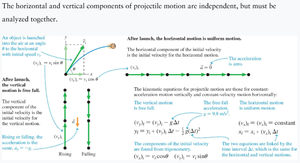
Independence: Horizontal and vertical motions are analyzed separately.
Vertical Acceleration: (downward, )
Horizontal Acceleration: (no horizontal force)
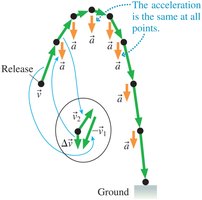
Analyzing Projectile Motion
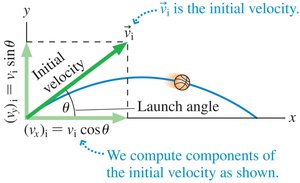
Launch Angle (): The angle at which the projectile is launched above the horizontal.
Initial Velocity Components:
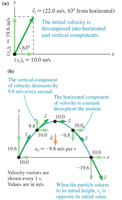
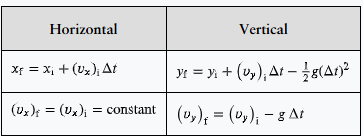
Kinematic Equations for Projectile Motion
Horizontal | Vertical |
|---|---|
(constant) |
Section 3.6: Projectile Motion—Solving Problems
Solving projectile motion problems involves breaking the motion into horizontal and vertical components, applying kinematic equations, and using initial conditions to find unknowns such as range, time of flight, and maximum height.
Example: Dock Jumping
Given: Initial speed m/s, height m.
Find: Horizontal distance traveled before landing.
Method: Use vertical motion to find time in air, then horizontal motion to find range.
Example: Free Kick in Soccer
Given: m/s, , distance to goal = 18 m.
Find: Time to reach goal and height above ground at that point.
Range of a Projectile
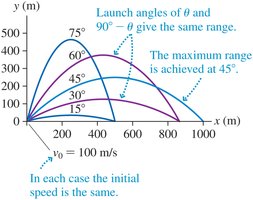
Range (): The horizontal distance a projectile travels before landing.
Formula (level ground):
Maximum Range: Achieved at (without air resistance).
Effect of Air Resistance: Reduces range and shifts optimal angle below for small objects.
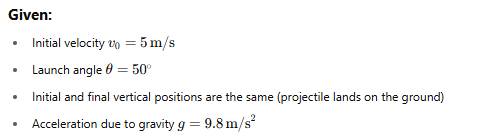
Example: Projectile Launched at an Angle
Given: m/s, , m/s.
Find: Total time of flight and range.
Additional info: In all projectile motion problems, always resolve the initial velocity into horizontal and vertical components, use the vertical motion to determine time in the air, and then use the horizontal component to find the range.
