 Indietro
Chapter 1: Representing Motion – Physics with Calculus Study Notes
Guida di studio - Note intelligenti
 Appunti personalizzati basati sui tuoi materiali, ampliati con definizioni chiave, esempi e contesto.
Chapter 1: Representing Motion
Introduction to Motion
Understanding motion is fundamental to physics. This chapter introduces the basic concepts and mathematical tools needed to describe and analyze motion, setting the foundation for further study in mechanics.
Types of Motion
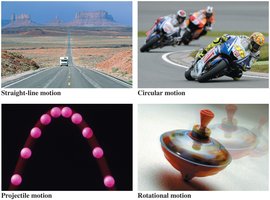
Motion is the change of an object’s position or orientation with time.
The trajectory is the path along which an object moves.
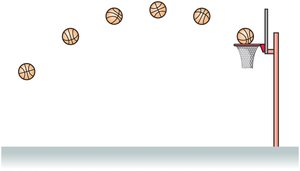
Common types of motion include straight-line motion, circular motion, projectile motion, and rotational motion.
Motion Diagrams
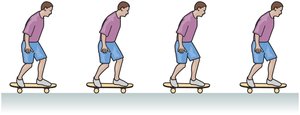
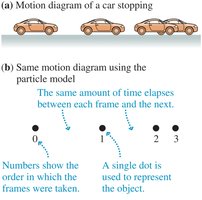
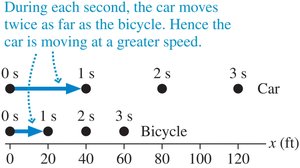
Motion diagrams provide a visual representation of an object's position at successive time intervals, helping to analyze different types of motion such as constant speed, acceleration, and deceleration.
Each dot represents the object's position at a specific time.
Equal spacing between dots indicates constant speed; increasing or decreasing spacing indicates acceleration or deceleration.


Models and Modeling in Physics
Models are simplified representations of physical systems that capture essential features while ignoring unnecessary details. They are crucial for understanding and predicting physical phenomena.
Descriptive models describe properties in simple terms.
Explanatory models use physical laws to predict behavior.
The particle model treats an object as if all its mass is concentrated at a single point.
Position, Displacement, and Coordinate Systems
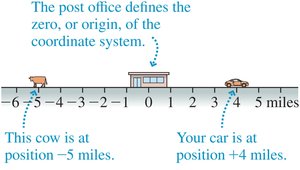
To describe motion quantitatively, we use coordinate systems and define position, displacement, and time intervals.
Position is specified relative to an origin and along a chosen axis.
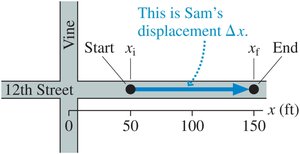
Displacement () is the change in position: .
Time interval () is the elapsed time: .
Example: Displacement Calculation
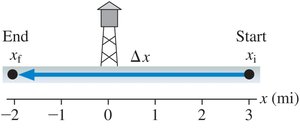
Example: Emily rides from 3 miles east to 2 miles west of a water tower. Her displacement is:
Initial position: mi
Final position: mi
Displacement: mi
Velocity and Speed
Velocity and speed are key quantities for describing motion. Velocity includes direction, while speed does not.
Average velocity:
Speed is the magnitude of velocity and is always positive.
Uniform motion: motion at constant speed in a straight line.
Example: Calculating Velocity
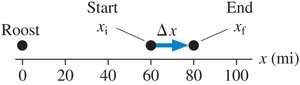
Example: An albatross moves from 60 mi to 80 mi east of its roost in 0.25 h. Its velocity is:
mi
h
mph$
Significant Figures, Scientific Notation, and Units
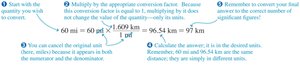
Precision in measurement is communicated through significant figures and scientific notation. Physics uses the SI system for units.
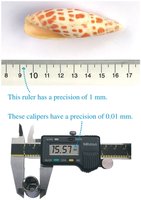
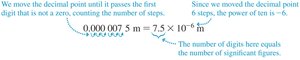
Significant figures are digits known with certainty plus one estimated digit.
When multiplying/dividing, the result has as many significant figures as the least precise value.
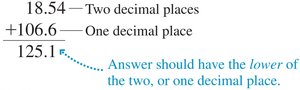
When adding/subtracting, the result has as many decimal places as the least precise value.
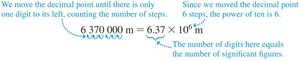
Scientific notation expresses numbers as .
SI units: meters (m) for length, kilograms (kg) for mass, seconds (s) for time.

Estimation and Order-of-Magnitude Calculations
Order-of-magnitude estimates are rough calculations, typically accurate to within a factor of 10, useful for checking the plausibility of results.
Symbol indicates an order-of-magnitude estimate.
Example: Walking speed is estimated as m/s.
Vectors and Scalars
Physical quantities are classified as scalars or vectors. Scalars have only magnitude; vectors have both magnitude and direction.
Scalar: mass, temperature, time
Vector: displacement, velocity, acceleration
Vectors are represented graphically by arrows; the length indicates magnitude, and the arrow points in the direction.

Vector Addition and Subtraction
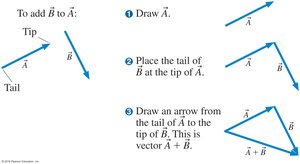
Vectors are added graphically by placing the tail of one at the head of the other. The resultant vector is drawn from the tail of the first to the head of the last.
For two vectors and , the sum is found by the tip-to-tail method.
Subtraction is performed by adding the negative of a vector.
Trigonometry and Vectors
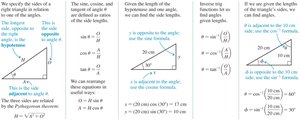
Trigonometry is essential for resolving vectors into components and for calculating magnitudes and directions in two-dimensional motion.
Pythagorean theorem:
Angle:
Example: Displacement in Two Dimensions
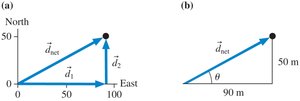
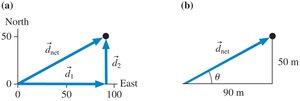
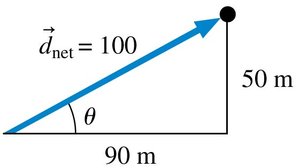
Example: Anna walks 90 m east, then 50 m north. Her net displacement is:
Magnitude: m
Direction: north of east
Velocity Vectors and Motion Diagrams
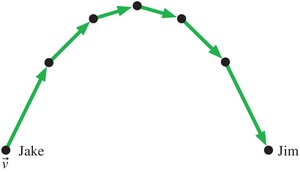
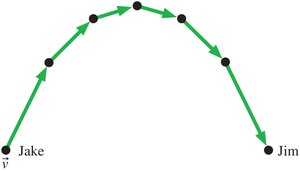
Velocity vectors indicate both the speed and direction of an object's motion at each instant. In motion diagrams, velocity vectors are drawn tangent to the path.
Velocity vectors change in length and direction if the object accelerates or turns.
Summary Table: Common SI Units
Quantity | SI Unit | Symbol |
|---|---|---|
Length | meter | m |
Mass | kilogram | kg |
Time | second | s |
Summary of Key Concepts
Motion is described using position, displacement, velocity, and time.
Models such as the particle model simplify analysis.
Vectors are essential for describing quantities with direction.
Significant figures and scientific notation ensure clarity and precision in calculations.
SI units are the standard in scientific measurement.
