 Indietro
Chapter 1: Units, Physical Quantities, and Vectors – Physics with Calculus
Guida di studio - Note intelligenti
 Appunti personalizzati basati sui tuoi materiali, ampliati con definizioni chiave, esempi e contesto.
Introduction to Physics
The Scope and Nature of Physics
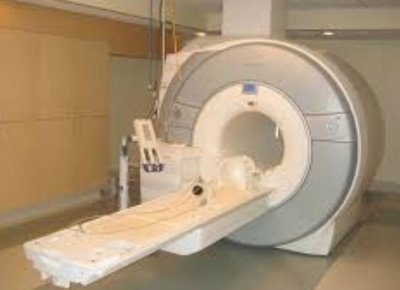
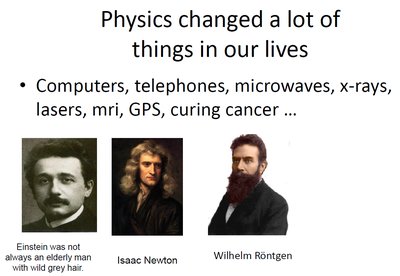
Physics is the study of the fundamental principles governing the natural world, from the smallest particles to the largest cosmic structures. It is an experimental science that seeks to uncover patterns, which are formulated as physical theories. When these theories are well-established, they are known as physical laws or principles. Physics is integral to many fields, including engineering, medicine, and technology, and its discoveries have profoundly impacted society.

Problem-Solving in Physics
General Problem-Solving Strategy
Solving physics problems requires a systematic approach. The following four steps are recommended for tackling any physics problem:
Identify the relevant concepts, target variables, and known quantities.
Set Up the problem by choosing appropriate equations and drawing a sketch.
Execute the solution by performing the necessary calculations.
Evaluate your answer by comparing it with estimates and checking for consistency.
Units and Physical Quantities
Fundamental Quantities and SI Units
Physics relies on three fundamental quantities: length, time, and mass. The International System of Units (SI) is the standard system used worldwide:
Length: meter (m)
Time: second (s)
Mass: kilogram (kg)
Unit Prefixes and Orders of Magnitude
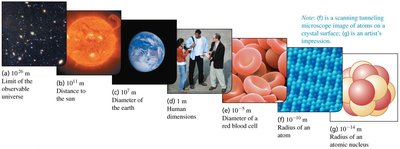
Prefixes are used to express very large or very small quantities. For example:
1 µm = m
1 km = m
1 mg = kg
1 ns = s
Unit Conversions and Dimensional Consistency
Equations in physics must be dimensionally consistent. When converting units, ensure that all terms have the same dimensions. For example, converting miles per hour to meters per second involves multiplying by appropriate conversion factors.
Uncertainty and Significant Figures
Accuracy, Precision, and Error
Accuracy refers to how close a measurement is to the true value, while precision describes how close repeated measurements are to each other. Errors can be random or systematic, and even small errors can have significant consequences.
Significant Figures
Significant figures indicate the precision of a measurement. The rules for determining significant digits are:
All nonzero digits are significant.
Zeros between significant digits are significant.
Trailing zeros to the right of the decimal and a significant digit are significant.
Leading zeros or zeros used only to position the decimal are not significant.
Examples:
200 (1 significant digit)
200.2 (4 significant digits)
0.00203 (3 significant digits)
Significant Figures in Calculations
For multiplication/division: The result has as many significant figures as the factor with the fewest significant figures.
For addition/subtraction: The result is limited by the term with the fewest digits to the right of the decimal point.
Scientific notation is used to express very large or small numbers, e.g., m.
Uncertainties
Absolute uncertainty: Expressed in the same units as the measured quantity.
Relative uncertainty: Expressed as a percentage.
When adding/subtracting, combine absolute uncertainties in quadrature.
When multiplying/dividing, combine relative uncertainties in quadrature.
Scalars and Vectors
Definitions
Scalar: A quantity described by a single number (and unit), e.g., mass, temperature.
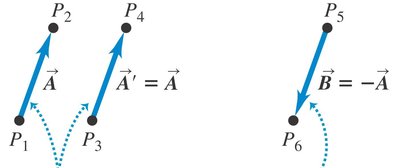
Vector: A quantity with both magnitude and direction, e.g., displacement, velocity, force. Vectors are denoted in boldface with an arrow, such as .
Vector Representation and Operations
Vectors can be represented graphically as arrows. The length of the arrow indicates the magnitude, and the direction shows the vector's direction.
Vector Addition and Subtraction
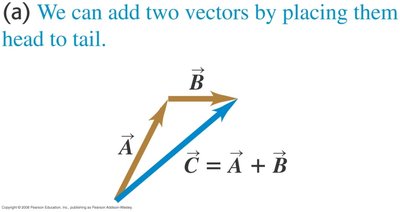
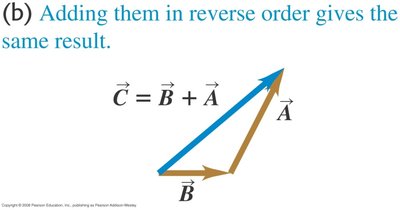
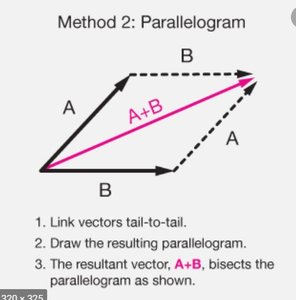
Vectors can be added graphically by the head-to-tail method or the parallelogram method. The order of addition does not affect the result (commutative property).
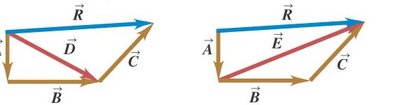
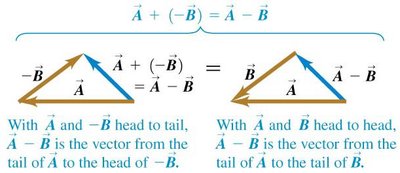
Vector subtraction is performed by adding the negative of a vector.
Multiplying a Vector by a Scalar
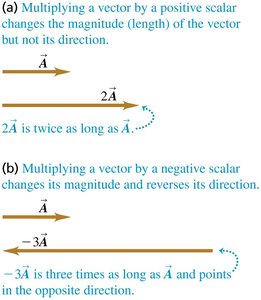
Multiplying a vector by a positive scalar changes its magnitude but not its direction. Multiplying by a negative scalar reverses its direction.
Components of a Vector
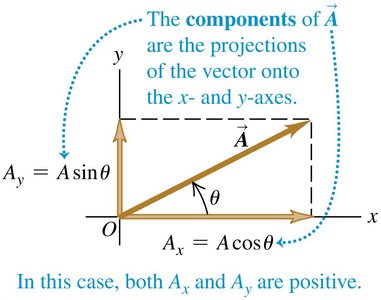
Any vector in a plane can be decomposed into x and y components. If makes an angle with the x-axis:
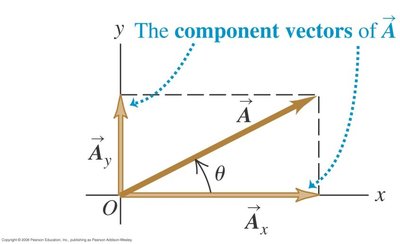
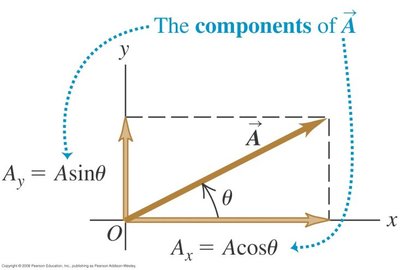
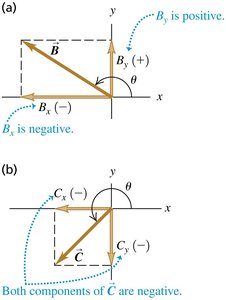
Components can be positive or negative depending on the direction of the vector.
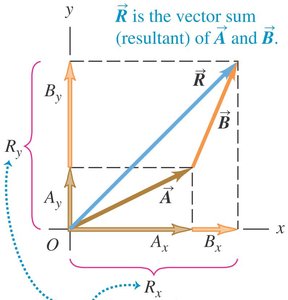
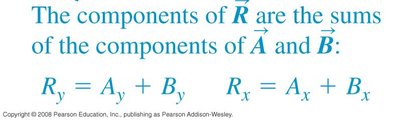
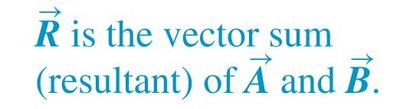
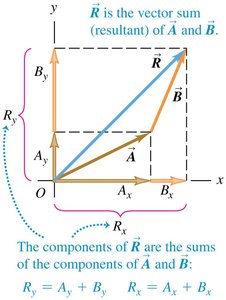
Vector Addition Using Components
To add vectors using components:
Add the x-components:
Add the y-components:
The resultant vector:
Unit Vectors
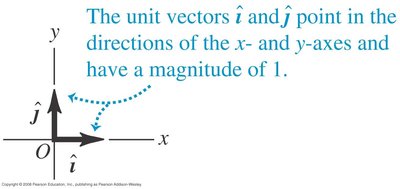
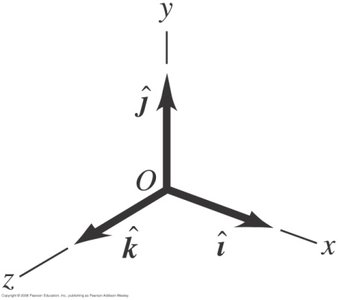
Unit vectors have a magnitude of 1 and indicate direction along coordinate axes:
: x-direction
: y-direction
: z-direction (in 3D)
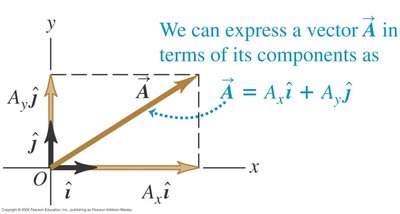
A vector can be written in terms of its components and unit vectors:
(in 2D)
(in 3D)
Products of Vectors
Scalar (Dot) Product
The dot product of two vectors and is a scalar given by:
Where is the angle between the vectors.

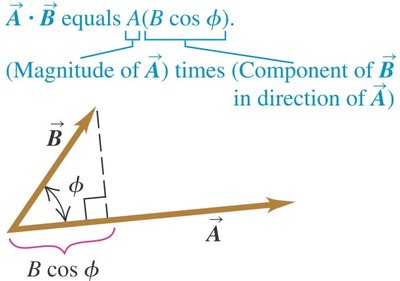
In component form:

Vector (Cross) Product
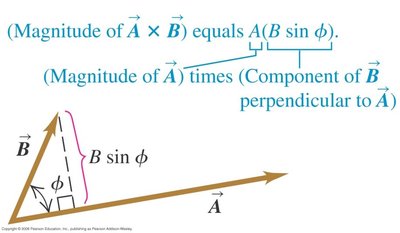
The cross product of two vectors and is a vector given by:
(magnitude)
The direction is perpendicular to the plane containing and , determined by the right-hand rule.
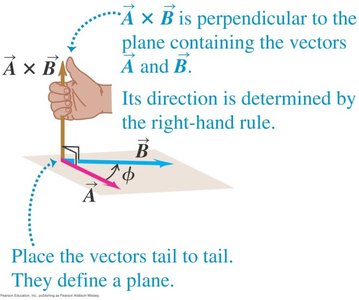
In component form:

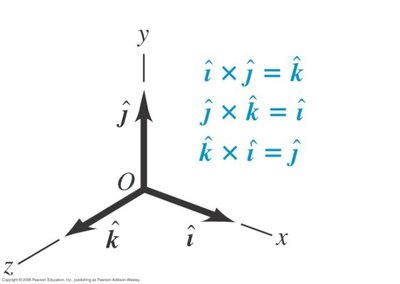
Unit vector cross products:
Summary Table: SI Base Units and Prefixes
Quantity | Unit Name | Unit Symbol |
|---|---|---|
Length | meter | m |
Mass | kilogram | kg |
Time | second | s |
Prefix | Symbol | Factor |
|---|---|---|
kilo | k | |
milli | m | |
micro | µ | |
nano | n |
Additional info: This guide covers all foundational concepts from Chapter 1 of a calculus-based physics course, including units, uncertainties, significant figures, and vector mathematics, with relevant images and tables to reinforce understanding.
