 Indietro
Chapter 17: Superposition and Interference of Waves
Guida di studio - Note intelligenti
 Appunti personalizzati basati sui tuoi materiali, ampliati con definizioni chiave, esempi e contesto.
Superposition of Waves
Principle of Superposition
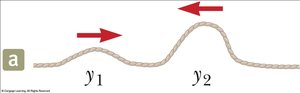
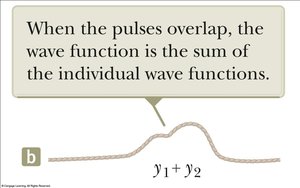
The principle of superposition states that when two or more waves are present at a single point in space, the displacement of the medium at that point is the sum of the displacements due to each individual wave. This principle is fundamental to understanding how waves interact in various physical systems.
Mathematical Statement: If the displacements due to two waves are and , the net displacement is .
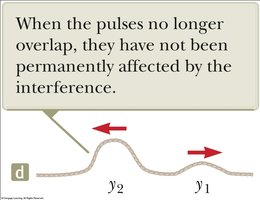
Physical Meaning: The waves pass through each other without being permanently altered.
Constructive and Destructive Interference
When waves overlap, their displacements combine. The nature of this combination depends on the relative signs of the displacements:
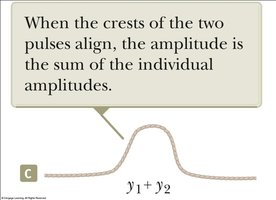
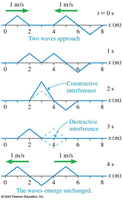
Constructive Interference: Occurs when the displacements have the same sign, resulting in a larger amplitude.
Destructive Interference: Occurs when the displacements have opposite signs, resulting in a reduced or zero amplitude.
Superposition Example
Consider two pulses traveling in opposite directions on a string. As they overlap, their displacements add algebraically. After passing through each other, the pulses continue unaffected.
Key Steps:
Pulses approach each other.
They overlap, and their amplitudes add (constructive or destructive).
Pulses separate and continue unchanged.
Standing Waves
Formation of Standing Waves
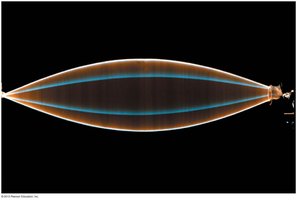
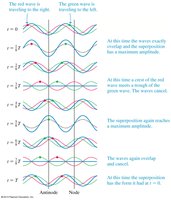
A standing wave is formed by the superposition of two waves of the same frequency, amplitude, and wavelength traveling in opposite directions. Standing waves are characterized by stationary nodes (points of zero displacement) and antinodes (points of maximum displacement).
Nodes: Points that never move; spaced apart.
Antinodes: Points of maximum oscillation, located halfway between nodes.
Mathematical Description of Standing Waves
The displacement of a standing wave can be written as:
where is the amplitude function, and is the angular frequency. The amplitude reaches a maximum value of at antinodes.

Standing Waves on a String
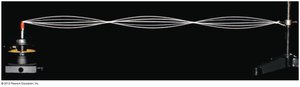
For a string of length fixed at both ends, standing waves are formed only for certain wavelengths and frequencies:
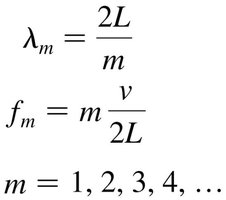
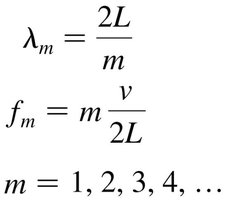
Allowed Wavelengths: , where
Allowed Frequencies: , where is the wave speed.
Fundamental Frequency: (first harmonic).

Standing Sound Waves in Air Columns
Closed-Closed and Open-Open Tubes
Standing sound waves can form in tubes with different boundary conditions:
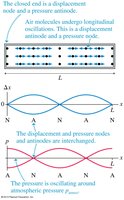
Closed-Closed Tube: Both ends are displacement nodes (pressure antinodes).
Open-Open Tube: Both ends are displacement antinodes (pressure nodes).
Open-Closed Tubes
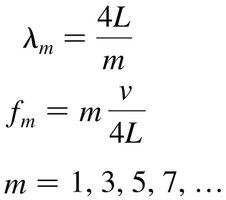
For a tube open at one end and closed at the other, only odd harmonics are present:
Allowed Wavelengths: ,
Allowed Frequencies: ,
Interference of Waves
Constructive and Destructive Interference
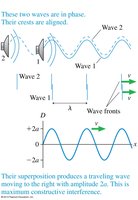
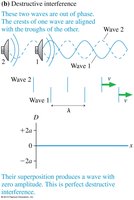
When two waves of the same frequency and amplitude travel together, their interference depends on their phase difference :
Constructive Interference: Occurs when (waves are in phase), resulting in maximum amplitude .
Destructive Interference: Occurs when (waves are out of phase), resulting in zero amplitude.
Mathematical Formulation
The net displacement for two waves can be written as:
Using trigonometric identities, this can be simplified to:

Path Difference and Interference
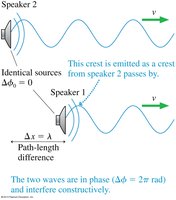
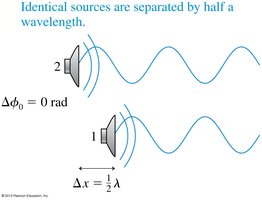
The condition for constructive or destructive interference can also be expressed in terms of the path-length difference :
Constructive:
Destructive:
Interference in Thin Films
Thin-Film Interference
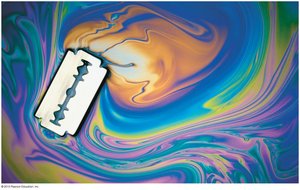
Thin films, such as soap bubbles or oil on water, display colorful patterns due to interference between light waves reflected from the top and bottom surfaces of the film. The interference depends on both the path difference and any phase changes upon reflection.
Phase Change: A 180° phase change occurs when light reflects from a medium of higher refractive index.
Path Difference: The extra distance traveled by the wave reflected from the lower surface is , where is the film thickness.
Wavelength in Film: , where is the refractive index of the film.
Conditions for Interference in Thin Films
Type of Interference | Condition |
|---|---|
Constructive | |
Destructive |
where
Note: If the film is between two different media, the conditions may be reversed depending on the relative indices of refraction.
Applications
Antireflection Coatings: Thin films are used on lenses and optical devices to reduce unwanted reflections by causing destructive interference for specific wavelengths.
Summary Table: Types of Interference
Type | Condition | Result |
|---|---|---|
Constructive | Displacements same sign, , | Maximum amplitude |
Destructive | Displacements opposite sign, , | Minimum (zero) amplitude |
Additional info: The notes above include expanded academic context, definitions, and examples to ensure completeness and clarity for college-level Physics with Calculus students.
