 Indietro
Chapter 23: The Electric Field – Principles, Calculations, and Applications
Guida di studio - Note intelligenti
 Appunti personalizzati basati sui tuoi materiali, ampliati con definizioni chiave, esempi e contesto.
The Electric Field
Introduction to the Electric Field
The electric field is a fundamental concept in electromagnetism, describing the influence that electric charges exert on each other at a distance. The field is defined as the force per unit charge experienced by a small positive test charge placed in the vicinity of other charges.
Definition: The electric field \( \vec{E} \) at a point is given by the force \( \vec{F}_{on\ q} \) on a test charge q divided by the magnitude of the charge:
Direction: The direction of the electric field is the direction of the force on a positive test charge.
Units: The SI unit of electric field is newtons per coulomb (N/C).
Electric Field of Point Charges and Superposition Principle
When multiple point charges are present, the net electric field at any point is the vector sum of the fields produced by each charge. This is known as the principle of superposition.
Electric Field of a Point Charge:
Superposition Principle: For charges q_1, q_2, ... at distances r_1, r_2, ... from the point of interest, the net field is:
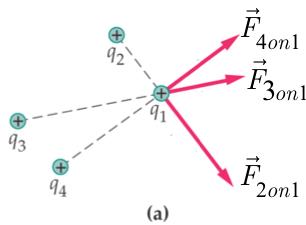
Example: The image above shows the forces on charge q_1 due to other charges. The net electric field at q_1 is the vector sum of the individual fields.
Electric Field Strength: Sample Calculations
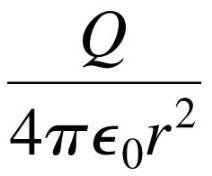
For a single point charge Q at a distance r:
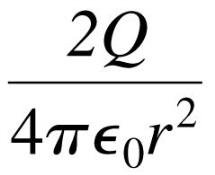
For two charges of Q and 2Q at the same distance r:
For four charges of Q each at the same distance r:
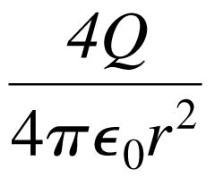
For a configuration where the distance is not the same, the denominator changes accordingly:
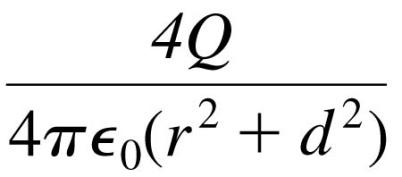
Electric Field of Multiple Charges: Example
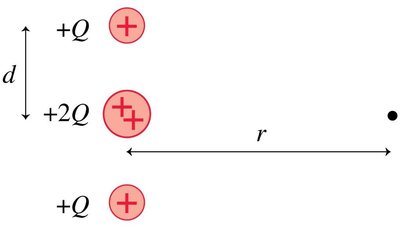
Example: The image above shows three point charges arranged in a line. The net electric field at the dot is the vector sum of the fields due to each charge, calculated using the superposition principle.
Electric Field Lines
Electric field lines are a visual representation of the direction and strength of the electric field. They are drawn such that the tangent to a field line at any point gives the direction of the electric field vector at that point.
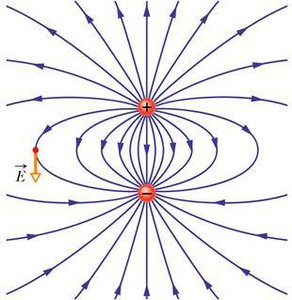
Field lines start on positive charges and end on negative charges.
The density of field lines indicates the strength of the field (closer lines = stronger field).
Field lines never cross.
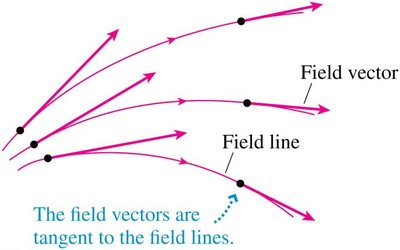
Example: The image above shows field vectors tangent to field lines, illustrating the direction of the electric field at various points.
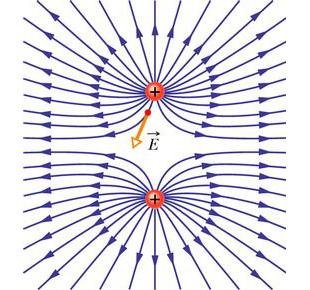
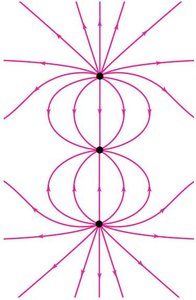
Electric Field Lines for Different Charge Configurations
For a positive and negative charge (dipole), field lines emerge from the positive and terminate at the negative.
For two positive charges, field lines repel and do not connect.
For unequal charges, more lines originate or terminate on the charge with greater magnitude.
Continuous Charge Distributions
Linear Charge Density and Line Charges
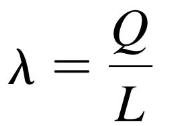
For objects with charge distributed along a length, the linear charge density \( \lambda \) is defined as:
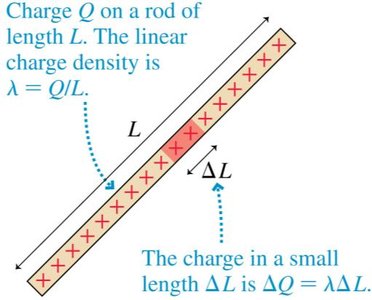
Example: The image above shows a rod of length L with total charge Q. The charge in a small segment \( \Delta L \) is \( \Delta Q = \lambda \Delta L \).
Electric Field of a Finite and Infinite Line of Charge
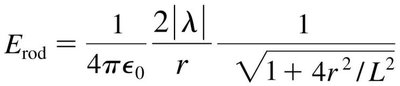
For a finite rod of length L and total charge Q, the electric field at a perpendicular distance r from the center is:
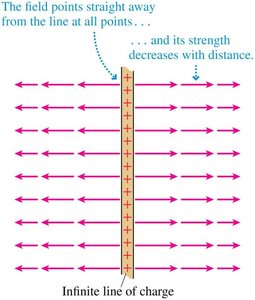
For an infinite line of charge, the field simplifies to:

Example: The field points radially outward from a positive line of charge and decreases with distance.
Surface Charge Density and Planar Distributions
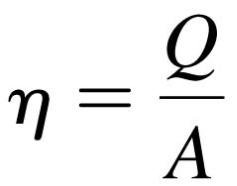
For a two-dimensional surface, the surface charge density \( \eta \) is:
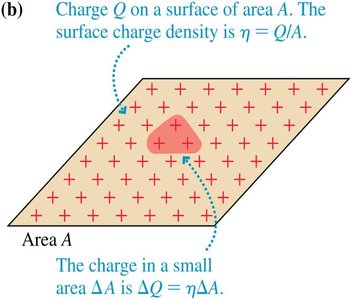
The electric field of an infinite plane of charge is:


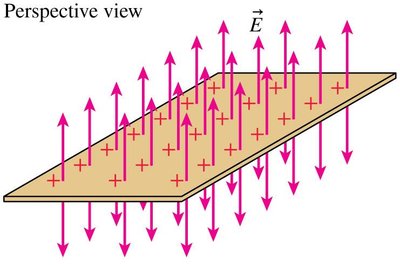
The Parallel-Plate Capacitor
Structure and Field of a Parallel-Plate Capacitor
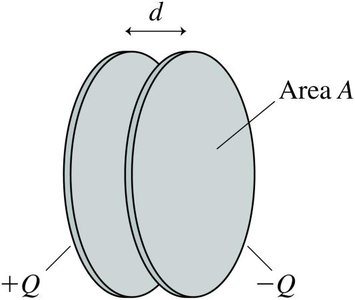
A parallel-plate capacitor consists of two large, flat, parallel plates separated by a small distance d, one carrying charge +Q and the other -Q. The electric field between the plates is uniform and directed from the positive to the negative plate.
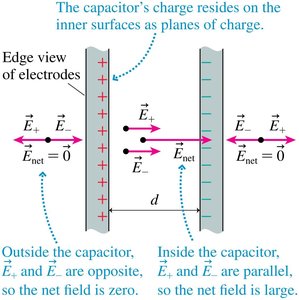
The electric field inside the capacitor is:
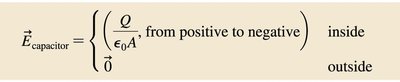
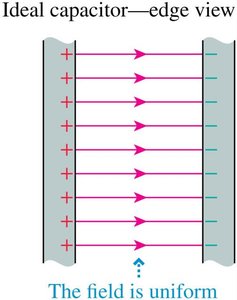
Outside the plates, the field is nearly zero due to cancellation.
Electric Field of Continuous Charge Distributions
Volume, Surface, and Linear Charge Densities
Volume charge density:
Surface charge density:
Linear charge density:
For a continuous distribution, the field at point P is the vector sum of the fields due to all infinitesimal charge elements dq:
Motion of a Charged Particle in an Electric Field
Force and Acceleration
A charged particle of charge q and mass m in an electric field E experiences a force:
and an acceleration:
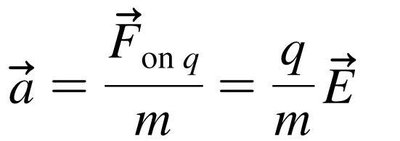
Example: In a uniform field, the acceleration is constant, and the motion can be analyzed using kinematic equations.
Electric Dipoles
Definition and Properties
An electric dipole consists of two equal and opposite charges separated by a small distance. The dipole moment \( \vec{p} \) is defined as:
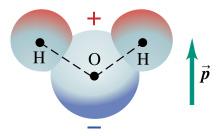
Example: The water molecule has a large dipole moment, making it an excellent solvent for ionic substances.
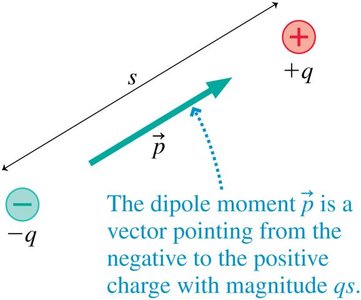
The dipole moment points from the negative to the positive charge.
Dipole in an Electric Field
A dipole in a uniform electric field experiences no net force but does experience a torque that tends to align the dipole with the field. The torque is given by:
where \( \phi \) is the angle between \( \vec{p} \) and \( \vec{E} \).
Example: The torque causes the dipole to rotate until it is aligned with the field direction.
Summary Table: Electric Field Expressions
Configuration | Electric Field Expression |
|---|---|
Point Charge | |
Infinite Line Charge | |
Infinite Plane | |
Parallel-Plate Capacitor | |
Dipole (on axis, far field) |
