 Indietro
Coulomb’s Law and Electric Fields: Physics with Calculus Study Guide
Guida di studio - Note intelligenti
 Appunti personalizzati basati sui tuoi materiali, ampliati con definizioni chiave, esempi e contesto.
Coulomb’s Law & Electric Fields
Origin of Electric Charge
Electric charge arises from the fundamental particles that make up atoms: protons, neutrons, and electrons. Protons carry a positive charge, electrons carry a negative charge, and neutrons are electrically neutral. The total charge of an object is determined by the sum of its protons and electrons; neutrons do not contribute to charge.
Proton: Mass kg, Charge C
Electron: Mass kg, Charge C
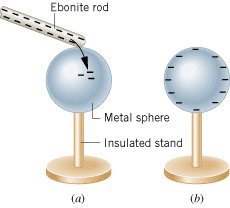
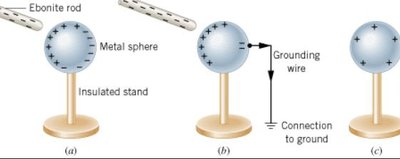
Conservation of Charge: Charge cannot be created or destroyed, only transferred by moving electrons.
Formula for Total Charge:
Example: To change an object's charge, electrons must be added or removed.
Coulomb’s Law
Coulomb’s Law describes the force between two point charges. The magnitude of the electric force is directly proportional to the product of the charges and inversely proportional to the square of the distance between them.
Formula: , where N·m2/C2
Typical Charge Values: 1 nC = C, 1 μC = C
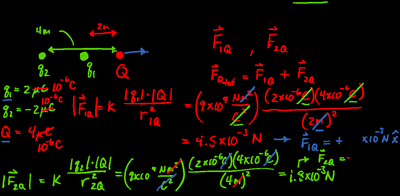
Distance Calculation:
Vector Form:
Component Formulas: ,
Direction: Like charges repel, opposite charges attract.
Newton’s Third Law:
Example: Calculating the force between three charges on a line.
Math Review: Vectors
Vectors are quantities with both magnitude and direction, essential for describing forces and fields in physics. Scalars have only magnitude.
Vector Representation:
Decomposition:
Magnitude:
Trigonometric Relations: ,
Common Triangles: 45-45-90 and 30-60-90 triangles are useful for quick calculations.
Vector Addition:
Methods: Parallelogram and head-to-tail methods for vector addition.
Electric Fields: Concept and Definition
An electric field is a region of space where a charged particle experiences a force due to another charge. The field model replaces the idea of action-at-a-distance with a physical field generated by charges.
Field Definition: At every point in space, the electric field has a specific value and direction.
Physical Phenomenon: Electric fields are real and observable in nature.


Deriving the Electric Field Equation
The electric field at a point due to a source charge is defined as the force per unit charge experienced by a test charge placed at that point.
Formula:
Electric Field Equation:
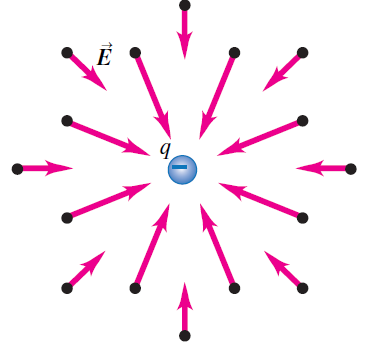
Direction: The direction of depends on the sign of (outward for positive, inward for negative).
Drawing Electric Field Lines
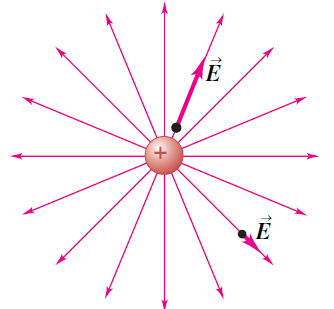
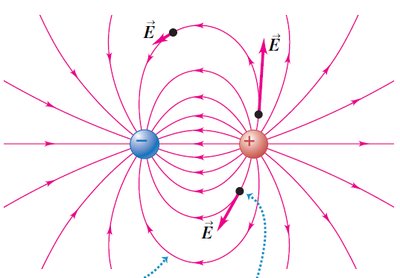
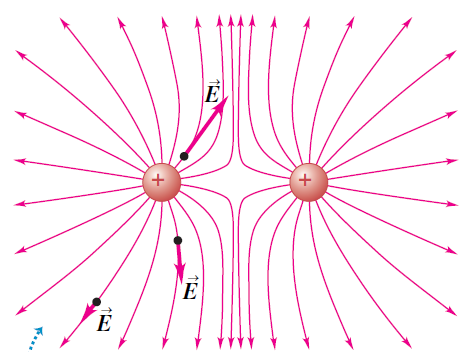
Electric field lines are a visual representation of the direction and strength of the electric field in space.
Field lines originate from positive charges and terminate on negative charges or extend to infinity.
The number of lines is proportional to the magnitude of the charge.
Field line density indicates field strength.
The direction of the field is tangent to the field line at any point.
Field lines never cross.
Applications and Examples
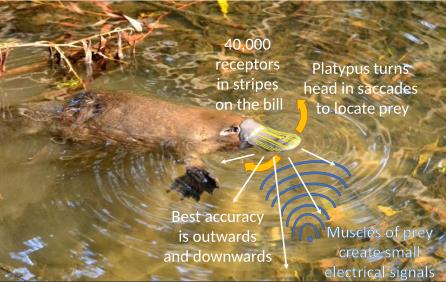
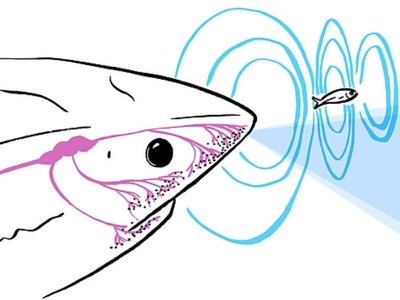
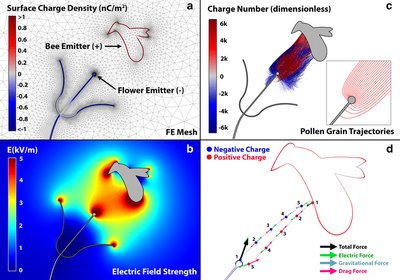
Electric fields are not only theoretical constructs but are observed in nature and technology. For example, sharks and platypuses use electric fields to locate prey, and bees interact with flowers using electric fields for pollination.
Biological Application: Animals sense electric fields for navigation and hunting.
Technological Application: Electric fields are used in sensors and electronic devices.
Summary Table: Key Concepts in Coulomb’s Law and Electric Fields
Concept | Definition | Formula |
|---|---|---|
Electric Charge | Property of matter that causes it to experience a force in an electric field | |
Coulomb’s Law | Force between two point charges | |
Electric Field | Force per unit charge at a point in space | |
Vector Addition | Combining vectors by adding their components |
