 Indietro
Dynamics: Newton’s Laws of Motion – Study Notes
Guida di studio - Note intelligenti
 Appunti personalizzati basati sui tuoi materiali, ampliati con definizioni chiave, esempi e contesto.
Dynamics: Newton’s Laws of Motion
Introduction to Dynamics
Dynamics is the branch of physics concerned with the study of forces and their effects on motion. Newton’s laws of motion form the foundation for understanding how objects move and interact under the influence of forces.
Force
Definition and Measurement
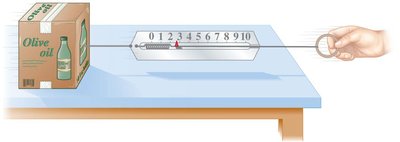
Force is a push or pull acting on an object, capable of changing its state of motion or shape.
The magnitude of a force can be measured using a spring scale.
Forces are vector quantities, possessing both magnitude and direction.
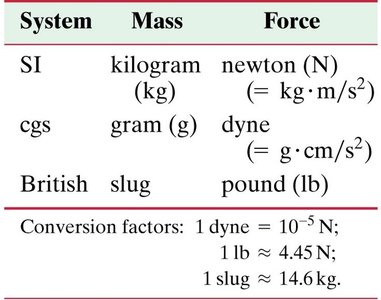
Unit of force in the SI system: newton (N).
Other units: dyne (cgs), pound (British system).
Newton’s First Law of Motion (Law of Inertia)
Statement and Inertial Reference Frames
Every object continues in its state of rest or uniform velocity in a straight line unless acted upon by a net external force.
This property is called inertia.
An inertial reference frame is one in which Newton’s first law holds (i.e., not accelerating or rotating).
Mass
Definition and Distinction from Weight
Mass is a measure of an object’s inertia; it quantifies the amount of matter in an object.
SI unit: kilogram (kg).
Weight is the force of gravity acting on an object: it depends on the local gravitational acceleration.
Mass is constant everywhere; weight varies with location (e.g., on the Moon vs. Earth).
Newton’s Second Law of Motion
Relation Between Force, Mass, and Acceleration
The acceleration of an object is directly proportional to the net force acting on it and inversely proportional to its mass.
Mathematical form:
For two dimensions:
Force is a vector; the law applies to each component separately.

Newton’s Third Law of Motion
Action-Reaction Pairs
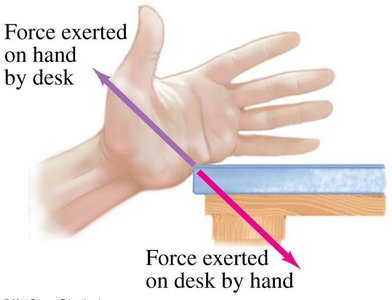
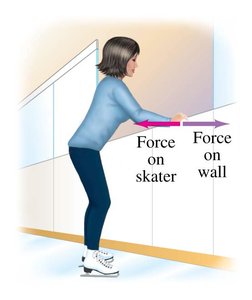
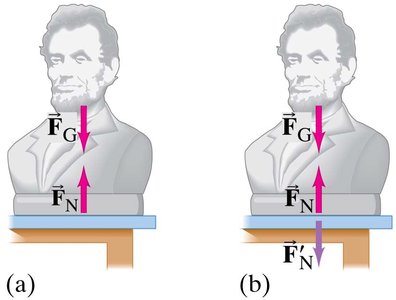
Whenever one object exerts a force on a second object, the second exerts an equal and opposite force on the first.
These forces act on different objects and are called action-reaction pairs.
Mathematical form:
Example: Rocket propulsion—exhaust gases push backward, rocket moves forward.

Weight and the Normal Force
Gravitational Force and Support Forces
Weight () is the gravitational force on an object:
The normal force () is the force exerted by a surface perpendicular to the object resting on it.
For an object at rest on a horizontal surface: (if no other vertical forces act).
Solving Problems with Newton’s Laws: Free-Body Diagrams
Systematic Problem-Solving Steps
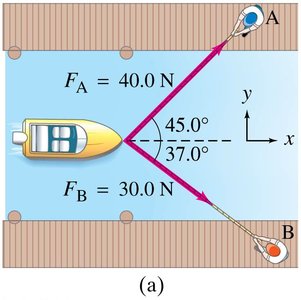
Draw a sketch of the situation.
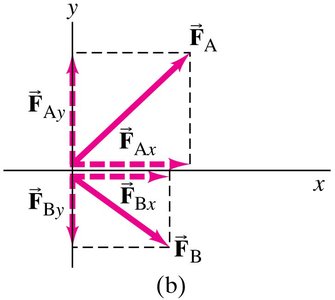
Draw a free-body diagram (FBD) for each object, showing all forces acting on it.
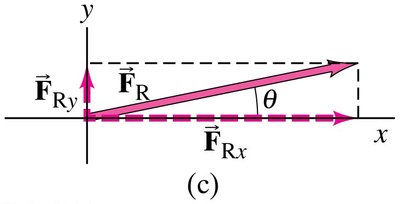
Resolve all forces into components along chosen axes.
Apply Newton’s second law to each component.
Solve the resulting equations for the unknowns.
Friction and Inclined Planes
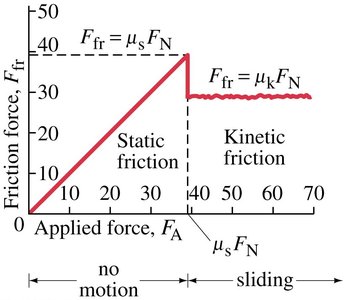
Kinetic and Static Friction
Friction is a force that opposes the relative motion of two surfaces in contact.
Kinetic friction () acts when objects are sliding: where is the coefficient of kinetic friction.
Static friction prevents motion up to a maximum value: where is the coefficient of static friction.
Friction coefficients depend on the materials in contact.

Forces on Inclined Planes
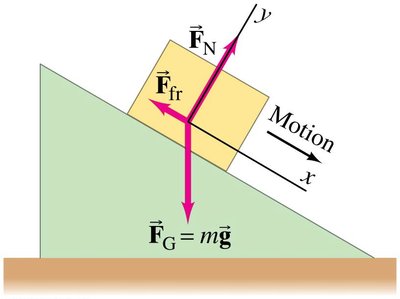
An object on an incline experiences three main forces: gravity, normal force, and friction.
The normal force is perpendicular to the surface; friction is parallel to the surface.
When at rest, static friction balances the component of gravity down the incline.
Summary of Key Equations
Newton’s First Law: If , then is constant ().
Newton’s Second Law:
Newton’s Third Law:
Weight:
Kinetic friction:
Static friction:
Example Problem
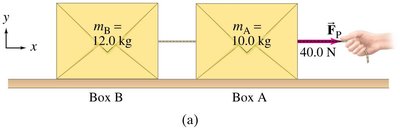
Draw the free-body diagram and write the equations of motion for two boxes connected by a rope, with a force pulling on one box:
Identify all forces acting on each box (tension, weight, normal force, applied force).
Apply Newton’s second law to each box separately to solve for acceleration and tension.
