 Indietro
Electric Fields, Potentials, and Dipoles: Step-by-Step Physics with Calculus Guidance
Guida di studio - Note intelligenti
 Appunti personalizzati basati sui tuoi materiali, ampliati con definizioni chiave, esempi e contesto.
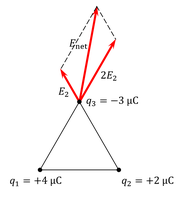
Q1. Three point charges are located at the corners of an equilateral triangle of side length 0.40 m. Their charges are , , . (a) Calculate the magnitude of the electric field at the location of due to . (b) Calculate the magnitude of the electric field at the location of $q_3$ due to . (c) Determine the magnitude of the net electric field at $q_3$.
Background
Topic: Electric Fields from Point Charges & Vector Addition
This question tests your understanding of Coulomb's law for electric fields, superposition principle, and vector addition in the context of an equilateral triangle arrangement.
Key Terms and Formulas
Electric field from a point charge:
(Coulomb's constant)
Superposition principle: Net field is the vector sum of individual fields.
For equilateral triangle, the angle between fields is .
Cosine rule for vector addition:
Step-by-Step Guidance
Identify the distances: Each side of the triangle is , so the distance from and to is .
Calculate the electric field at due to using .
Calculate the electric field at due to using .
Recognize that the fields and are not collinear; they make an angle of at (see diagram below).
Set up the cosine rule for vector addition: , but do not compute the final value yet.
Try solving on your own before revealing the answer!
Final Answer:
(a)
(b)
(c) Using the cosine rule and the diagram,
The diagram helps visualize the vector addition, and the angle is crucial for correct calculation.
Q2. A point charge with charge is fixed in space. The coordinate is the distance from the point charge. The potential is zero for . (a) Find the electric potential at . (b) A proton is released from rest at $r = 0.50 \, \text{m}$ and moves to . Calculate the change in its electric potential energy. (c) Determine the proton’s speed at $r = 1.50 \, \text{m}$.
Background
Topic: Electric Potential and Energy Conservation
This question tests your ability to calculate electric potential, potential energy changes, and apply energy conservation to find the speed of a charged particle.
Key Terms and Formulas
Electric potential:
Change in potential energy:
Energy conservation:
Proton charge:
Proton mass:
Step-by-Step Guidance
Calculate the electric potential at using .
Find the initial and final potentials at and .
Compute the change in electric potential energy for the proton: .
Apply energy conservation: The proton starts from rest, so . Set up .
Express the final speed using and solve for , but do not calculate the final value yet.
Try solving on your own before revealing the answer!
Final Answer:
(a)
(b)
(c)
The proton gains kinetic energy as it moves away from the positive charge, converting potential energy to motion.
Q3. A dipole consists of two point charges with charges and separated by . The dipole is placed in a uniform electric field of magnitude . It makes an angle of with the field. (a) Calculate the magnitude of the dipole moment. (b) Calculate the magnitude of the torque acting on the dipole. (c) How much work must an external agent do to rotate the dipole from this $30^\circ$ angle (at rest) to a angle (at rest)?
Background
Topic: Electric Dipoles in Uniform Fields
This question tests your understanding of dipole moment, torque, and work done in rotating a dipole in an electric field.
Key Terms and Formulas
Dipole moment:
Torque:
Work to rotate dipole:
Step-by-Step Guidance
Calculate the dipole moment using with and .
Set up the torque formula: with .
For work, use , where and .
Plug in the values for , , and the angles, but do not compute the final numeric result yet.
Try solving on your own before revealing the answer!
Final Answer:
(a)
(b)
(c)
The dipole moment quantifies the separation of charge, torque measures the rotational effect, and work is the energy needed to rotate the dipole.
Q4. A thin spherical shell of radius carries a total charge that is uniformly distributed. (a) What is the electric field at a distance from the center of the shell? (b) Determine the magnitude of the electric field at a distance from the center of the sphere. (c) What is the electric flux passing through a spherical Gaussian surface of radius that is concentric with the shell? Include its sign.
Background
Topic: Gauss's Law and Shell Theorem
This question tests your understanding of electric fields inside and outside a charged shell, and calculation of electric flux using Gauss's law.
Key Terms and Formulas
Shell theorem: inside a uniformly charged shell ()
Outside shell:
Electric flux:
Step-by-Step Guidance
For (inside shell), apply the shell theorem: .
For (outside shell), use .
For flux, use for a Gaussian surface enclosing the shell.
Plug in the values for and , but do not compute the final numeric result yet.
Try solving on your own before revealing the answer!
Final Answer:
(a) (inside shell)
(b)
(c)
Gauss's law and the shell theorem simplify the calculations for these symmetric charge distributions.
