 Indietro
Kinematics in One Dimension: Physics with Calculus Study Notes
Guida di studio - Note intelligenti
 Appunti personalizzati basati sui tuoi materiali, ampliati con definizioni chiave, esempi e contesto.
Chapter 2: Kinematics in One Dimension
Introduction to Kinematics
Kinematics is the branch of physics that describes the motion of objects without considering the causes of motion. In this chapter, we focus on motion along a straight line (one dimension), introducing key concepts such as position, displacement, velocity, and acceleration.
Uniform Motion
Definition and Characteristics
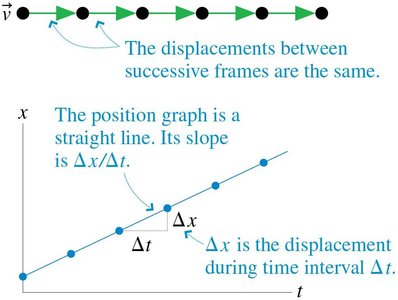
Uniform motion refers to motion along a straight line at a constant, unvarying speed.
The position-versus-time graph for uniform motion is a straight line, indicating a constant velocity.
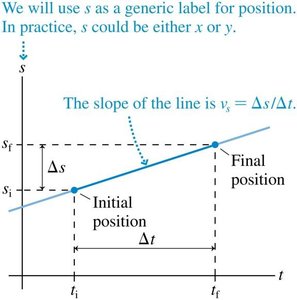
The average velocity is the slope of the position-versus-time graph.
Mathematical Representation
For one-dimensional motion, average velocity is given by:
SI units of velocity: meters per second (m/s).
The final position for uniform motion:
Interpreting Position-Time Graphs
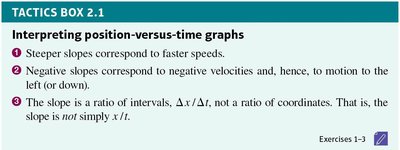
Steeper slopes correspond to faster speeds.
Negative slopes indicate negative velocities (motion to the left or down).
The slope is a ratio of intervals, not simply the ratio of coordinates.
Scalars and Vectors
Key Quantities
Distance is a scalar quantity (magnitude only, no direction).
Displacement is a vector quantity (final position minus initial position).
Speed is scalar; velocity is vector (includes direction).
In one dimension, direction is indicated by the sign (+ or –).
Example: Ant on a Picnic Table
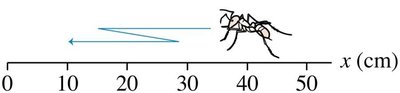
An ant zig-zags back and forth; its distance traveled is the total path length, while displacement is the straight-line distance from start to end.
Instantaneous Velocity
Definition and Calculation
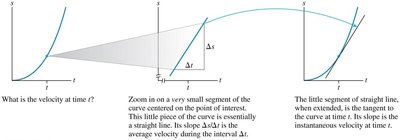
Instantaneous velocity is the velocity at a single instant of time, including both speed and direction.
It is the limit of average velocity as the time interval approaches zero:
Graphically, it is the slope of the tangent to the position-versus-time curve at a given point.
Velocity and Position Graphs
Relating Position and Velocity Graphs
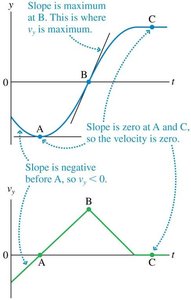
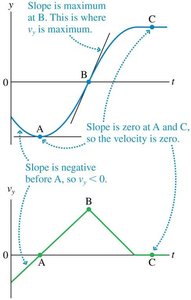
The value of the velocity graph at any instant equals the slope of the position graph at that instant.
Velocity graphs and position graphs can look very different; always transfer slope information from the position graph to the velocity graph.
Finding Position from Velocity
Integration and Area Under the Curve
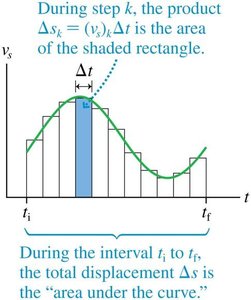
If velocity is known as a function of time, the position can be found by integrating velocity over time:
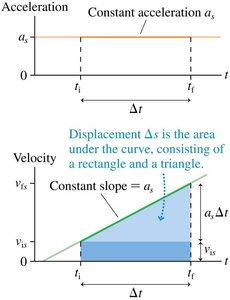
Graphically, the displacement is the area under the velocity-versus-time curve.
Motion with Constant Acceleration
Definition and Equations
Acceleration is the rate of change of velocity:
SI units: .
For constant acceleration, the following kinematic equations apply:
Free Fall
Gravity as Constant Acceleration
Free fall is motion under the influence of gravity alone.
All objects in free fall near Earth's surface have the same acceleration:
Direction is downward (negative y-direction).
Motion on an Inclined Plane
Acceleration Along the Incline
For an object sliding down a frictionless incline, the acceleration along the incline is:
The sign depends on the direction of the tilt.
Summary Table: Kinematic Quantities
Quantity | Symbol | Type | SI Unit |
|---|---|---|---|
Position | s, x, y | Vector | m |
Displacement | Δs, Δx, Δy | Vector | m |
Distance | d | Scalar | m |
Velocity | v | Vector | m/s |
Speed | v | Scalar | m/s |
Acceleration | a | Vector | m/s² |
Key Takeaways
Uniform motion is described by straight-line position-time graphs and constant velocity.
Instantaneous velocity is the slope of the tangent to the position-time curve.
Displacement can be found as the area under the velocity-time graph.
Constant acceleration leads to parabolic position-time graphs and linear velocity-time graphs.
Free fall and motion on inclines are special cases of constant acceleration.
