 Indietro
Kinematics in Two Dimensions and Vectors: Study Notes
Guida di studio - Note intelligenti
 Appunti personalizzati basati sui tuoi materiali, ampliati con definizioni chiave, esempi e contesto.
Chapter 3: Kinematics in Two Dimensions; Vectors
3.1 Vectors and Scalars
Kinematics in two dimensions requires understanding both vectors and scalars. Vectors are quantities that have both magnitude and direction, while scalars have only magnitude.
Vector quantities: displacement, velocity, force, momentum
Scalar quantities: mass, time, temperature
Vectors are represented graphically by arrows; the length indicates magnitude, and the arrow points in the direction of the vector.
3.2 Addition of Vectors—Graphical Methods
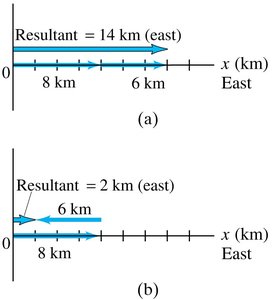
Vectors can be added using graphical methods. In one dimension, simple addition and subtraction suffice, but in two dimensions, more care is needed.
Collinear vectors: Add or subtract their magnitudes, considering direction (sign).
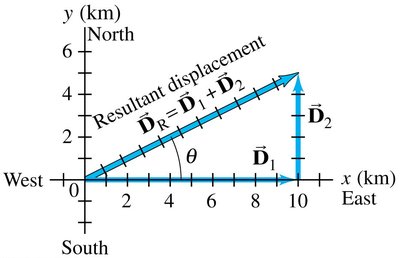
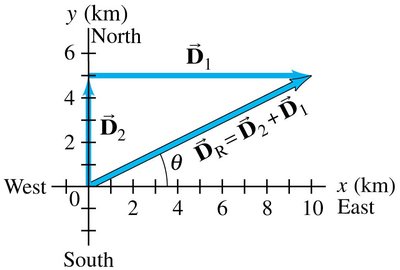
Perpendicular vectors: Use the Pythagorean theorem to find the resultant.
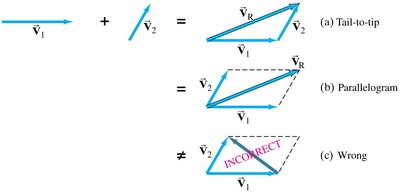
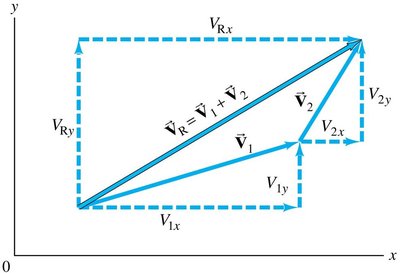
Tail-to-tip method: Place the tail of the second vector at the tip of the first; the resultant is from the tail of the first to the tip of the last.
Parallelogram method: Place vectors tail-to-tail and complete the parallelogram; the diagonal is the resultant.
3.3 Subtraction of Vectors, and Multiplication of a Vector by a Scalar
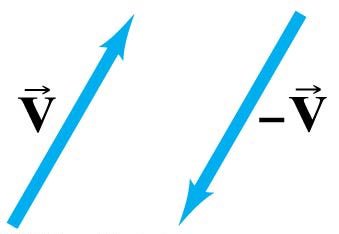
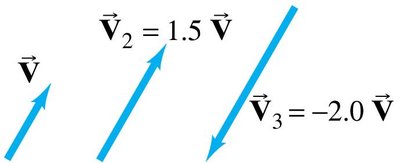
Vector subtraction is defined by adding the negative of a vector. Multiplying a vector by a scalar changes its magnitude but not its direction (unless the scalar is negative).
Negative vector: Same magnitude, opposite direction.
Subtraction: \( \vec{A} - \vec{B} = \vec{A} + (-\vec{B}) \)
Scalar multiplication: \( c\vec{V} \) has magnitude \( |c|V \) and direction of \( \vec{V} \) if \( c > 0 \), opposite if \( c < 0 \).

3.4 Adding Vectors by Components
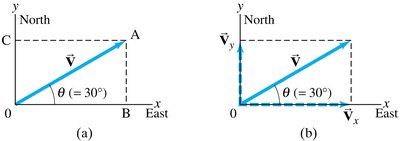
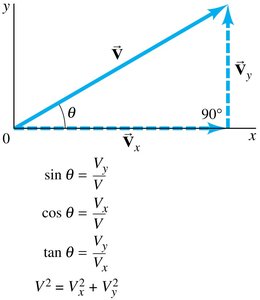
Any vector can be resolved into perpendicular components, usually along the x and y axes. This allows for algebraic addition of vectors.
Components: \( V_x = V \cos \theta \), \( V_y = V \sin \theta \)
Resultant vector: \( V = \sqrt{V_x^2 + V_y^2} \)
Direction: \( \theta = \tan^{-1}(V_y / V_x) \)
To add vectors:
Draw a diagram and choose axes.
Resolve each vector into x and y components.
Add components in each direction.
Find the magnitude and direction of the resultant.
Key Equations:
3.5 Projectile Motion
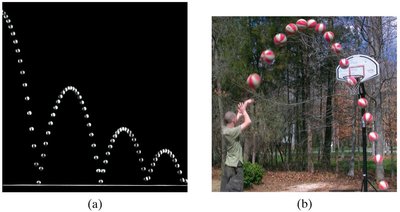
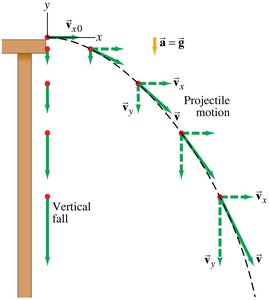
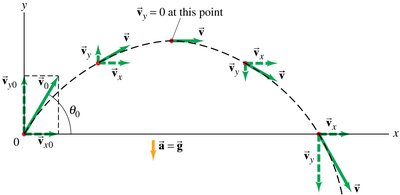
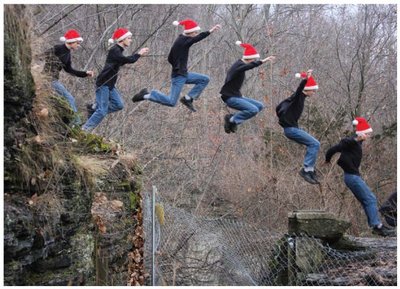
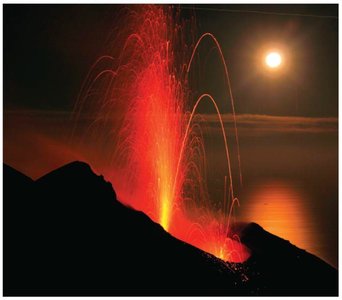
Projectile motion describes the motion of an object moving in two dimensions under the influence of gravity. The path is a parabola.
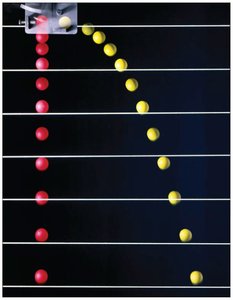
Horizontal and vertical motions are analyzed separately.
Horizontal velocity is constant; vertical velocity changes due to gravity.
At any instant, the horizontal and vertical positions can be found using kinematic equations.
3.6 Solving Projectile Motion Problems
Projectile motion problems are solved by applying kinematic equations to the horizontal and vertical components separately.
Choose the object and draw a diagram.
Choose a coordinate system and origin.
List known and unknown quantities.
Use the following kinematic equations (for vertical motion, upward positive):
Horizontal Motion | Vertical Motion |
|---|---|
Additional info: The time of flight is determined by the vertical motion; range and maximum height can be found using these equations.
3.7 Projectile Motion Is Parabolic
The path of a projectile is a parabola. By eliminating time from the kinematic equations, the vertical position as a function of horizontal position is:
(where A and B are constants depending on initial velocity and angle)
This is the general equation for a parabola.
3.8 Relative Velocity
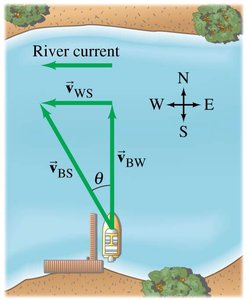
Relative velocity in two dimensions involves vector addition. The velocity of an object relative to one frame can be found by adding velocities relative to other frames.
Notation: = velocity of water relative to shore, = velocity of boat relative to shore, = velocity of boat relative to water.
Relationship:
Velocities must be added as vectors, considering both magnitude and direction.
Summary of Key Points
A quantity with magnitude and direction is a vector; with magnitude only, a scalar.
Vector addition can be graphical or by components; the sum is the resultant vector.
Projectile motion is the motion of an object near Earth’s surface under gravity, following a parabolic path.
Relative velocity in two dimensions requires vector addition.
