 Indietro
Kinematics of Freefall and the Law of Falling Bodies
Guida di studio - Note intelligenti
 Appunti personalizzati basati sui tuoi materiali, ampliati con definizioni chiave, esempi e contesto.
Kinematics of Freefall
Definition and Conditions for Freefall
Freefall describes the motion of an object when the only force acting upon it is the gravitational attraction of a nearby planet, such as Earth. This means that all other forces—such as air resistance, propulsion, or contact with a surface—are absent.
Freefall: Motion under gravity alone; initial velocity can be any value (including zero).
Forces that prevent freefall: air resistance, support from a surface, propulsion, or any external push/pull.
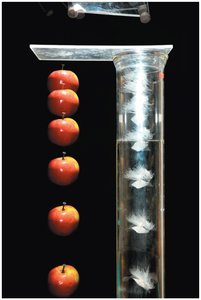
Additional info: The image above visually demonstrates the uniform acceleration of objects in freefall, as the spacing between positions increases with time, consistent with constant acceleration.
Law of Falling Bodies
The Law of Falling Bodies, first systematically studied by Galileo Galilei, states that in the absence of air resistance, all objects near the surface of a planet experience the same constant acceleration due to gravity, regardless of their mass.
Acceleration due to gravity (g) is constant and directed downward (toward the planet's center).
All objects, regardless of mass, fall with the same acceleration in freefall.


Additional info: Galileo's experiments, such as those at the Leaning Tower of Pisa, provided evidence that the acceleration due to gravity is independent of mass.
Earth’s Surface Gravity
Value and Variations of g
Near the Earth's surface, the acceleration due to gravity is approximately constant, but it can vary slightly depending on location and altitude.
Standard value for calculations:
g is slightly weaker at the equator (~9.78 m/s2) and stronger at the poles (~9.82 m/s2).
g decreases with altitude above Earth's surface.
1 "gee" is a common unit for acceleration:
Warning: Do not confuse "g" (acceleration due to gravity) with "gram" (unit of mass).
Kinematic Equations for Freefall
Constant Acceleration Equations
When an object is in freefall, its acceleration is constant and equal to (downward). The kinematic equations for constant acceleration apply:
Position as a function of time:
For freefall (choosing upward as positive, ):
For freefall (choosing downward as positive, ):
The total distance fallen is proportional to the square of the elapsed time ().
Example: Object Dropped from Rest
Suppose an object is dropped from rest () and for simplicity:
Displacement after seconds: m (if upward is positive)
Displacement values at successive seconds: 0 m, -5 m, -20 m, -45 m, -80 m, -125 m (for to $5$ s)
The distance fallen during each interval follows the sequence of odd numbers (5 m, 15 m, 25 m, ...).
Direction Conventions in Freefall Problems
Choosing the Positive Direction
In freefall problems, you may choose either upward or downward as the positive direction. This choice affects the sign of and the displacement .
If upward is positive:
If downward is positive:
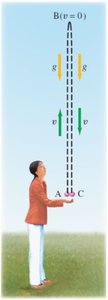
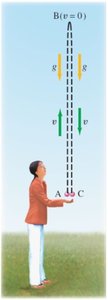
Additional info: At the apex of the motion, velocity is zero, but acceleration remains (downward).
Graphical Analysis of Freefall
Position-Time and Velocity-Time Graphs
Graphical representations help visualize the motion of objects in freefall:
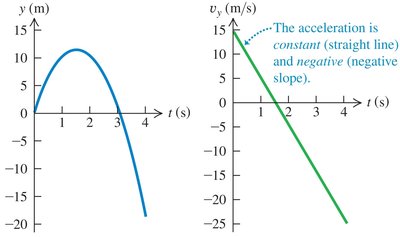
The position-time graph ( vs. ) is a parabola, indicating quadratic dependence on time.
The velocity-time graph ( vs. ) is a straight line with a negative slope equal to .
Worked Example: Thrown Ball
Analysis of Upward and Downward Motion
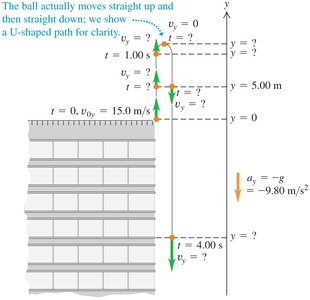
Consider a ball thrown straight upward with initial velocity . It rises, stops momentarily at the apex, then falls back down. The acceleration is always (downward), regardless of the direction of motion.
Time of ascent equals time of descent (if starting and ending at the same height).
At the highest point, velocity is zero, but acceleration is still .
Historical Context: Galileo’s Experiments
Galileo and the Leaning Tower of Pisa
Galileo Galilei is credited with foundational experiments on falling bodies, including the legendary (though possibly apocryphal) experiment at the Leaning Tower of Pisa, where he demonstrated that objects of different masses fall at the same rate in the absence of air resistance.


Review Quiz: Conceptual Questions on Freefall
Key Concepts Tested
Acceleration during ascent and descent: Always downward, even at the apex.
Time of ascent vs. descent: Equal if the object returns to its starting height.
Average velocity: Zero if the object returns to its starting position.
Average speed: Total distance divided by total time (requires calculation).
Example Question: Suppose you throw a basketball directly upward with initial velocity and catch it at the same position. What is the ball’s acceleration at the highest point? Answer: downward.
