 Indietro
Newton's Laws, Equilibrium, and Spring Forces: Study Notes with Visual Examples
Guida di studio - Note intelligenti
 Appunti personalizzati basati sui tuoi materiali, ampliati con definizioni chiave, esempi e contesto.
Newton's Laws of Motion
Conservation of Momentum and Action-Reaction
Newton's laws of motion describe the fundamental principles governing the movement of objects. The third law, often stated as "For every action, there is an equal and opposite reaction," is crucial for understanding momentum conservation in isolated systems.
Newton's Third Law: If object A exerts a force on object B, then object B exerts an equal and opposite force on object A.
Conservation of Momentum: In the absence of external forces, the total momentum of a system remains constant.
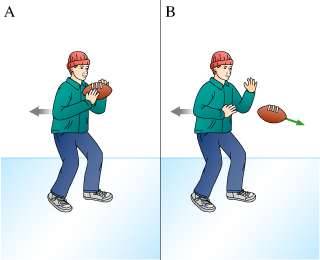
Example: When a person throws a football while standing on ice, both the person and the football move in opposite directions due to the conservation of momentum.
Equilibrium and Force Analysis
Static Equilibrium of Objects
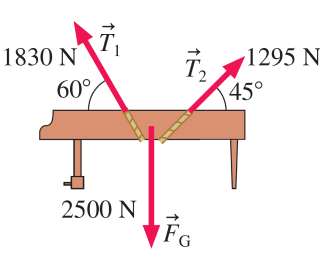
Static equilibrium occurs when the sum of all forces and torques acting on an object is zero, resulting in no acceleration. This principle is essential for analyzing objects supported by multiple forces, such as a piano held by ropes.
Equilibrium Condition: and
Force Components: Forces can be resolved into their x and y components for analysis.
Example: A piano is supported by two ropes at different angles, with the forces and angles labeled. The sum of the tension forces and the gravitational force must balance for equilibrium.
Spring Forces and Hooke's Law
Forces on a Mass Attached to a Spring
When a mass is attached to a spring, it experiences a restoring force proportional to its displacement from equilibrium. This is described by Hooke's Law, which is fundamental in understanding oscillatory motion and equilibrium positions.
Hooke's Law:
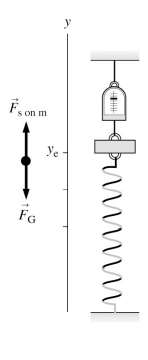
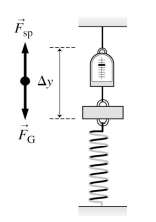
Equilibrium Position: The point where the spring force balances the gravitational force ().
Displacement: is the change in length from the spring's natural length.
Example: A mass hanging from a spring stretches it until the upward spring force equals the downward gravitational force.
Spring Extension and Force Balance
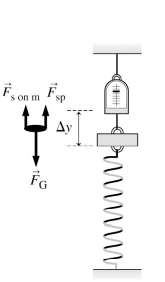
As the mass stretches the spring further, the spring force increases until it balances the weight. The diagrams illustrate the forces acting on the mass and the spring at different positions.
Force Balance: At equilibrium, .
Extension: The spring's extension is directly related to the mass and gravity ().
Example: The spring stretches more as the mass increases, and the force diagrams show the direction and magnitude of forces.
Summary Table: Key Concepts
Concept | Equation | Example/Application |
|---|---|---|
Newton's Third Law | Person throws football on ice | |
Equilibrium | Piano supported by ropes | |
Hooke's Law | Mass hanging from spring |
