 Indietro
Newton’s Laws of Motion and Applications: Forces, Free-Body Diagrams, and Friction
Guida di studio - Note intelligenti
 Appunti personalizzati basati sui tuoi materiali, ampliati con definizioni chiave, esempi e contesto.
Dynamics: Newton’s Laws of Motion
Introduction to Force
In physics, a force is defined as a push or pull acting upon an object as a result of its interaction with another object. Forces are responsible for changes in the motion of objects, including starting, stopping, or altering their velocity.
Magnitude of Force: The strength of a force can be measured using devices such as a spring scale.
Unit of Force: The SI unit of force is the newton (N), where 1 N = 1 kg·m/s2.
Force as a Vector: Force has both magnitude and direction.
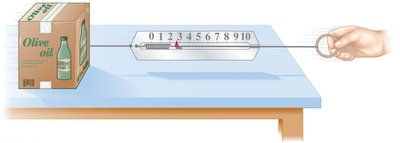
Newton’s First Law of Motion (Law of Inertia)
Newton’s first law states that an object will remain at rest or in uniform motion in a straight line unless acted upon by a net external force. This property is called inertia.
Inertial Reference Frames: Frames of reference in which Newton’s first law holds true (i.e., not accelerating or rotating).
Mass: The measure of an object’s inertia; in SI units, mass is measured in kilograms (kg).
Mass vs. Weight: Mass is an intrinsic property of matter, while weight is the force of gravity acting on that mass.
Newton’s Second Law of Motion
Newton’s second law quantifies the relationship between force, mass, and acceleration. It states that the acceleration of an object is directly proportional to the net force acting on it and inversely proportional to its mass.
Mathematical Formulation:
Force is a vector: The equation applies to each coordinate axis independently.
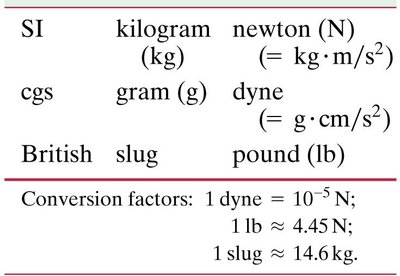
Units of Mass and Force:
System | Mass | Force |
|---|---|---|
SI | kilogram (kg) | newton (N) (= kg·m/s2) |
cgs | gram (g) | dyne (= g·cm/s2) |
British | slug | pound (lb) |
Conversion factors: 1 dyne = 10-5 N; 1 lb ≈ 4.45 N; 1 slug ≈ 14.6 kg. | ||
Newton’s Third Law of Motion
Newton’s third law states that for every action, there is an equal and opposite reaction. Whenever one object exerts a force on a second object, the second object exerts an equal force in the opposite direction on the first.
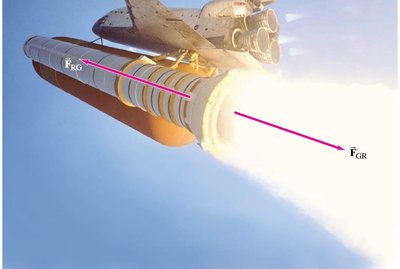
Action-Reaction Pairs: These forces always act on different objects.
Notation: The first subscript indicates the object being acted upon; the second indicates the source.
Applications: Rocket propulsion is explained by the expulsion of gases (action) and the resulting thrust (reaction).
Weight, the Force of Gravity, and the Normal Force
Weight
Weight is the force exerted on an object by gravity. Near the Earth’s surface, it is given by:
g: Acceleration due to gravity (≈ 9.8 m/s2 on Earth).
Normal Force
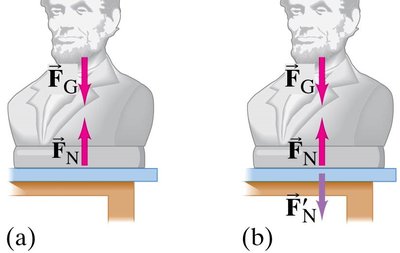
The normal force is the force exerted by a surface perpendicular to the object resting on it. It balances the component of weight perpendicular to the surface.
If the object is at rest on a horizontal surface: (if no other vertical forces act).
If additional vertical forces are present, the normal force adjusts accordingly.
Solving Problems with Newton’s Laws: Free-Body Diagrams
Steps for Problem Solving
Free-body diagrams are essential tools for visualizing forces acting on an object. The steps are:
Draw a sketch of the situation.
Draw a free-body diagram for each object, showing all forces acting on it.
Resolve all forces into components along chosen axes.
Apply Newton’s second law to each component.
Solve the resulting equations for the unknowns.
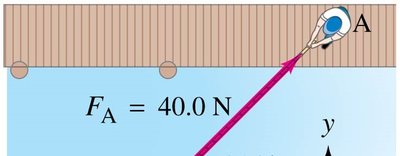
Tension Force
When a cord or rope pulls on an object, the force it exerts is called tension. Tension is always directed along the rope and away from the object.
Friction and Inclined Planes
Frictional Forces
Friction is the force that opposes the relative motion or tendency of such motion of two surfaces in contact. There are two main types:
Static Friction (Ffr, static): Prevents motion up to a maximum value.
Kinetic Friction (Ffr, kinetic): Acts when objects are sliding past each other.
The frictional force can be modeled as:
Static: Kinetic:
= coefficient of static friction
= coefficient of kinetic friction
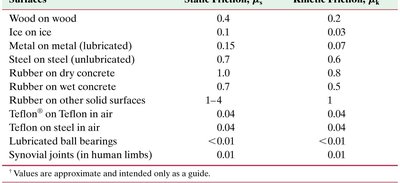
Coefficients of Friction
The coefficients of friction depend on the materials in contact. Typical values are shown below:
Surfaces | Coefficient of Static Friction, | Coefficient of Kinetic Friction, |
|---|---|---|
Wood on wood | 0.4 | 0.2 |
Ice on ice | 0.1 | 0.03 |
Steel on steel (unlubricated) | 0.7 | 0.6 |
Rubber on dry concrete | 1.0 | 0.8 |
Teflon on Teflon in air | 0.04 | 0.04 |
Lubricated ball bearings | <0.01 | <0.01 |

Friction on Inclined Planes
When an object is on an incline, three forces act on it: the normal force (perpendicular to the surface), the gravitational force (downward), and the frictional force (parallel to the surface).
The normal force is always perpendicular to the surface.
The frictional force is parallel to the surface and opposes motion.
The gravitational force can be resolved into components parallel and perpendicular to the incline.
Worked Examples and Applications
Example: Calculating Frictional Force
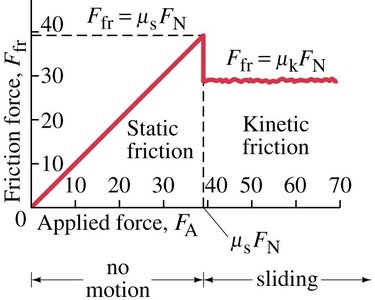
Suppose a 10.0-kg box rests on a horizontal floor with and . The force of friction for various applied forces is:
If , friction matches (static friction).
If , the box moves and friction is (kinetic friction).
Example: Forces on an Inclined Plane
For an object of mass on an incline of angle :
Normal force:
Component of gravity down the incline:
Frictional force (if moving):
Summary Table: Key Equations
Concept | Equation |
|---|---|
Newton’s Second Law | |
Weight | |
Static Friction (max) | |
Kinetic Friction | |
Normal Force (horizontal) | |
Normal Force (incline) |
