 Indietro
Physics with Calculus: Kinematics, Vectors, and Projectile Motion Exam Guidance
Guida di studio - Note intelligenti
 Appunti personalizzati basati sui tuoi materiali, ampliati con definizioni chiave, esempi e contesto.
Q1. Which one of these is not a vector?
Background
Topic: Scalars vs. Vectors
This question tests your understanding of the difference between scalar and vector quantities in physics. Vectors have both magnitude and direction, while scalars have only magnitude.
Key Terms:
Vector: A quantity with both magnitude and direction (e.g., displacement, velocity, acceleration).
Scalar: A quantity with only magnitude (e.g., distance, speed, mass).
Step-by-Step Guidance
Review the definitions of each option: displacement, distance, acceleration, and velocity.
Identify which of these quantities does not require a direction to be fully described.
Recall that vectors are typically represented with arrows and can be positive or negative depending on direction, while scalars are always positive.
Try solving on your own before revealing the answer!
Final Answer: B. Distance
Distance is a scalar quantity; it only has magnitude and no direction. The other options (displacement, acceleration, velocity) are all vectors.
Q2. Relative velocity: Leo running on a train
Background
Topic: Relative Motion in One Dimension
This question tests your ability to use the concept of relative velocity to relate the velocities of objects as measured from different reference frames.
Key Formula:
: Velocity of A relative to B
: Velocity of A relative to C
: Velocity of B relative to C
Step-by-Step Guidance
Define the reference frames: Leo (A), Train (B), Director (C).
Write the equation for Leo's velocity relative to the train:
Plug in the given values: m/s (east), m/s (east).
Set up the subtraction, being careful with the direction (signs) of each velocity.
Try solving on your own before revealing the answer!
Final Answer: B. -12.3 m/s
Leo's velocity relative to the train is m/s. The negative sign indicates Leo is moving west relative to the train.
Q3. Position vs. Time Graph: Signs of Acceleration and Velocity at Point P
Background
Topic: Kinematics Graphs
This question tests your ability to interpret position vs. time graphs and determine the signs of velocity and acceleration at a specific point.
Key Concepts:
Velocity: The slope of the position vs. time graph at a point.
Acceleration: The curvature (concavity) of the graph; if the graph is concave up, acceleration is positive; if concave down, acceleration is negative.
Step-by-Step Guidance
Look at the slope of the curve at point P to determine the sign of the velocity.
Examine the curvature (is the graph bending upwards or downwards?) at point P to determine the sign of the acceleration.
Recall: If the graph is curving downward (concave down), acceleration is negative; if curving upward (concave up), acceleration is positive.
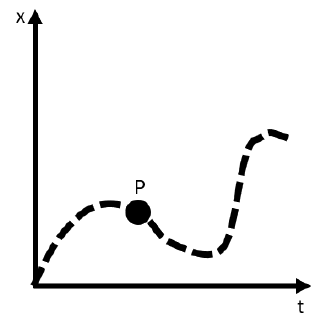
Try solving on your own before revealing the answer!
Final Answer: D. a < 0; v < 0
At point P, the slope is negative (velocity < 0) and the graph is curving downward (acceleration < 0).
Q4. Cost of driving to grandma’s house in dollars per second
Background
Topic: Unit Conversion and Rates
This question tests your ability to use unit analysis and rates to convert the cost of a trip into dollars per second.
Key Steps and Formulas:
Find the total gallons used:
Find the total cost:
Find the total time:
Convert time to seconds if needed.
Calculate cost per second:
Step-by-Step Guidance
Calculate the number of gallons needed for a 40-mile trip with 30 miles/gallon efficiency.
Multiply the gallons by the cost per gallon to get the total cost.
Calculate the time taken for the trip using the average speed (convert hours to seconds).
Set up the division to find the cost per second.
Try solving on your own before revealing the answer!
Final Answer: A. per second
The cost per second is approximately when all conversions are done correctly.
Q5. Sprinter’s total distance from A to B (acceleration, constant speed, deceleration)
Background
Topic: Kinematics with Constant Acceleration
This question tests your ability to break a motion into segments (acceleration, constant speed, deceleration) and use kinematic equations to find total distance.
Key Formulas:
For acceleration:
For constant speed:
For deceleration: (solve for )
Step-by-Step Guidance
Calculate the distance covered during the acceleration phase (first 5.0 s, starting from rest).
Find the velocity at the end of the acceleration phase to use for the constant speed segment.
Calculate the distance covered during the constant speed phase (15 s).
Use the deceleration rate and final velocity (0 m/s) to find the distance during the stopping phase.
Add up the distances from all three segments to get the total distance.
Try solving on your own before revealing the answer!
Final Answer: B. 187.5 m
The total distance from A to B is 187.5 meters when all segments are calculated and summed.
Q6. Magnitude of the hobbits’ total displacement (vector addition)
Background
Topic: Vector Addition and Displacement
This question tests your ability to add vectors (using the law of cosines or components) to find the magnitude of the total displacement.
Key Formula:
If two vectors and are at an angle to each other:
Step-by-Step Guidance
Draw a vector diagram showing the two legs of the journey (650 mi east, 1258 mi southeast).
Determine the angle between the two vectors (southeast is 45° from east).
Set up the law of cosines with the given magnitudes and angle.
Plug in the values and prepare to compute the magnitude of the resultant displacement.
Try solving on your own before revealing the answer!
Final Answer: C. 1778 mi
The magnitude of the hobbits’ total displacement is approximately 1778 miles.
Q7a. Draw a diagram of projectile motion over the city walls
Background
Topic: Projectile Motion Diagrams
This part asks you to visually represent the projectile motion of a stone, labeling velocity and acceleration vectors at key points.
Key Concepts:
At launch: Velocity has both horizontal and vertical components; acceleration is downward (gravity).
At the peak: Velocity is purely horizontal; acceleration is still downward.
Halfway up: Both velocity components are present; acceleration is downward.
Step-by-Step Guidance
Draw a parabolic trajectory starting from the catapult and ending just over the wall.
At the launch point, draw and label the velocity vector at a 45° angle and the acceleration vector straight down.
At the peak, draw the velocity vector horizontally and the acceleration vector downward.
Halfway up, show both velocity components and the downward acceleration.
Try sketching your own diagram before revealing the answer!
Final Answer:
Your diagram should show a parabolic path with velocity vectors at the launch (angled), peak (horizontal), and halfway (angled but shorter), and acceleration vectors always pointing downward (gravity).
Q7b. Calculate the minimum initial speed to clear the wall
Background
Topic: Projectile Motion Calculations
This question tests your ability to use projectile motion equations to find the minimum initial speed needed to clear a wall at a given distance and height.
Key Formulas:
Horizontal motion:
Vertical motion:
Given: m, m,
Step-by-Step Guidance
Express time in terms of using the horizontal motion equation.
Substitute this expression for into the vertical motion equation.
Set m and m, and solve for .
Set up the resulting equation for and prepare to solve for its value.
Try solving on your own before revealing the answer!
Final Answer: m/s
The minimum initial speed required to barely clear the wall is approximately 33.7 m/s.
Q8. Baseball mitt thrown vertically to intercept a home run
Background
Topic: Relative Motion and Projectile Interception
This question tests your ability to analyze projectile motion and determine the initial speed needed for one object (the mitt) to intercept another (the ball) at the same height and time.
Key Steps and Formulas:
Find the time it takes for the ball to reach the position above you (25 m away).
Use the vertical motion equation for the mitt:
Set equal to the height of the ball when it is above you, and solve for .
Step-by-Step Guidance
Calculate the time it takes for the ball to travel 25 m horizontally using its horizontal velocity component.
Find the height of the ball at that time using the vertical motion equation.
Set up the equation for the mitt to reach that height in the same time interval.
Prepare to solve for the required initial speed of the mitt.
Try solving on your own before revealing the answer!
Final Answer: m/s
You would need to throw your mitt upward at approximately 32.6 m/s to intercept the ball at the correct height and time.
