 Indietro
Physics with Calculus: Practice Exam Study Guidance
Guida di studio - Note intelligenti
 Appunti personalizzati basati sui tuoi materiali, ampliati con definizioni chiave, esempi e contesto.
Q9. A gas expands from A to B as shown in the graph. Calculate the work (in joules) done by the gas. (1 atm = 1.01 × 10⁵ N/m2.)
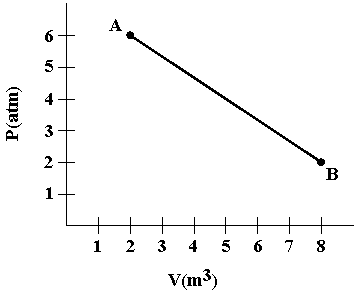
Background
Topic: Thermodynamics – Work Done by a Gas (PV Diagrams)
This question tests your understanding of how to calculate the work done by a gas during a thermodynamic process, specifically by interpreting a pressure-volume (PV) diagram.
Key Terms and Formulas
Work done by a gas (W): The area under the curve on a PV diagram between two states.
Formula for work (for a straight line on a PV diagram):
For a straight line (linear change in P and V):
= Pressure and volume at point A
= Pressure and volume at point B
1 atm = N/m2
Step-by-Step Guidance
Read the values for pressure and volume at points A and B from the graph. Make sure to note the units (atm for pressure, m3 for volume).
Convert the pressures from atm to pascals (N/m2) using the conversion factor: .
Calculate the change in volume: .
Apply the formula for the work done during a linear process: , making sure all units are in SI (Pascals for pressure, m3 for volume).
Set up the calculation with the converted values, but stop before plugging in the final numbers and computing the result.
Try solving on your own before revealing the answer!
Final Answer: J
Using the formula and converting all units to SI, you find the area under the straight line on the PV diagram, which gives the work done by the gas during this process.
