 Indietro
Projectile Motion: Physics with Calculus Study Notes
Guida di studio - Note intelligenti
 Appunti personalizzati basati sui tuoi materiali, ampliati con definizioni chiave, esempi e contesto.
Projectile Motion
Introduction to Projectile Motion
Projectile motion describes the movement of objects that are launched into the air and are influenced only by gravity (and air resistance, if present). The path followed by a projectile is a combination of constant horizontal velocity and accelerated vertical motion due to gravity. Understanding projectile motion requires separating the motion into horizontal and vertical components.
Vector and Scalar Quantities
Physical quantities can be classified as either vectors or scalars. This distinction is fundamental in physics, especially when analyzing motion.
Vector Quantity: Requires both magnitude and direction for a complete description. Examples include velocity, acceleration, and momentum.
Scalar Quantity: Described only by magnitude. Examples include mass, volume, and time.
Operations: Scalars can be added, subtracted, multiplied, and divided like ordinary numbers. Vectors require vector addition rules.
Example: 10 kg to the north is a vector; 10 kg is a scalar.
Velocity Vectors
Velocity is a vector quantity, and the resultant velocity is found by combining two or more velocity vectors. When vectors are perpendicular, the resultant is the diagonal of the rectangle formed by the vectors.
Resultant Vector: The sum of two or more vectors.
Perpendicular Vectors: The resultant is calculated using the Pythagorean theorem.
Scale Drawing: Vectors can be represented graphically using a scale (e.g., 1 cm = 20 km/h).

Formula: For two perpendicular vectors of magnitude a and b, the resultant is:
Example: An airplane flying north at 80 km/h in a 60 km/h crosswind has a resultant speed of 100 km/h relative to the ground.
Components of Vectors
Any vector can be resolved into two perpendicular components, typically horizontal (x) and vertical (y). These components are independent of each other and are useful for analyzing projectile motion.
Resolution: The process of breaking a vector into its components.
Component Vectors: Two vectors at right angles that add up to the original vector.
Independence: The horizontal and vertical components do not affect each other.
Formula: For a vector V at angle θ:
Projectile Motion Components
Projectile motion can be separated into horizontal and vertical components. The horizontal component is constant (assuming no air resistance), while the vertical component is affected by gravity.
Horizontal Motion: Like a ball rolling on a frictionless surface; velocity is constant.
Vertical Motion: Like a freely falling object; velocity changes due to gravity.
Independence: The two components are independent and combine to produce the curved path of a projectile.


Projectiles Launched Horizontally
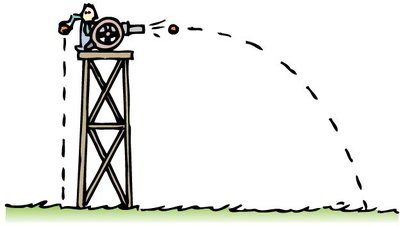
When a projectile is launched horizontally, its downward motion is identical to that of an object in free fall. The horizontal velocity remains constant, and the vertical velocity increases due to gravity.
Simultaneous Drop: Two balls released at the same time—one dropped, one launched horizontally—will hit the ground simultaneously.
Path: The path traced is a parabola when air resistance is negligible.
Projectiles Launched at an Angle
Projectiles launched at an angle follow a parabolic path. The vertical distance fallen below an ideal straight-line path is the same for equal times, regardless of the horizontal motion.
Vertical Distance: The vertical distance below the straight-line path is meters.
Velocity Components: The horizontal component remains constant; the vertical component changes due to gravity.
Maximum Range: Achieved at a launch angle of 45°.
Symmetry: The time to reach maximum height equals the time to descend.
Effect of Air Resistance: High-speed projectiles deviate from the ideal parabola.
Formula: For a projectile launched at speed v and angle θ:
Example: An object thrown at 60° and 30° with the same speed will have the same range.
Assessment Questions
Question | Answer |
|---|---|
Which of these expresses a vector quantity? | 10 m/s to the north |
An ultra-light aircraft traveling north at 40 km/h in a 30-km/h crosswind has a groundspeed of: | 50 km/h |
A ball launched at 45° to the horizontal initially has: | Equal horizontal and vertical components |
When no air resistance acts on a fast-moving baseball, its acceleration is: | Downward, g |
When no air resistance acts on a projectile, its horizontal acceleration is: | Zero |
Without air resistance, the time for a vertically tossed ball to return to where it was thrown is: | The same as the time going upward |
from the study notes, if your teacher gives the two “parts” (horizontal part and vertical part), you can just treat them as two separate 1D motions—no trig needed.
Given “parts” Horizontal part: the given constant horizontal velocity (often written as vₕ or “horizontal speed”)
Vertical part: the given initial vertical velocity (often written as vᵥ or “initial vertical speed”) Horizontal velocity (constant)
➡️ vₕ=constant Also from the notes: horizontal acceleration is zero, so the horizontal velocity does not change.
Horizontal distance 📏➡️ Δ h=vₕ t (plain text: horizontal distance = horizontal speed × time) Vertical motion (free-fall behavior)
⬆️⬇️ Acceleration: aᵥ=g downward (the notes state the acceleration is downward, g ) Vertical velocity changes due to gravity (notes: vertical motion is like a freely falling object)
Vertical distance fallen (from a straight-line path) ⬇️ from the notes: Δ v=5 t squared meters below the straight-line path (plain text: vertical distance fallen = 5 t^2 meters) Helpful timing fact (symmetry) ⏱️ from the notes: time up = time down (time to reach max height equals time to descend back to the same level)
