 Indietro
Rotational Motion: Physics with Calculus Study Notes
Guida di studio - Note intelligenti
 Appunti personalizzati basati sui tuoi materiali, ampliati con definizioni chiave, esempi e contesto.
Rotational Motion
Describing Circular and Rotational Motion
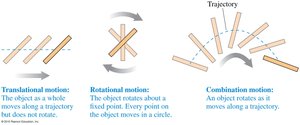
Rotational motion refers to the movement of objects that spin about an axis. This type of motion is fundamental in understanding the behavior of many physical systems, from wheels to planetary orbits.
Rotational motion: The object spins about a fixed axis.
Circular motion: Every point on the object moves in a circle around the axis.
Combination motion: An object rotates as it moves along a trajectory.
Angular Position
The angular position of a particle in circular motion is described by the angle θ, measured from the positive x-axis. The angle is positive when measured counterclockwise and negative when measured clockwise.
Angle θ: Describes the particle’s location.
Arc length (s): The distance traveled along the circular path.
Radius (r): The distance from the center of circular motion to the particle.
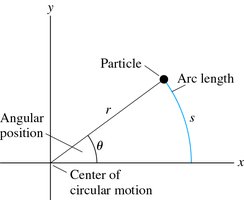
Angles are measured in radians (rad), not degrees. One radian is defined as the angle subtended by an arc length equal to the radius.
One revolution (rev) corresponds to radians or 360 degrees.
Conversion:
Angular Displacement and Angular Velocity
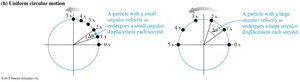
Angular displacement is the change in angular position, and angular velocity is the rate at which this displacement occurs. For uniform circular motion, angular velocity is constant.
Angular displacement:
Angular velocity: (in rad/s)
Angular speed: The absolute value of angular velocity.
Period (T): Time for one revolution.
Frequency (f): Number of revolutions per second.
Relating Linear Speed and Angular Speed
Points farther from the axis of rotation move at higher linear speeds. The linear speed (v) at any point is related to the angular speed (ω) by:
Angular speed must be in units of rad/s.

The Rotation of a Rigid Body
Rigid Body Rotation
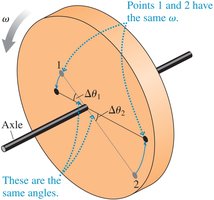
In a rigid body, every point rotates with the same angular velocity, but points at different distances from the axis have different linear speeds.
All points share the same angular velocity ().
Linear speed increases with distance from the axis.
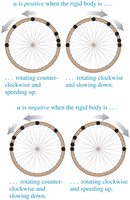
Angular Acceleration
Angular acceleration () is the rate of change of angular velocity. It is measured in rad/s².
Positive : Rotating counterclockwise and speeding up, or clockwise and slowing down.
Negative : Rotating clockwise and speeding up, or counterclockwise and slowing down.
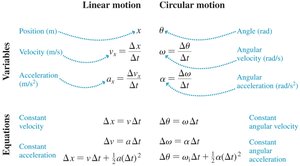
Synthesis: Linear and Circular Motion
Variables and equations for linear motion have direct analogs in circular motion.
Position: (linear), (angular)
Velocity: (linear), (angular)
Acceleration: (linear), (angular)
A high-speed drill rotating counterclockwise takes 2.5 s to
speed up to 2400 rpm.
A. What is the drill’s angular acceleration?
B. How many revolutions does it make as it reaches top
speed?
Linear Motion | Circular Motion |
|---|---|
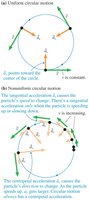
Tangential Acceleration
Tangential acceleration is the component of acceleration directed tangentially to the circle, measuring the rate at which the particle’s speed around the circle increases.
Relates tangential acceleration to angular acceleration.
Torque
Definition and Calculation of Torque
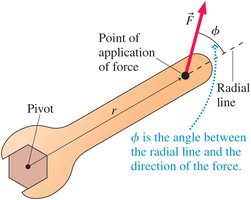
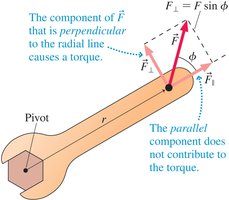
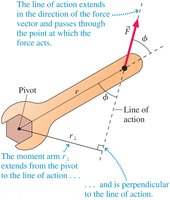
Torque is the rotational equivalent of force. It depends on the magnitude of the force, the distance from the pivot, and the angle at which the force is applied.
Units: newton-meters (N·m)
Moment arm: Perpendicular distance from the line of action to the pivot.
Net Torque
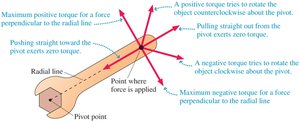
The net torque is the sum of the torques due to all applied forces. Torques that rotate the object counterclockwise are positive; clockwise torques are negative.
Example: Force in Turning a Capstan
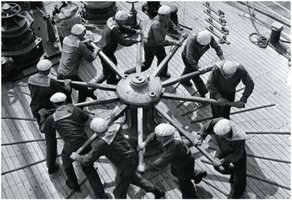
When turning a capstan, the net torque must be zero for constant speed. The force applied by the sailor is one-seventh the force exerted by the rope, due to the longer lever arm.
Torque due to rope:
Torque due to sailor:
Net torque:
Gravitational Torque and the Center of Gravity
Gravitational Torque
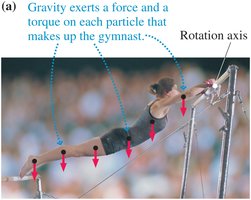
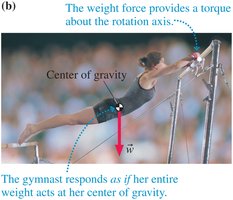
Gravity exerts a force and a torque on every particle of an object. The net gravitational torque can be calculated by assuming the weight acts at the center of gravity.
Center of gravity: Point where the net force of gravity acts.
Gravitational torque:
Example: Gravitational Torque on a Flagpole
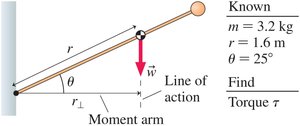
The torque is calculated using the moment arm and the weight of the flagpole acting at its center of gravity.
Moment arm:
Torque:
Calculating the Center of Gravity
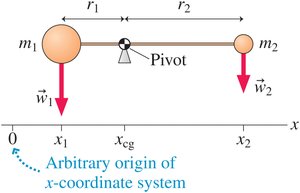
The center of gravity is found by balancing torques on either side of the pivot. It depends on the mass and distance of each particle from the pivot.
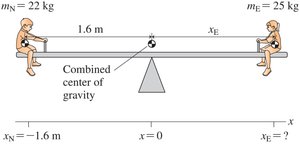
Example: Balancing a Seesaw
To balance a seesaw, the combined center of gravity of the children must be at the pivot. The heavier child sits closer to the pivot.
Balance condition:
Rotational Dynamics and Moment of Inertia
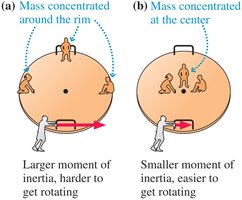
Moment of Inertia
The moment of inertia (I) is the rotational equivalent of mass. It depends on both the mass and its distribution relative to the axis of rotation.
Objects with mass farther from the axis have higher moment of inertia.
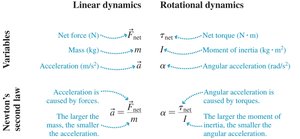
Newton’s Second Law for Rotational Motion
Newton’s second law for rotation states that a net torque causes angular acceleration, proportional to the moment of inertia.
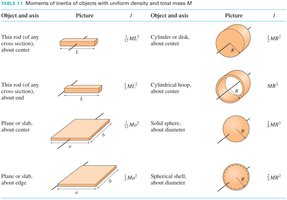
Moments of Inertia of Common Shapes
Different shapes have characteristic moments of inertia, depending on their mass and geometry.
Object and Axis | Moment of Inertia (I) |
|---|---|
Thin rod, center | |
Cylinder or disk, center | |
Solid sphere, diameter | |
Spherical shell, diameter |
Rolling Motion
Rolling Without Slipping
Rolling motion is a combination of rotation and translation. For rolling without slipping, the velocity of the object’s center is linked to its angular velocity.
The point at the bottom of the wheel is instantaneously at rest.
Example: Rotating Your Tires
When driving, the frequency of tire rotation and the speed of points on the tire can be calculated using rolling motion equations.
Angular speed:
Frequency:
Speed at top of tire:
