 Indietro
Traveling Waves: Properties, Mathematics, and Applications
Guida di studio - Note intelligenti
 Appunti personalizzati basati sui tuoi materiali, ampliati con definizioni chiave, esempi e contesto.
Traveling Waves
Introduction to Traveling Waves
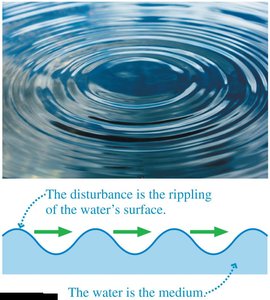
Traveling waves are organized disturbances that move through a medium, transferring energy from one location to another without transporting matter. The study of traveling waves is fundamental in physics, as it applies to mechanical, sound, and electromagnetic waves.
Wave Model: A wave is an organized disturbance that travels with a well-defined speed through a medium.
Medium: The substance through or along which the wave moves (e.g., water, air, string).
Mechanical Waves: Require a medium to propagate, such as sound waves in air or waves on a string.
Examples: Water waves, sound waves, and waves on a string.
Types of Waves
Transverse and Longitudinal Waves
Waves are classified based on the direction of particle displacement relative to the direction of wave propagation.
Transverse Waves: The displacement of the medium is perpendicular to the direction of wave travel. Example: waves on a string.
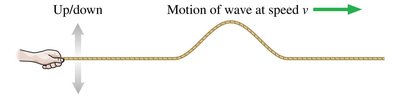
Longitudinal Waves: The displacement of the medium is parallel to the direction of wave travel. Example: sound waves in air, compressions and rarefactions in a spring.

Wave Speed and Medium Properties
Wave Speed on a String
The speed of a wave on a stretched string depends on the tension in the string and its linear mass density.
Wave Speed Formula:

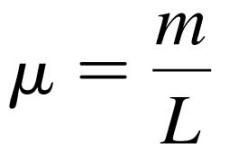
Linear Density: , where is the mass and is the length of the string.
Key Point: Wave speed depends only on the properties of the medium (tension and mass density), not on the amplitude of the wave.
Wave Graphs and Descriptions
Snapshot and History Graphs
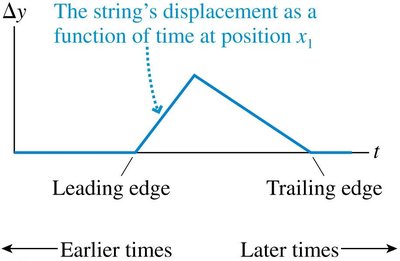
Waves can be described using graphs that show displacement as a function of position (snapshot) or time (history).
Snapshot Graph: Shows the wave's displacement as a function of position at a single instant in time.
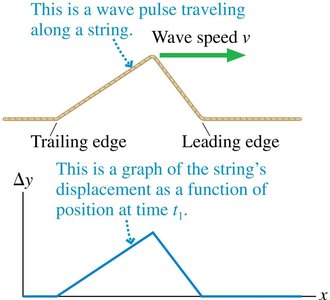
History Graph: Shows the displacement of a single point in the medium as a function of time.
Sinusoidal Waves
Mathematical Description
Sinusoidal waves are a common and important type of wave, described mathematically by sine or cosine functions.
General Equation (positive x-direction):
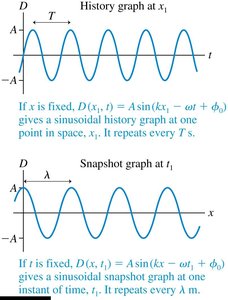
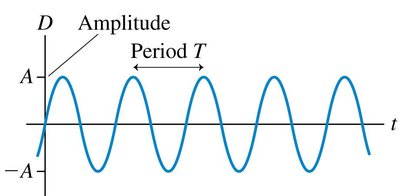
Amplitude (A): Maximum displacement from equilibrium.
Wavelength (\(\lambda\)): Distance over which the wave's shape repeats.
Period (T): Time for one complete cycle at a fixed point.
Frequency (f): Number of cycles per second, .
Wave Number (k):
Angular Frequency (\(\omega\)):
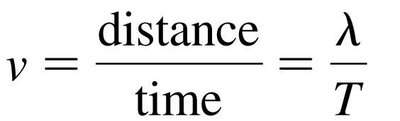
Wave Speed:
Wave Motion and Particle Motion
Velocity and Acceleration of Particles
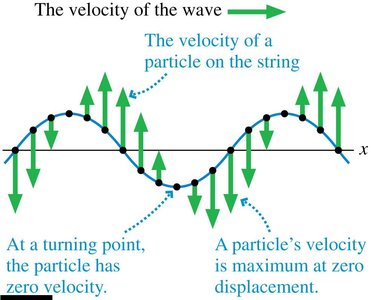
As a wave passes, each particle in the medium oscillates about its equilibrium position. The velocity and acceleration of these particles can be found by differentiating the displacement function.
Particle Velocity:
Particle Acceleration:
Waves in Two and Three Dimensions
Circular and Spherical Waves
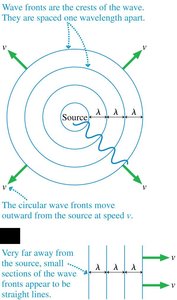
Waves can propagate in more than one dimension, forming circular or spherical wave fronts.
Wave Fronts: Lines or surfaces of constant phase, such as the crests of water waves.
Far from the source: Spherical or circular wave fronts appear as plane waves.
Phase and Phase Difference
Understanding Phase
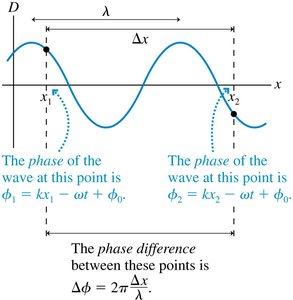
The phase of a wave at a point describes the state of oscillation. The phase difference between two points depends on their separation and the wavelength.
Phase:
Phase Difference:
Sound Waves
Nature of Sound Waves
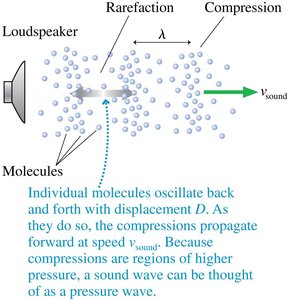
Sound waves are longitudinal mechanical waves that propagate through a medium by compressions and rarefactions.
Displacement: Particles oscillate parallel to the direction of wave travel.
Pressure Variation: Sound waves cause periodic variations in pressure.
Speed of Sound: In air at 20°C, m/s.
Electromagnetic Waves
Properties of Electromagnetic Waves
Electromagnetic waves, such as light, are oscillations of electric and magnetic fields that do not require a medium and travel at the speed of light in a vacuum.
Speed of Light: m/s in vacuum.
Electromagnetic Spectrum: Includes radio waves, microwaves, visible light, ultraviolet, etc.
Power, Intensity, and Decibels
Wave Power and Intensity
The power of a wave is the rate at which it transfers energy. Intensity is the power per unit area.
Intensity of Spherical Waves: , where is power and is distance from the source.
Sound Intensity Level (Decibels): , where W/m².
The Doppler Effect
Frequency Change Due to Motion
The Doppler effect is the apparent change in frequency or wavelength of a wave due to the relative motion of the source and observer.
General Formula:
Applications: Used in radar, medical imaging, and astronomy.
Summary Table: Key Wave Quantities
Quantity | Symbol | Formula | Units |
|---|---|---|---|
Wave Speed | v | m/s | |
Wavelength | m | ||
Frequency | f | Hz | |
Period | T | s | |
Wave Number | k | rad/m | |
Angular Frequency | rad/s |
Additional info: This guide covers the essential concepts, mathematical descriptions, and applications of traveling waves, including both mechanical and electromagnetic waves, as well as the Doppler effect and sound intensity.
