 Indietro
Vectors and Coordinate Systems: Physics with Calculus Study Notes
Guida di studio - Note intelligenti
 Appunti personalizzati basati sui tuoi materiali, ampliati con definizioni chiave, esempi e contesto.
Vectors and Coordinate Systems
Introduction to Scalars and Vectors
In physics, quantities are classified as either scalars or vectors. Scalars are described by a single number (magnitude) and have no direction, while vectors have both magnitude and direction. Understanding vectors is essential for describing motion and forces in physics.
Scalar Quantity: Defined by magnitude only (e.g., mass, temperature, volume).
Vector Quantity: Defined by both magnitude and direction (e.g., displacement, velocity, acceleration).
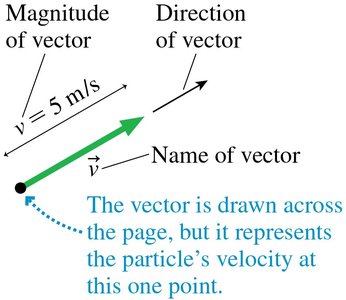
Geometric Representation: Vectors are represented as arrows; the length indicates magnitude, and the arrowhead indicates direction.
Notation: Vectors are denoted with an arrow above the letter, such as for position, for velocity, and for acceleration.
Properties of Vectors
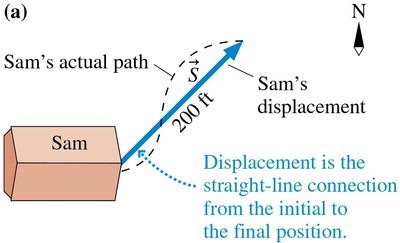
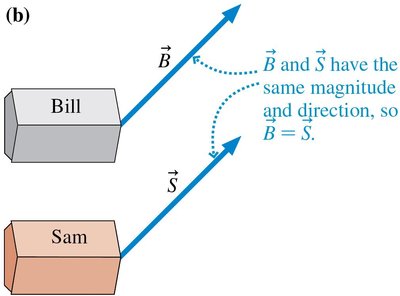
Vectors are characterized by their magnitude and direction, regardless of their initial position. Two vectors are equal if they have the same magnitude and direction, even if they start from different points.
Displacement Example: If Sam walks 200 ft northeast, his displacement vector is .
Magnitude: .
Equality of Vectors: If Bill also walks 200 ft northeast, .
Vector Addition
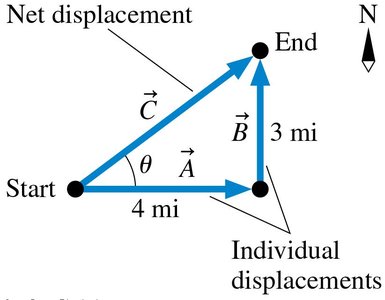
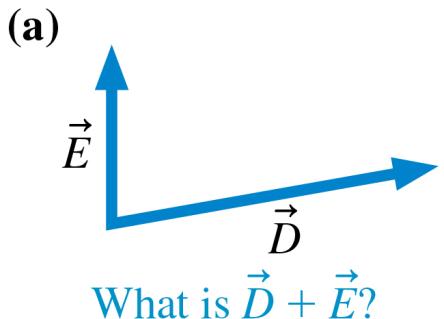
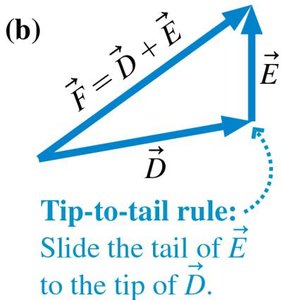
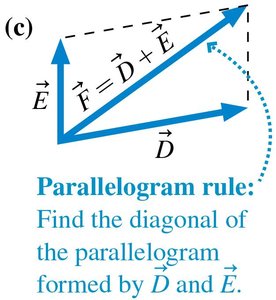
Vectors can be added graphically or algebraically. The tip-to-tail method and the parallelogram rule are common graphical techniques. When vectors are perpendicular, the Pythagorean theorem is used to find the resultant magnitude.
Tip-to-Tail Method: Place the tail of the second vector at the tip of the first; the resultant vector is from the tail of the first to the tip of the last.
Pythagorean Theorem: For vectors and at right angles, .
Direction: , where is the angle of the resultant vector.
Graphical Methods for Vector Addition
Tip-to-Tail Rule: Slide vectors so the tail of each follows the tip of the previous.
Parallelogram Rule: Place vectors with tails together; the diagonal of the parallelogram formed is the resultant.
Addition of More Than Two Vectors
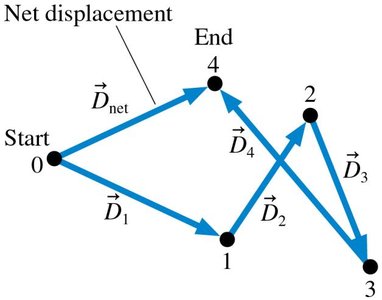
Vector addition can be extended to any number of vectors by repeated application of the tip-to-tail method. The net displacement is the vector from the initial to the final position.
Net Displacement:
More Vector Mathematics
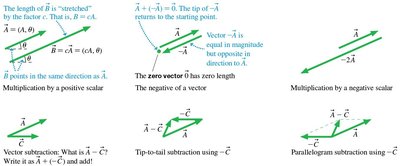
Vectors can be multiplied by scalars, subtracted, or reversed in direction. The zero vector has zero magnitude and no direction.
Multiplication by Scalar: stretches or shrinks by factor .
Negative Vector: has the same magnitude as but opposite direction.
Vector Subtraction: is equivalent to .
Coordinate Systems and Vector Components
Coordinate Systems
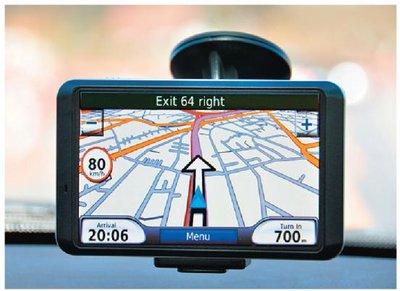
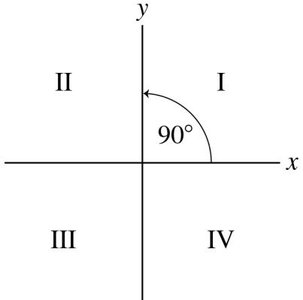
A coordinate system is a grid imposed on a problem to specify positions and directions. The origin and orientation of axes can be chosen for convenience. The most common is the Cartesian (x, y) system, divided into four quadrants.
Origin: The reference point (0,0).
Axes Orientation: Axes are perpendicular; x is usually horizontal, y is vertical.
Component Vectors and Decomposition
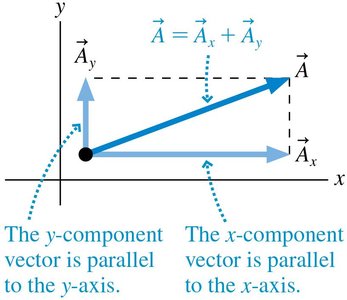
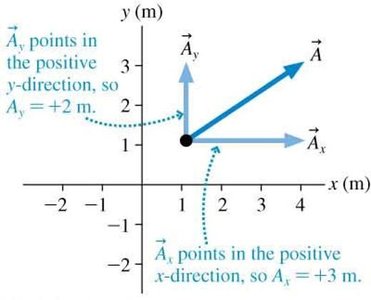
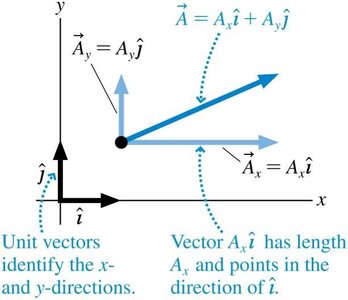
Any vector can be decomposed into two perpendicular components, parallel to the coordinate axes. This process simplifies calculations and is fundamental in physics problem-solving.
Component Vectors:
Decomposition: Breaking a vector into its x- and y-components.
Determining Vector Components
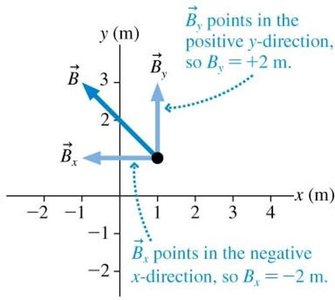
The components of a vector describe its projection along the axes. The sign of each component indicates direction relative to the axis.
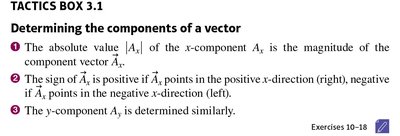
Component: The magnitude and sign of the projection along an axis.
Positive/Negative: Positive if pointing in the positive axis direction, negative otherwise.
Moving Between Geometric and Component Representations
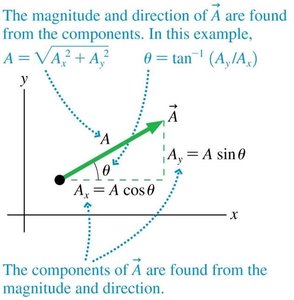
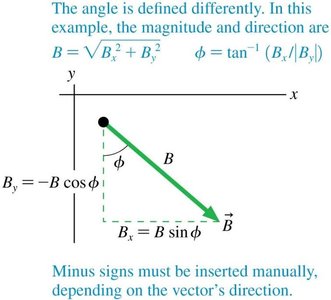
Vectors can be described by their magnitude and direction (geometric) or by their components. The conversion uses trigonometric relationships.
From Components to Magnitude and Direction:
From Magnitude and Direction to Components:
Minus signs must be inserted manually if the vector points left or down.
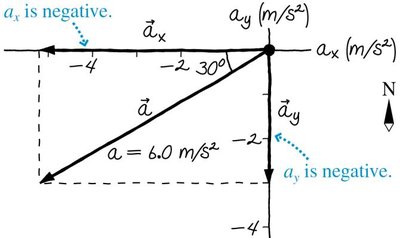
Example: Finding Components of an Acceleration Vector
Given an acceleration vector , the x- and y-components are found using trigonometry and sign conventions.
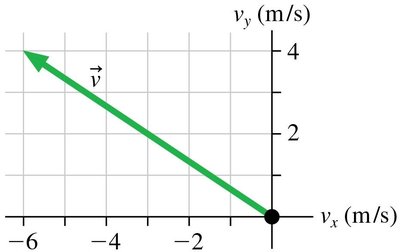
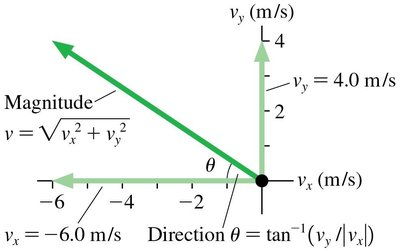
Example: Finding the Direction of Motion
Given velocity components and , the speed and direction are:
above the negative x-axis
Unit Vectors and Vector Algebra
Unit Vectors
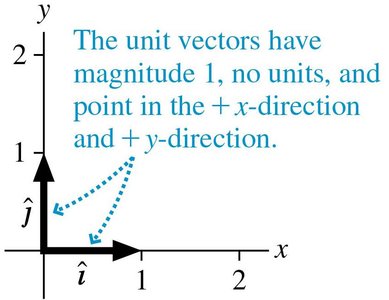
Unit vectors have magnitude 1 and no units. They indicate direction along the axes and are denoted as (x-direction) and (y-direction).
Expressing Vectors with Unit Vectors
Vectors can be written as a sum of their components multiplied by unit vectors:
Algebraic Vector Operations
Vector addition, subtraction, and scalar multiplication can be performed algebraically by operating on the components:
Addition: ,
Subtraction: ,
Scalar Multiplication: ,
Tilted Axes and Arbitrary Directions
Sometimes, it is useful to tilt the coordinate axes to align with a surface or direction of interest. The axes remain perpendicular, but are not necessarily horizontal and vertical. This approach simplifies the analysis of forces and motion along inclined planes or other arbitrary directions.
Summary Table: Vector Operations
Operation | Equation | Description |
|---|---|---|
Addition | Tip-to-tail or parallelogram rule | |
Subtraction | Add the negative of | |
Scalar Multiplication | Stretches or shrinks by | |
Component Form | Expresses vector in terms of components |
Key Equations
Magnitude from Components:
Direction from Components:
Components from Magnitude and Direction:
Additional info: These notes cover the essential concepts of vectors and coordinate systems, including graphical and algebraic methods, decomposition, and the use of unit vectors. Mastery of these topics is foundational for all subsequent topics in calculus-based physics.
