 Indietro
Work and Energy in Electrostatics: Structured Study Notes
Guida di studio - Note intelligenti
 Appunti personalizzati basati sui tuoi materiali, ampliati con definizioni chiave, esempi e contesto.
Chapter 25: Work and Energy in Electrostatics
Section 25.1: Electric Potential Energy
Electric potential energy is the energy stored in a system of electric charges due to their positions relative to each other. This concept is analogous to gravitational potential energy, where the configuration of masses determines the energy stored.
Definition: Electric potential energy is the energy associated with the configuration of charged objects in an electric field.
Stable Configurations: Charges move spontaneously to configurations with lower potential energy, which are more stable.
Attractive vs. Repulsive Cases: The change in potential energy depends on whether the interaction is attractive or repulsive.
Example: Movement of a charge near a sheet of charge alters the system's potential energy.
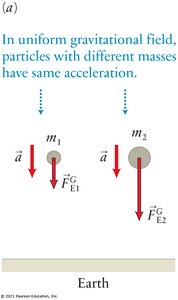
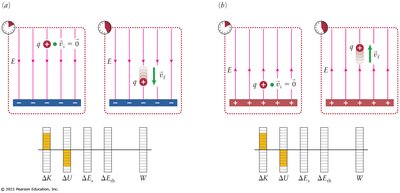
Checkpoint 25.1: Kinetic Energy and Acceleration of Charged Particles
When two particles are released from rest and interact only via electric forces:
Kinetic Energy Comparison: If both particles undergo the same displacement, their kinetic energies are equal because the work done by the electric force is the same for both.
Acceleration Adjustment: To make their accelerations equal, the ratio of their charges must match the ratio of their masses: .
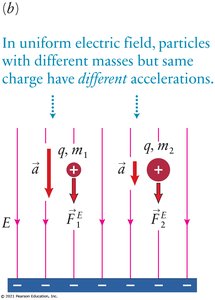
Section 25.2: Electrostatic Work
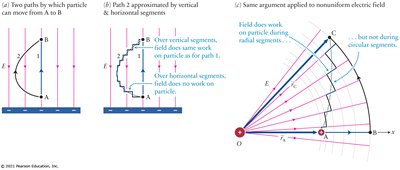
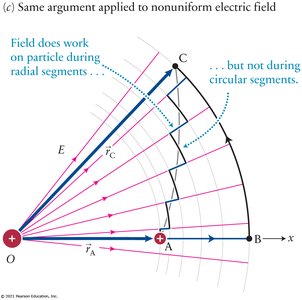
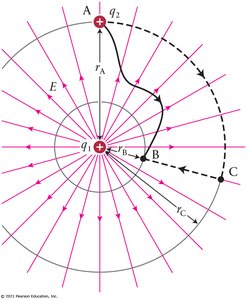
Electrostatic work is the work done by an electric field on a charged particle as it moves from one point to another. This work is independent of the path taken and depends only on the endpoints.
Path Independence: The work done by the electrostatic field is a function of the initial and final positions, not the trajectory.
Work Formula:
Closed Path: The work done around a closed path in an electrostatic field is zero.
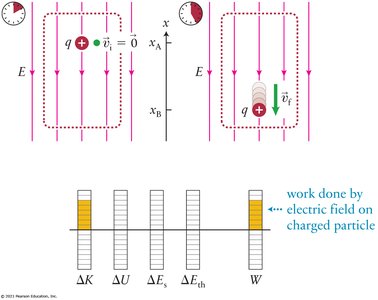
Section 25.3: Equipotentials
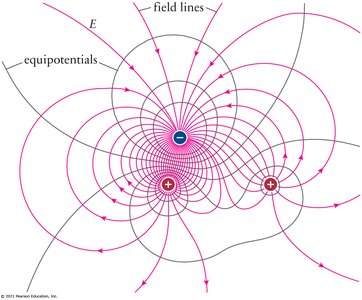
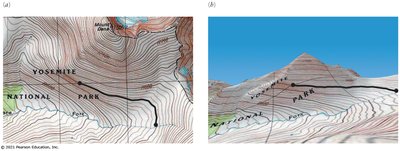
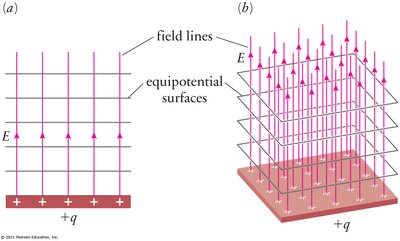
Equipotential lines and surfaces are regions where the electric potential is constant. Moving a charge along an equipotential requires no work.
Definition: Equipotential lines are lines along which the electrostatic potential does not change.
Properties:
Equipotential surfaces are perpendicular to electric field lines.
Electric field points from higher to lower potential.
Positively charged particles move toward lower potential; negatively charged particles move toward higher potential.
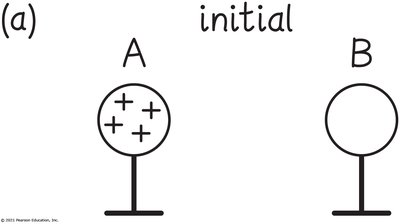
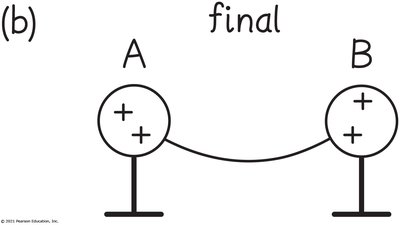
Example: Spheres connected by a wire reach electrostatic equilibrium, forming an equipotential.
Section 25.4: Calculating Work and Energy in Electrostatics
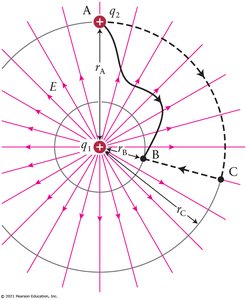
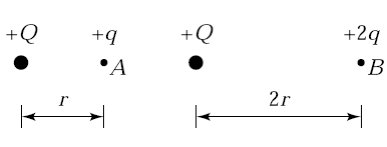
Work and energy calculations in electrostatics use Coulomb's law and the concept of potential energy. The work done is independent of the path and depends only on the initial and final positions.
Work Formula:
Potential Energy Change:
Potential Energy at Infinite Separation: for
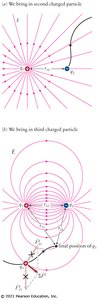
Generalization for Multiple Charges: Use the superposition principle to sum contributions from all pairs.
Section 25.5: Potential Difference
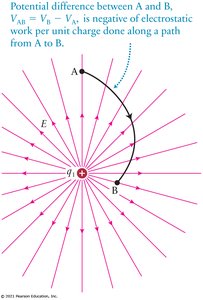
The potential difference between two points is the negative of the electrostatic work per unit charge done on a charged particle moving between those points. Potential difference is a scalar quantity measured in volts (V).
Definition:
Units: 1 V = 1 J/C
Reference Points: Infinity is often chosen as the reference for potential in systems of charged particles; ground is used for circuits.
Potential Formula for Point Charge:
Potential Difference in Uniform Field:
Section 25.6: Electrostatic Potentials of Continuous Charge Distributions
For extended objects with continuous charge distributions, the electrostatic potential is calculated by integrating over the entire object.
Procedure:
Sketch the charge distribution and divide it into infinitesimal segments.
Choose appropriate coordinates for integration.
Express the distance between each segment and the point of interest.
Integrate using the charge density and geometry.
Example: Potential at a point due to a charged rod or disk.
Section 25.7: Obtaining the Electric Field From the Potential
The electric field can be derived from the electrostatic potential by taking the negative gradient (partial derivatives) of the potential function.
Formulas:
Application: Use the potential function to find the electric field in various configurations, such as between parallel plates or along the axis of a dipole.
Concept | Formula | Notes |
|---|---|---|
Work in Electrostatics | Path independent | |
Potential Energy (2 charges) | Zero at infinite separation | |
Potential Difference | Scalar field | |
Electric Field from Potential | Partial derivatives in Cartesian coordinates |
Additional info: These notes expand on brief points and diagrams, providing full academic context, definitions, and step-by-step procedures for calculations. All included images directly reinforce the explanations and are referenced in the relevant paragraphs.
