Ch. 02 - Describing Motion: Kinematics in One Dimension
Giancoli Douglas - Physics for Scientists and Engineers 5th edition
Giancoli Douglas5th editionPhysics for Scientists and EngineersISBN: 9780137488179Non è quello che usi tu?Cambia libro di testo
Capitolo 2, Problema 97a

A parachutist bails out of an airplane, and freely falls 75 m (ignore air friction). Then the parachute opens, and her acceleration is ― 1.5 m/s² (up). The parachutist reaches the ground with a speed of 1.5 m/s. From how high did she bail out of the plane?

Guida verificata passo dopo passo
1
Step 1: Break the problem into two phases: (1) free fall before the parachute opens, and (2) motion with the parachute open. Use kinematic equations to analyze each phase separately.
Step 2: For the free-fall phase, use the kinematic equation: vf2 = vi + 2gd, where vi is the initial velocity (0 m/s), g is the acceleration due to gravity (9.8 m/s²), and d is the distance fallen (75 m). Solve for the final velocity vf at the end of the free-fall phase.
Step 3: For the parachute phase, use the kinematic equation: vf = vi + at, where vf is the final velocity (1.5 m/s), vi is the velocity at the start of this phase (calculated in Step 2), a is the acceleration (-1.5 m/s²), and t is the time. Solve for the time t during this phase.
Step 4: Use the kinematic equation: d = vit + rac{1}{2}at2 to calculate the distance fallen during the parachute phase. Add this distance to the 75 m from the free-fall phase to find the total distance fallen.
Step 5: Add the total distance fallen to the final height above the ground (1.5 m/s corresponds to the final velocity just before landing). This gives the total height from which the parachutist bailed out of the plane.

Risposta video verificata per un problema simile:

Questa soluzione video è stata consigliata dai nostri tutor come utile per risolvere questo problema.
Durata del video:
11m

Concetti chiave

Ecco i concetti essenziali che devi comprendere per rispondere correttamente alla domanda.

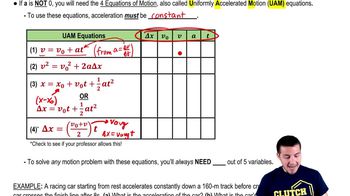
Kinematic Equations

Kinematic equations describe the motion of objects under constant acceleration. They relate displacement, initial velocity, final velocity, acceleration, and time. In this scenario, we can use these equations to determine the height from which the parachutist bailed out by considering her free fall and subsequent motion after the parachute opens.
Video consigliato:
Percorso guidato
08:25
Kinematics Equations

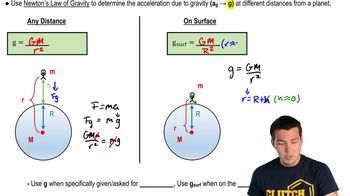
Acceleration due to Gravity

Acceleration due to gravity is the acceleration experienced by an object when it is in free fall near the Earth's surface, approximately 9.81 m/s² downward. In this problem, the parachutist falls freely for 75 m before the parachute opens, and understanding this acceleration is crucial for calculating the time of free fall and the height of the jump.
Video consigliato:
Percorso guidato
05:20
Acceleration Due to Gravity

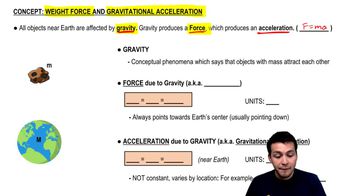
Net Force and Acceleration

The net force acting on an object determines its acceleration according to Newton's second law (F = ma). After the parachute opens, the parachutist experiences an upward acceleration of -1.5 m/s², indicating that the upward force from the parachute is less than the downward gravitational force. This concept is essential for analyzing the motion after the parachute deployment and calculating the total height of the fall.
Video consigliato:
Percorso guidato
07:32
Weight Force & Gravitational Acceleration
Pratica correlata
Domanda del libro di testo

Bill can throw a ball vertically at a speed 1.5 times faster than Joe can. How many times higher will Bill's ball go than Joe's?

2033
views

Domanda del libro di testo

A robot used in a pharmacy picks up a medicine bottle at t = 0. It accelerates at 0.20 m/s² for 4.5 s, then travels without acceleration for 68 s and finally decelerates at ―0.40 m/s² for 2.5 s to reach the counter where the pharmacist will take the medicine from the robot. From how far away did the robot fetch the medicine?

1369
views
Domanda del libro di testo

A police car at rest is passed by a speeder traveling at a constant 140 km/h. The police officer takes off in hot pursuit and catches up to the speeder in 850 m, maintaining a constant acceleration. Qualitatively plot the position vs. time graph for both cars from the police car's start to the catch-up point.

758
views
Domanda del libro di testo

Figure 2–55 shows the position vs. time graph for two bicycles, A and B. At which instant(s) are the bicycles passing each other? Which bicycle is passing the other?

1649
views
Domanda del libro di testo

Two children are playing on two trampolines. The first child bounces up one-and-a-half times higher than the second child. The initial speed upwards of the second child is 4.0 m/s. What is the initial speed of the first child?

1525
views
Domanda del libro di testo

Suppose a 65-kg person jumps from a height of 3.0 m down to the ground. What is the speed of the person just before landing (Chapter 2)?

<IMAGE>

1542
views