
Ch. 03 - Kinematics in Two or Three Dimensions; Vectors
Giancoli Douglas - Physics for Scientists and Engineers 5th edition
Giancoli Douglas5th editionPhysics for Scientists and EngineersISBN: 9780137488179Non è quello che usi tu?Cambia libro di testo
Capitolo 3, Problema 23a

A skier is accelerating down a 30.0° hill at 1.80 m/s² (Fig. 3–42). What is the vertical component of her acceleration?
<IMAGE>

Guida verificata passo dopo passo
1
Identify the given values: The acceleration of the skier down the hill is 1.80 m/s², and the angle of the hill with respect to the horizontal is 30.0°.
Understand the problem: The vertical component of the acceleration is the portion of the skier's acceleration that acts in the vertical direction (perpendicular to the horizontal). This can be determined using trigonometry.
Use the sine function to find the vertical component of the acceleration. The relationship is given by: avertical = atotal ⋅ sin(θ), where atotal is the total acceleration (1.80 m/s²) and θ is the angle of the hill (30.0°).
Substitute the known values into the equation: avertical = 1.80 ⋅ sin(30.0°). Note that the sine of 30.0° is a known trigonometric value.
Simplify the expression to find the vertical component of the acceleration. Ensure the units remain consistent (m/s²).

Risposta video verificata per un problema simile:

Questa soluzione video è stata consigliata dai nostri tutor come utile per risolvere questo problema.

Concetti chiave

Ecco i concetti essenziali che devi comprendere per rispondere correttamente alla domanda.

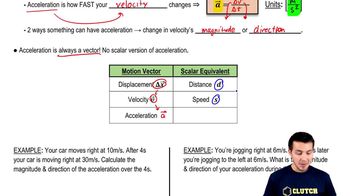
Acceleration

Acceleration is the rate of change of velocity of an object with respect to time. In this context, it refers to the skier's change in speed as she moves down the hill. The acceleration can be influenced by various factors, including gravity, friction, and the incline of the hill.
Video consigliato:
Percorso guidato
05:47
Intro to Acceleration

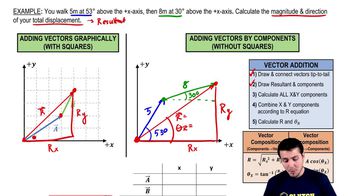
Components of Acceleration

When dealing with inclined planes, acceleration can be broken down into components: vertical and horizontal. The vertical component is influenced by gravity and the angle of the incline, while the horizontal component relates to the skier's movement along the slope. Understanding these components is essential for analyzing motion on an incline.
Video consigliato:
Percorso guidato
07:30
Vector Addition By Components

Trigonometric Functions

Trigonometric functions, such as sine and cosine, are used to relate the angles of a triangle to the ratios of its sides. In this scenario, the vertical component of the skier's acceleration can be calculated using the sine function, which helps determine how much of the total acceleration acts in the vertical direction based on the angle of the hill.
Video consigliato:
Percorso guidato
08:30
Intro to Wave Functions