An airplane is traveling 815 km/h in a direction 41.5° west of north (Fig. 3–40). Find the components of the velocity vector in the northerly and westerly directions.
Ch. 03 - Kinematics in Two or Three Dimensions; Vectors
Giancoli Douglas5th editionPhysics for Scientists and EngineersISBN: 9780137488179Non è quello che usi tu?Cambia libro di testo
Tutti i libri di testo
Giancoli Douglas 5th edition
Ch. 03 - Kinematics in Two or Three Dimensions; Vectors
Problema 17b
Giancoli Douglas 5th edition
Ch. 03 - Kinematics in Two or Three Dimensions; Vectors
Problema 17bCapitolo 3, Problema 17b
Two vectors, and , add to a resultant . Describe and if .
Guida verificata passo dopo passo1
Step 1: Recognize that the equation Vᵣ² = V₁² + V₂² resembles the Pythagorean theorem, which applies to right triangles. This suggests that the vectors V₁ and V₂ are perpendicular to each other.
Step 2: Understand that when two vectors are perpendicular, their resultant vector forms the hypotenuse of a right triangle, with the two vectors as the legs of the triangle.
Step 3: To confirm this, recall that the magnitude of the resultant vector Vᵣ is given by |Vᵣ| = √(V₁² + V₂²) when the vectors are perpendicular. Squaring both sides gives Vᵣ² = V₁² + V₂², which matches the given condition.
Step 4: Conclude that V₁ and V₂ must be at a 90° angle to each other for the given relationship Vᵣ² = V₁² + V₂² to hold true.
Step 5: If needed, represent the vectors graphically or mathematically to verify their perpendicularity, ensuring that the angle between them is indeed 90°.

Risposta video verificata per un problema simile:
Questa soluzione video è stata consigliata dai nostri tutor come utile per risolvere questo problema.
Durata del video:
2mConcetti chiave
Ecco i concetti essenziali che devi comprendere per rispondere correttamente alla domanda.
Vector Addition
Vector addition is the process of combining two or more vectors to produce a resultant vector. This involves adding the corresponding components of the vectors, which can be visualized graphically using the head-to-tail method. The resultant vector represents the cumulative effect of the individual vectors in both magnitude and direction.
Video consigliato:
Percorso guidato
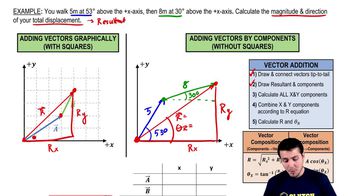
Vector Addition By Components
Pythagorean Theorem in Vector Context
The Pythagorean theorem states that in a right triangle, the square of the length of the hypotenuse is equal to the sum of the squares of the lengths of the other two sides. In the context of vectors, if two vectors are perpendicular, the magnitude of the resultant vector can be calculated using this theorem, leading to the equation Vᵣ² = V₁² + V₂².
Video consigliato:
Percorso guidato
Parallel Axis Theorem
Magnitude of a Vector
The magnitude of a vector is a measure of its length or size, regardless of its direction. It is calculated using the square root of the sum of the squares of its components. Understanding the magnitude is crucial for vector addition, especially when applying the Pythagorean theorem to find the resultant vector's length when vectors are orthogonal.
Video consigliato:
Percorso guidato
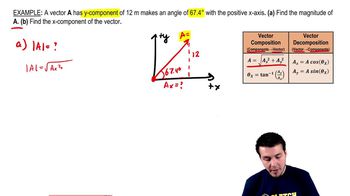
Calculating Magnitude & Components of a Vector
Pratica correlata
Domanda del libro di testo
2055
views
Domanda del libro di testo
A car is moving with speed 16.0 m/s due south at one moment and 25.7 m/s due east 8.00 s later. Over this time interval, determine the magnitude and direction of (a) its average velocity, (b) its average acceleration. (c) What is its average speed? [Hint: Can you determine all these from the information given?]
2176
views
Domanda del libro di testo
A skier is accelerating down a 30.0° hill at 1.80 m/s² (Fig. 3–42). What is the vertical component of her acceleration?
<IMAGE>
2085
views
Domanda del libro di testo
A skier is accelerating down a 30.0° hill at 1.80 m/s² (Fig. 3–42). How long will it take her to reach the bottom of the hill, assuming she starts from rest and accelerates uniformly, if the elevation change is 125 m?
<IMAGE>
1658
views