
Ch. 05 - Using Newton's Laws: Friction, Circular Motion, Drag Forces
Giancoli Douglas - Physics for Scientists and Engineers 5th edition
Giancoli Douglas5th editionPhysics for Scientists and EngineersISBN: 9780137488179Non è quello che usi tu?Cambia libro di testo
Capitolo 5, Problema 61

A pilot performs an evasive maneuver by diving vertically at a constant 310 m/s. If he can withstand an acceleration of 9.0 g’s without blacking out, at what altitude must he begin to pull his plane out of the dive (moving in a vertical circular path) to avoid crashing into the sea?

Guida verificata passo dopo passo
1
Identify the key variables in the problem: the speed of the plane \( v = 310 \; \text{m/s} \), the maximum acceleration the pilot can withstand \( a = 9.0g = 9.0 \times 9.8 \; \text{m/s}^2 \), and the goal is to find the minimum radius of the circular path \( r \) to avoid crashing into the sea.
Recall the formula for centripetal acceleration in circular motion: \( a_c = \frac{v^2}{r} \). Here, \( a_c \) is the centripetal acceleration, \( v \) is the speed, and \( r \) is the radius of the circular path.
Rearrange the formula to solve for the radius \( r \): \( r = \frac{v^2}{a_c} \). Substitute \( a_c = 9.0 \times 9.8 \; \text{m/s}^2 \) and \( v = 310 \; \text{m/s} \) into the equation.
Calculate the radius \( r \) using the substituted values. This radius represents the minimum distance from the center of the circular path to the plane. Since the plane is diving vertically, the altitude at which the pilot must begin pulling out of the dive is equal to this radius.
Interpret the result: The altitude at which the pilot must begin to pull out of the dive is equal to the calculated radius \( r \). This ensures the centripetal acceleration does not exceed the maximum tolerable acceleration of \( 9.0g \), preventing the pilot from blacking out and avoiding a crash into the sea.

Risposta video verificata per un problema simile:

Questa soluzione video è stata consigliata dai nostri tutor come utile per risolvere questo problema.
Durata del video:
2m

Concetti chiave

Ecco i concetti essenziali che devi comprendere per rispondere correttamente alla domanda.

Acceleration and G-Forces

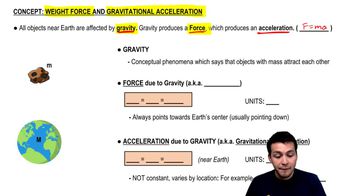
Acceleration is the rate of change of velocity of an object. In this context, the pilot can withstand an acceleration of 9.0 g's, where 'g' represents the acceleration due to Earth's gravity (approximately 9.81 m/s²). This means the pilot can endure an acceleration of about 88.29 m/s² before experiencing blackout, which is crucial for determining the safe altitude for the maneuver.
Video consigliato:
Percorso guidato
07:32
Weight Force & Gravitational Acceleration

Vertical Circular Motion

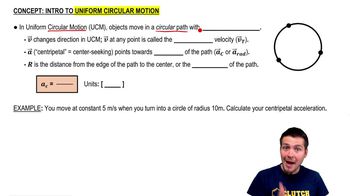
When an object moves in a vertical circular path, it experiences varying forces due to gravity and centripetal acceleration. As the pilot pulls out of the dive, the plane must generate enough lift to counteract the gravitational force and provide the necessary centripetal force to maintain the circular motion. Understanding the dynamics of vertical circular motion is essential for calculating the required altitude.
Video consigliato:
Percorso guidato
03:48
Intro to Circular Motion

Kinematics and Energy Conservation

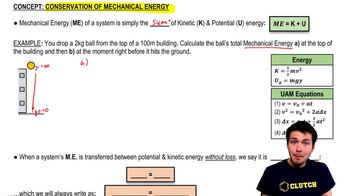
Kinematics involves the study of motion without considering the forces that cause it. In this scenario, energy conservation principles can be applied, where the kinetic energy of the plane at the bottom of the dive must be converted into potential energy as it ascends. This relationship helps determine the altitude needed to safely pull out of the dive without crashing.
Video consigliato:
Percorso guidato
06:24
Conservation Of Mechanical Energy
Pratica correlata
Domanda del libro di testo

On an ice rink two skaters of equal mass grab hands and spin in a mutual circle once every 2.5 s. If we assume their arms are each 0.80 m long and their individual masses are 55.0 kg, how hard are they pulling on one another?

1331
views
Domanda del libro di testo

The 70.0-kg climber in Fig. 5–53 is supported in the 'chimney' by the friction forces exerted on his shoes and back. The static coefficients of friction between his shoes and the wall, and between his back and the wall, are 0.80 and 0.60, respectively. What is the minimum normal force he must exert? Assume the walls are vertical and that the static friction forces are both at their maximum. Ignore his grip on the rope.

1406
views
Domanda del libro di testo

Tarzan plans to cross a gorge by swinging in an arc from a hanging vine (Fig. 5–50). If his arms are capable of exerting a force of 1350 N on the vine, what is the maximum speed he can tolerate at the lowest point of his swing? His mass is 78 kg and the vine is 4.8 m long.

1412
views
Domanda del libro di testo

A coffee cup on the horizontal dashboard of a car slides forward when the driver decelerates from 45 km/h to rest in 3.5 s or less, but not if she decelerates in a longer time. What is the coefficient of static friction between the cup and the dash? Assume the road and the dashboard are level (horizontal).

1631
views
Domanda del libro di testo

A jet plane traveling 1890 km/h (525 m/s) pulls out of a dive by moving in an arc of radius 4.80 km. What is the plane's acceleration in g's?

1570
views
Domanda del libro di testo

The position of a particle moving in the xy plane is given by r→\(\overrightarrow{r}\) = (2.0m) cos [(3.0 rad/s)t ] i^\(\hat{i}\) +(2.0m) sin [(3.0 rad/s)t ] j^\(\hat{j}\), where r is in meters and t is in seconds. Calculate the velocity and acceleration vectors as functions of time.

1711
views