Ch. 05 - Using Newton's Laws: Friction, Circular Motion, Drag Forces
Giancoli Douglas - Physics for Scientists and Engineers 5th edition
Giancoli Douglas5th editionPhysics for Scientists and EngineersISBN: 9780137488179Non è quello che usi tu?Cambia libro di testo
Capitolo 5, Problema 62b

The position of a particle moving in the xy plane is given by r→\(\overrightarrow{r}\) = (2.0m) cos [(3.0 rad/s)t ] i^\(\hat{i}\) +(2.0m) sin [(3.0 rad/s)t ] j^\(\hat{j}\), where r is in meters and t is in seconds. Calculate the velocity and acceleration vectors as functions of time.

Guida verificata passo dopo passo
1
Start by understanding the given position vector: \( \vec{r}(t) = (2.0 \text{ m}) \cos[(3.0 \text{ rad/s})t] \hat{i} + (2.0 \text{ m}) \sin[(3.0 \text{ rad/s})t] \hat{j} \). This describes the motion of the particle in the xy-plane as a function of time.
To find the velocity vector \( \vec{v}(t) \), take the time derivative of the position vector \( \vec{r}(t) \). Use the derivative rules for trigonometric functions: \( \frac{d}{dt}[\cos(\omega t)] = -\omega \sin(\omega t) \) and \( \frac{d}{dt}[\sin(\omega t)] = \omega \cos(\omega t) \).
Apply the derivative to each component of \( \vec{r}(t) \): \( \frac{d}{dt}[(2.0 \text{ m}) \cos(3.0t)] = -(2.0 \text{ m})(3.0 \text{ rad/s}) \sin(3.0t) \) for the \( \hat{i} \)-component, and \( \frac{d}{dt}[(2.0 \text{ m}) \sin(3.0t)] = (2.0 \text{ m})(3.0 \text{ rad/s}) \cos(3.0t) \) for the \( \hat{j} \)-component.
Combine the results to write the velocity vector: \( \vec{v}(t) = -(6.0 \text{ m/s}) \sin(3.0t) \hat{i} + (6.0 \text{ m/s}) \cos(3.0t) \hat{j} \).
To find the acceleration vector \( \vec{a}(t) \), take the time derivative of the velocity vector \( \vec{v}(t) \). Use the same derivative rules for trigonometric functions. For the \( \hat{i} \)-component, \( \frac{d}{dt}[-(6.0 \text{ m/s}) \sin(3.0t)] = -(6.0 \text{ m/s})(3.0 \text{ rad/s}) \cos(3.0t) \), and for the \( \hat{j} \)-component, \( \frac{d}{dt}[(6.0 \text{ m/s}) \cos(3.0t)] = -(6.0 \text{ m/s})(3.0 \text{ rad/s}) \sin(3.0t) \). Combine these to write \( \vec{a}(t) = -(18.0 \text{ m/s}^2) \cos(3.0t) \hat{i} - (18.0 \text{ m/s}^2) \sin(3.0t) \hat{j} \).

Risposta video verificata per un problema simile:

Questa soluzione video è stata consigliata dai nostri tutor come utile per risolvere questo problema.
Durata del video:
12m

Concetti chiave

Ecco i concetti essenziali che devi comprendere per rispondere correttamente alla domanda.

Position Vector

The position vector describes the location of a particle in space relative to a reference point. In this case, the position vector r→ is expressed in terms of its components along the x and y axes, using trigonometric functions to indicate circular motion. Understanding the position vector is crucial for deriving other motion-related quantities such as velocity and acceleration.
Video consigliato:
Percorso guidato
07:07
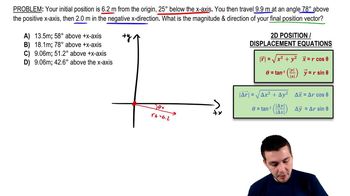
Final Position Vector

Velocity Vector

The velocity vector represents the rate of change of the position vector with respect to time. It is calculated by taking the derivative of the position vector r→ with respect to time t. In this scenario, the velocity will also exhibit a periodic nature due to the trigonometric functions involved, reflecting the particle's circular motion in the xy plane.
Video consigliato:
Percorso guidato
06:44
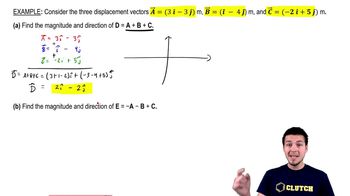
Adding 3 Vectors in Unit Vector Notation

Acceleration Vector

The acceleration vector indicates the rate of change of the velocity vector with respect to time. It is obtained by differentiating the velocity vector. For a particle in circular motion, the acceleration can be both tangential and centripetal, and understanding its components is essential for analyzing the dynamics of the particle's motion in the xy plane.
Video consigliato:
Percorso guidato
06:44
Adding 3 Vectors in Unit Vector Notation
Pratica correlata
Domanda del libro di testo

A train traveling at a constant speed rounds a curve of radius 215 m. A lamp suspended from the ceiling swings out to an angle of 18.5° throughout the curve. What is the speed of the train? [Hint: See Example 4–15.]

1456
views
Domanda del libro di testo

On an ice rink two skaters of equal mass grab hands and spin in a mutual circle once every 2.5 s. If we assume their arms are each 0.80 m long and their individual masses are 55.0 kg, how hard are they pulling on one another?

1331
views
Domanda del libro di testo

The 70.0-kg climber in Fig. 5–53 is supported in the 'chimney' by the friction forces exerted on his shoes and back. The static coefficients of friction between his shoes and the wall, and between his back and the wall, are 0.80 and 0.60, respectively. What is the minimum normal force he must exert? Assume the walls are vertical and that the static friction forces are both at their maximum. Ignore his grip on the rope.

1406
views
Domanda del libro di testo

Tarzan plans to cross a gorge by swinging in an arc from a hanging vine (Fig. 5–50). If his arms are capable of exerting a force of 1350 N on the vine, what is the maximum speed he can tolerate at the lowest point of his swing? His mass is 78 kg and the vine is 4.8 m long.

1412
views
Domanda del libro di testo

A coffee cup on the horizontal dashboard of a car slides forward when the driver decelerates from 45 km/h to rest in 3.5 s or less, but not if she decelerates in a longer time. What is the coefficient of static friction between the cup and the dash? Assume the road and the dashboard are level (horizontal).

1631
views
Domanda del libro di testo

A pilot performs an evasive maneuver by diving vertically at a constant 310 m/s. If he can withstand an acceleration of 9.0 g’s without blacking out, at what altitude must he begin to pull his plane out of the dive (moving in a vertical circular path) to avoid crashing into the sea?

1420
views