
Ch. 06 - Gravitation and Newton's Synthesis
Giancoli Douglas - Physics for Scientists and Engineers 5th edition
Giancoli Douglas5th editionPhysics for Scientists and EngineersISBN: 9780137488179Non è quello che usi tu?Cambia libro di testo
Capitolo 6, Problema 79

A particle is released at a height rE (radius of Earth) above the Earth’s surface. Determine its velocity when it hits the Earth. Ignore air resistance. [Hint: Use Newton’s second law, the law of universal gravitation, the chain rule, and integrate.]

Guida verificata passo dopo passo
1
Start by identifying the forces acting on the particle. The only force acting is the gravitational force, given by Newton's law of universal gravitation: F=GmMr2, where G is the gravitational constant, m is the mass of the particle, M is the mass of the Earth, and r is the distance from the center of the Earth to the particle.
Apply Newton's second law, F=ma, where a is the acceleration. Substituting the gravitational force, we get: ma=GmMr2. Cancel out m (the mass of the particle) to find the acceleration: a=GMr2.
Use the chain rule to relate acceleration to velocity and position: a=dvdt and vdrdt. Substituting, we get: a=vdvdr. Replace a with the gravitational acceleration: vdvdr=GMr2.
Integrate both sides to find the velocity. On the left, integrate with respect to v: ∫0vvdv, and on the right, integrate with respect to r: ∫rErGMr2dr. Solve these integrals to find the relationship between v and r.
After integration, use the limits of integration to evaluate the constants. The result will give the velocity v as a function of the initial height rE and the Earth's radius. This velocity represents the speed of the particle just before it hits the Earth's surface.

Risposta video verificata per un problema simile:

Questa soluzione video è stata consigliata dai nostri tutor come utile per risolvere questo problema.
Durata del video:
10m

Concetti chiave

Ecco i concetti essenziali che devi comprendere per rispondere correttamente alla domanda.

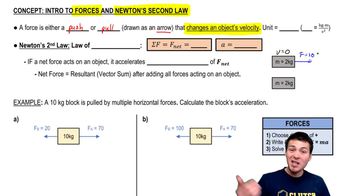
Newton's Second Law

Newton's Second Law states that the force acting on an object is equal to the mass of that object multiplied by its acceleration (F = ma). This principle is fundamental in analyzing the motion of the particle as it falls towards Earth, allowing us to relate the gravitational force to the particle's acceleration and ultimately its velocity.
Video consigliato:
Percorso guidato
06:54
Intro to Forces & Newton's Second Law

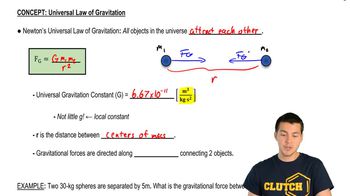
Law of Universal Gravitation

The Law of Universal Gravitation, formulated by Isaac Newton, states that every mass attracts every other mass with a force that is directly proportional to the product of their masses and inversely proportional to the square of the distance between their centers. This law is crucial for determining the gravitational force acting on the particle as it falls from a height above the Earth's surface.
Video consigliato:
Percorso guidato
04:05
Universal Law of Gravitation

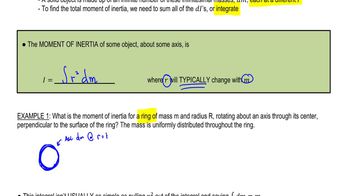
Integration and the Chain Rule

Integration is a mathematical process used to find the total accumulation of a quantity, such as velocity from acceleration. The chain rule is a fundamental technique in calculus that allows us to differentiate composite functions. In this context, integrating the gravitational force with respect to the height will help us derive the velocity of the particle as it impacts the Earth.
Video consigliato:
Percorso guidato
11:43
Finding Moment Of Inertia By Integrating