
Ch. 06 - Gravitation and Newton's Synthesis
Giancoli Douglas - Physics for Scientists and Engineers 5th edition
Giancoli Douglas5th editionPhysics for Scientists and EngineersISBN: 9780137488179Non è quello che usi tu?Cambia libro di testo
Capitolo 6, Problema 72a

A satellite circles a spherical planet of unknown mass in a circular orbit of radius 1.6 x 10⁷ m. The magnitude of the gravitational force exerted on the satellite by the planet is 120 N. What would be the magnitude of the gravitational force exerted on the satellite by the planet if the radius of the orbit were increased to 3.0 x 10⁷m?

Guida verificata passo dopo passo
1
Step 1: Recall the formula for gravitational force: F=GmMr2, where F is the gravitational force, G is the gravitational constant, m is the mass of the satellite, M is the mass of the planet, and r is the radius of the orbit.
Step 2: Use the given data for the initial orbit to solve for the product GmM. Rearrange the formula to get GmM=Fr2. Substitute F=120 N and r=1.6×10⁷ m into the equation.
Step 3: Calculate the new gravitational force when the radius of the orbit is increased to 3.0×10⁷ m. Use the same formula, but now substitute the new radius into F=GmMr2. Use the value of GmM calculated in Step 2.
Step 4: Simplify the expression for the new force. Note that the gravitational force is inversely proportional to the square of the radius, so you can write Fnew=rold2rnew2. Substitute the old and new radii to find the ratio of the forces.
Step 5: Multiply the initial force (120 N) by the ratio calculated in Step 4 to determine the new gravitational force. This will give you the magnitude of the gravitational force exerted on the satellite by the planet at the new orbital radius.

Risposta video verificata per un problema simile:

Questa soluzione video è stata consigliata dai nostri tutor come utile per risolvere questo problema.
Durata del video:
6m

Concetti chiave

Ecco i concetti essenziali che devi comprendere per rispondere correttamente alla domanda.

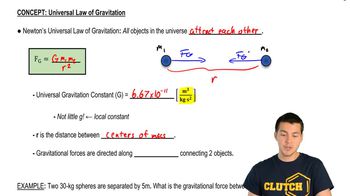
Newton's Law of Universal Gravitation

Newton's Law of Universal Gravitation states that every point mass attracts every other point mass in the universe with a force that is directly proportional to the product of their masses and inversely proportional to the square of the distance between their centers. This law is fundamental for understanding gravitational interactions, particularly in orbital mechanics.
Video consigliato:
Percorso guidato
04:05
Universal Law of Gravitation

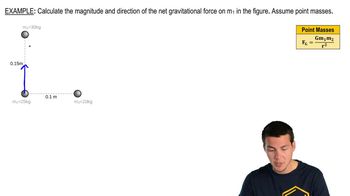
Gravitational Force and Distance

The gravitational force between two objects decreases with the square of the distance between them. This means that if the distance (or radius of orbit) increases, the gravitational force will decrease significantly, following the formula F = G(m1*m2)/r², where F is the gravitational force, G is the gravitational constant, m1 and m2 are the masses, and r is the distance between the centers of the two masses.
Video consigliato:
Percorso guidato
05:41
Gravitational Forces in 2D

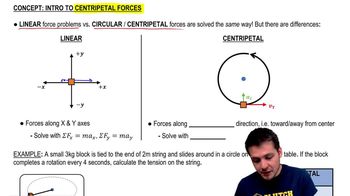
Circular Motion and Centripetal Force

In circular motion, an object moving in a circle experiences a centripetal force directed towards the center of the circle, which is provided by the gravitational force in the case of satellites. The balance between gravitational force and the required centripetal force allows satellites to maintain their orbits, making it essential to understand how changes in radius affect these forces.
Video consigliato:
Percorso guidato
06:48
Intro to Centripetal Forces