Ch. 06 - Gravitation and Newton's Synthesis
Giancoli Douglas - Physics for Scientists and Engineers 5th edition
Giancoli Douglas5th editionPhysics for Scientists and EngineersISBN: 9780137488179Non è quello che usi tu?Cambia libro di testo
Capitolo 6, Problema 25a

Use the binomial expansion (1±x)n=1±nx+n(n−1)2x2±…\(\left\)(1\(\pm\) x\(\right\))^{n}=1\(\pm\) nx+\(\frac{n(n-1)}{2}\)x^2\(\pm\)\(\ldots\) to show that the value of g is altered by approximately Δg≈−2gΔrrE\(\Delta\) g\(\thickapprox\)-2g\(\frac{\Delta r}{r_{E}\)} at a height ∆r above the Earth’s surface, where rE is the radius of the Earth, as long as ∆r ≪ rE.

Guida verificata passo dopo passo
1
Start by recalling the formula for gravitational acceleration near the Earth's surface: g = G * M / r², where G is the gravitational constant, M is the mass of the Earth, and r is the distance from the Earth's center.
When the height above the Earth's surface changes by a small amount ∆r, the new distance from the Earth's center becomes r = r_E + ∆r, where r_E is the Earth's radius.
Substitute r = r_E + ∆r into the formula for g: g' = G * M / (r_E + ∆r)². To simplify this expression, use the binomial expansion for (1 + x)ⁿ, where n = -2 and x = ∆r / r_E, assuming ∆r ≪ r_E.
Apply the binomial expansion: (1 + x)ⁿ ≈ 1 + nx + (n(n-1)/2)x². For n = -2, this becomes (1 + ∆r / r_E)⁻² ≈ 1 - 2(∆r / r_E) + 3(∆r / r_E)². Keep only the first-order term since higher-order terms are negligible for small ∆r.
Substitute the approximation back into the expression for g': g' ≈ G * M / r_E² * (1 - 2(∆r / r_E)). Recognize that G * M / r_E² is the original gravitational acceleration g, so g' ≈ g * (1 - 2(∆r / r_E)). The change in g is then ∆g = g' - g ≈ -2g(∆r / r_E).

Risposta video verificata per un problema simile:

Questa soluzione video è stata consigliata dai nostri tutor come utile per risolvere questo problema.
Durata del video:
6m

Concetti chiave

Ecco i concetti essenziali che devi comprendere per rispondere correttamente alla domanda.

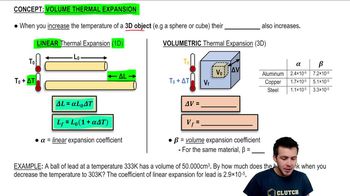
Binomial Expansion

The binomial expansion is a mathematical formula that expresses the powers of a binomial as a sum of terms involving coefficients, which can be calculated using combinations. It is particularly useful for approximating expressions when the exponent is a large number and the variable is small. In this context, it helps to simplify the expression for gravitational acceleration at a height above the Earth's surface.
Video consigliato:
Percorso guidato
05:21
Volume Thermal Expansion

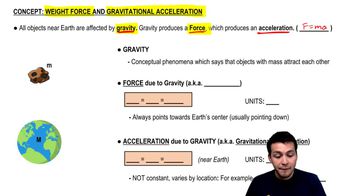
Gravitational Acceleration

Gravitational acceleration, denoted as 'g', is the acceleration experienced by an object due to the gravitational force exerted by a massive body, such as Earth. It varies with distance from the center of the Earth, decreasing as one moves away from the surface. Understanding how 'g' changes with height is crucial for analyzing the effects of altitude on gravitational force.
Video consigliato:
Percorso guidato
07:32
Weight Force & Gravitational Acceleration

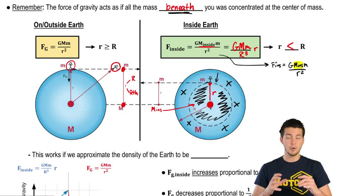
Radius of the Earth

The radius of the Earth, denoted as 'r_E', is the average distance from the Earth's center to its surface, approximately 6,371 kilometers. This value is essential in calculations involving gravitational forces, as it serves as a reference point for determining how gravitational acceleration changes with height. The relationship between height and radius is key to deriving the approximate change in gravitational acceleration, ∆g.
Video consigliato:
Percorso guidato
9:26
Gravitational Force Inside the Earth