Ch. 06 - Gravitation and Newton's Synthesis
Giancoli Douglas - Physics for Scientists and Engineers 5th edition
Giancoli Douglas5th editionPhysics for Scientists and EngineersISBN: 9780137488179Non è quello che usi tu?Cambia libro di testo
Capitolo 6, Problema 25b

The value of g is altered by approximately Δg≈−2gΔrrE\(\Delta\) g\(\thickapprox\)-2g\(\frac{\Delta r}{r_{E}\)} at a height ∆r above the Earth’s surface, where rE is the radius of the Earth, as long as ∆r ≪ rE. What is the meaning of the minus sign in this relation?

Guida verificata passo dopo passo
1
The given relation, ∆g ≈ -2g ∆r/r_E, describes how the acceleration due to gravity (g) changes with a small height (∆r) above the Earth's surface, assuming ∆r is much smaller than the Earth's radius (r_E). The minus sign in this equation indicates the direction of the change in g relative to the increase in height.
To understand the minus sign, recall that the acceleration due to gravity decreases as we move farther from the Earth's surface. This is because gravity weakens with distance according to the inverse-square law.
In this context, the minus sign signifies that as ∆r (the height above the Earth's surface) increases, the value of ∆g (the change in gravity) becomes negative, meaning g decreases.
Mathematically, the negative sign reflects the fact that the derivative of g with respect to r (distance from the Earth's center) is negative. This aligns with the physical reality that gravity diminishes with increasing distance.
Thus, the minus sign in the relation ∆g ≈ -2g ∆r/r_E conveys the inverse relationship between the change in gravity and the increase in height above the Earth's surface.

Risposta video verificata per un problema simile:

Questa soluzione video è stata consigliata dai nostri tutor come utile per risolvere questo problema.
Durata del video:
2m

Concetti chiave

Ecco i concetti essenziali che devi comprendere per rispondere correttamente alla domanda.

Gravitational Acceleration (g)

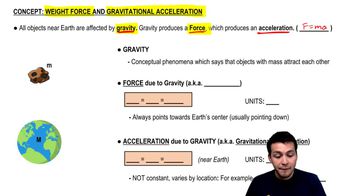
Gravitational acceleration, denoted as 'g', is the acceleration experienced by an object due to the gravitational force exerted by a massive body, such as Earth. Near the Earth's surface, this value is approximately 9.81 m/s². The value of 'g' decreases with increasing height above the Earth's surface, which is described by the formula provided in the question.
Video consigliato:
Percorso guidato
07:32
Weight Force & Gravitational Acceleration

Height Above Earth's Surface (∆r)

The term ∆r represents a small change in height above the Earth's surface. In the context of the question, it indicates how much higher an object is compared to the Earth's surface. The relationship between ∆g and ∆r shows that as one moves away from the Earth, the gravitational acceleration decreases, which is significant for understanding how gravity varies with altitude.
Video consigliato:
Percorso guidato
9:26
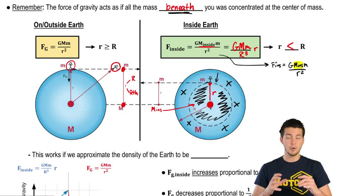
Gravitational Force Inside the Earth

Negative Sign in the Relation

The negative sign in the relation ∆g ≈ -2g ∆r/r_E indicates that the change in gravitational acceleration (∆g) is a decrease as height (∆r) increases. This means that as you move away from the Earth's surface, the gravitational pull becomes weaker, which is a fundamental concept in gravitational physics. The negative sign emphasizes the inverse relationship between height and gravitational acceleration.
Video consigliato:
Percorso guidato
08:55
Net Torque & Sign of Torque