
Ch. 07 - Work and Energy
Giancoli Douglas - Physics for Scientists and Engineers 5th edition
Giancoli Douglas5th editionPhysics for Scientists and EngineersISBN: 9780137488179Non è quello che usi tu?Cambia libro di testo
Capitolo 7, Problema 7.100d

A 2.0-kg block slides across a rough surface with a constant coefficient of kinetic friction of 0.50 (Fig. 7–38a). The block starts at x= 0 with an initial velocity of 4.9 m/s. Pushing the block is a force directed at 36.8° below the horizontal and whose magnitude increases with position as shown in Fig. 7–38b.
<IMAGE>
(d) Draw a line on the graph showing the magnitude of the friction force versus distance x.

Guida verificata passo dopo passo
1
Identify the forces acting on the block: The gravitational force (weight) acting downwards, the normal force acting upwards, the kinetic friction force acting opposite to the direction of motion, and the applied force which has a horizontal component pushing the block and a vertical component acting downwards.
Calculate the normal force on the block. The normal force is equal to the weight of the block minus the vertical component of the applied force. Use the equation: Normal Force = Weight - Vertical Component of Applied Force. The weight is calculated as the mass times the acceleration due to gravity (9.8 m/s^2). The vertical component of the applied force can be found using trigonometric functions (sine of the angle times the magnitude of the force).
Determine the frictional force using the coefficient of kinetic friction and the normal force. The frictional force can be calculated by multiplying the coefficient of kinetic friction by the normal force. Use the equation: Frictional Force = Coefficient of Kinetic Friction × Normal Force.
Since the problem states that the magnitude of the applied force increases with position, you need to consider how this affects the normal force and consequently the frictional force as the block moves. The frictional force will vary depending on the changing normal force.
Plot the frictional force versus distance on the graph. Start from the initial position (x = 0) with the initial frictional force calculated and extend the line considering the increase in the applied force and its effect on the normal and frictional forces as the block moves along the surface.

Risposta video verificata per un problema simile:

Questa soluzione video è stata consigliata dai nostri tutor come utile per risolvere questo problema.

Concetti chiave

Ecco i concetti essenziali che devi comprendere per rispondere correttamente alla domanda.

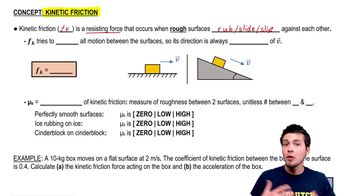
Kinetic Friction

Kinetic friction is the force that opposes the motion of two surfaces sliding past each other. It is characterized by the coefficient of kinetic friction (μk), which is a dimensionless value representing the ratio of the frictional force to the normal force. In this scenario, the coefficient is given as 0.50, meaning the frictional force can be calculated as F_friction = μk * N, where N is the normal force acting on the block.
Video consigliato:
Percorso guidato
06:18
Kinetic Friction Problems

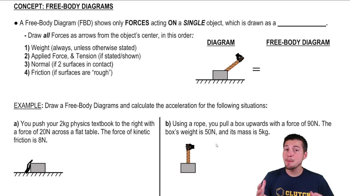
Free Body Diagram

A free body diagram (FBD) is a graphical representation used to visualize the forces acting on an object. In this case, it would include the gravitational force, the normal force, the applied force at an angle, and the frictional force. Analyzing the FBD helps in understanding how these forces interact and affect the block's motion, which is crucial for determining the friction force as a function of distance.
Video consigliato:
Percorso guidato
08:42
Free-Body Diagrams

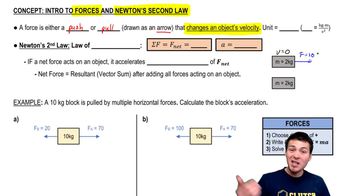
Newton's Second Law

Newton's Second Law states that the acceleration of an object is directly proportional to the net force acting on it and inversely proportional to its mass, expressed as F_net = m * a. This principle is essential for analyzing the block's motion, as it allows us to calculate the net force by considering all acting forces, including friction and the applied force, to determine how the block's velocity changes over distance.
Video consigliato:
Percorso guidato
06:54
Intro to Forces & Newton's Second Law