
The head of a hammer with a mass of 1.2 kg is allowed to fall onto a nail from a height of 0.65 m. What is the maximum amount of work it could do on the nail? Why do people not just “let it fall” but add their own force to the hammer as it falls?
Ch. 07 - Work and Energy
Giancoli Douglas5th editionPhysics for Scientists and EngineersISBN: 9780137488179Non è quello che usi tu?Cambia libro di testo
Capitolo 7, Problema 3
A 55.0-kg firefighter climbs a flight of stairs 28.0 m high at constant speed. How much work does she do?
Guida verificata passo dopo passo1
Identify the formula for work done against gravity: \( W = m \cdot g \cdot h \), where \( m \) is the mass of the firefighter, \( g \) is the acceleration due to gravity (approximately \( 9.8 \, \text{m/s}^2 \)), and \( h \) is the height climbed.
Substitute the given values into the formula: \( m = 55.0 \, \text{kg} \), \( g = 9.8 \, \text{m/s}^2 \), and \( h = 28.0 \, \text{m} \).
Perform the multiplication: First, calculate \( m \cdot g \), then multiply the result by \( h \).
Ensure the units are consistent: The mass is in kilograms, the height is in meters, and the acceleration due to gravity is in meters per second squared, so the resulting work will be in joules (\( \text{J} \)).
Interpret the result: The work done represents the energy expended by the firefighter to climb the stairs at constant speed, overcoming the force of gravity.

Risposta video verificata per un problema simile:
Questa soluzione video è stata consigliata dai nostri tutor come utile per risolvere questo problema.
Durata del video:
2mConcetti chiave
Ecco i concetti essenziali che devi comprendere per rispondere correttamente alla domanda.
Work
In physics, work is defined as the product of the force applied to an object and the distance over which that force is applied, in the direction of the force. Mathematically, it is expressed as W = F × d × cos(θ), where W is work, F is the force, d is the distance, and θ is the angle between the force and the direction of motion. When an object moves vertically against gravity, the work done is related to the gravitational force acting on the object.
Video consigliato:
Percorso guidato
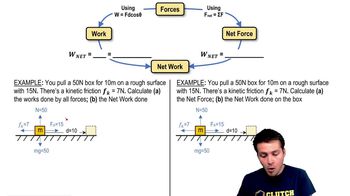
Calculating Net Work
Gravitational Force
Gravitational force is the attractive force that exists between any two masses. On Earth, this force can be calculated using the equation F = m × g, where F is the gravitational force, m is the mass of the object, and g is the acceleration due to gravity (approximately 9.81 m/s²). For the firefighter, her weight (mass times gravity) is the force she must work against while climbing the stairs.
Video consigliato:
Percorso guidato
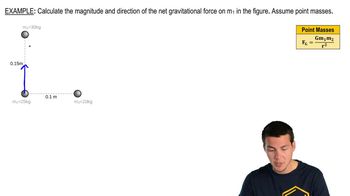
Gravitational Forces in 2D
Constant Speed
When an object moves at constant speed, it means that its velocity remains unchanged over time, implying that the net force acting on it is zero. In the context of the firefighter climbing stairs, moving at constant speed indicates that the work done against gravity is equal to the gravitational potential energy gained, and there is no acceleration involved. This simplifies the calculation of work, as the force exerted is equal to her weight.
Video consigliato:
Percorso guidato
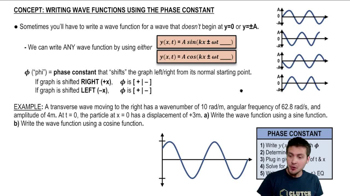
Phase Constant of a Wave Function
Pratica correlata
Domanda del libro di testo
1848
views
Domanda del libro di testo
Estimate the work you do to mow a lawn 10 m by 20 m with a 50-cm-wide mower. Assume you push with a horizontal force of about 15 N.
1756
views
1
rank
Domanda del libro di testo
A 2.0-kg block slides across a rough surface with a constant coefficient of kinetic friction of 0.50 (Fig. 7–38a). The block starts at x= 0 with an initial velocity of 4.9 m/s. Pushing the block is a force directed at 36.8° below the horizontal and whose magnitude increases with position as shown in Fig. 7–38b.
<IMAGE>
(d) Draw a line on the graph showing the magnitude of the friction force versus distance x.
2371
views
