
Ch. 08 - Conservation of Energy
Giancoli Douglas - Physics for Scientists and Engineers 5th edition
Giancoli Douglas5th editionPhysics for Scientists and EngineersISBN: 9780137488179Non è quello che usi tu?Cambia libro di testo
Capitolo 8, Problema 36b

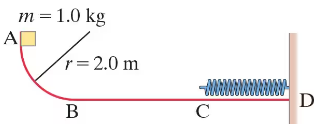
Consider the track shown in Fig. 8–39. The section AB is one quadrant of a circle of radius 2.0 m and is frictionless. B to C is a horizontal span 3.0 m long with a coefficient of kinetic friction μₖ = 0.25. The section CD under the spring is frictionless. A block of mass 1.0 kg is released from rest at A. After sliding on the track, it compresses the spring by 0.20 m. Determine the thermal energy produced as the block slides from B to C.
Diagram of a frictionless track with a 1.0 kg block at point A, a spring at point D, and distances labeled.

Guida verificata passo dopo passo
1
Step 1: Identify the relevant concepts. The problem involves energy conservation, work done by friction, and thermal energy. The thermal energy produced as the block slides from B to C is due to the work done by the kinetic friction force.
Step 2: Write the formula for thermal energy produced by friction. The thermal energy (E_thermal) is given by the work done by the friction force: E_thermal = f_k * d, where f_k is the kinetic friction force and d is the distance over which the force acts.
Step 3: Calculate the kinetic friction force. The kinetic friction force is given by f_k = μₖ * N, where μₖ is the coefficient of kinetic friction and N is the normal force. Since the block is on a horizontal surface, N = m * g, where m is the mass of the block and g is the acceleration due to gravity.
Step 4: Substitute the values into the formula for f_k. Use μₖ = 0.25, m = 1.0 kg, and g = 9.8 m/s² to calculate f_k. Then, substitute f_k and d = 3.0 m into the formula for E_thermal to find the thermal energy.
Step 5: Conclude the calculation. After substituting all the values, simplify the expression to determine the thermal energy produced as the block slides from B to C. Ensure the units are consistent throughout the calculation.

Risposta video verificata per un problema simile:

Questa soluzione video è stata consigliata dai nostri tutor come utile per risolvere questo problema.
Durata del video:
6m

Concetti chiave

Ecco i concetti essenziali che devi comprendere per rispondere correttamente alla domanda.

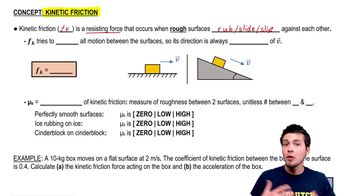
Kinetic Friction

Kinetic friction is the force that opposes the motion of two surfaces sliding past each other. It is quantified by the coefficient of kinetic friction (μₖ), which is a dimensionless value representing the ratio of the frictional force to the normal force. In this scenario, the coefficient of kinetic friction is given as 0.25, indicating the amount of energy lost as thermal energy due to friction when the block moves from point B to C.
Video consigliato:
Percorso guidato
06:18
Kinetic Friction Problems

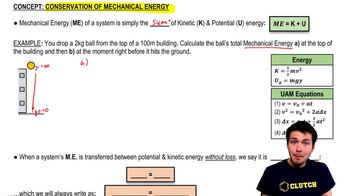
Conservation of Energy

The principle of conservation of energy states that energy cannot be created or destroyed, only transformed from one form to another. In this problem, the gravitational potential energy of the block at point A is converted into kinetic energy as it slides down the track and into thermal energy due to friction as it moves from B to C. Understanding this concept is crucial for calculating the energy transformations occurring in the system.
Video consigliato:
Percorso guidato
06:24
Conservation Of Mechanical Energy

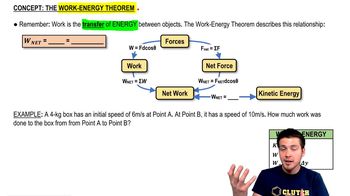
Work-Energy Principle

The work-energy principle states that the work done on an object is equal to the change in its kinetic energy. In the context of this problem, the work done by friction as the block slides from B to C results in a loss of kinetic energy, which is converted into thermal energy. This principle helps in quantifying the thermal energy produced during the block's motion across the frictional surface.
Video consigliato:
Percorso guidato
04:10
The Work-Energy Theorem
Pratica correlata
Domanda del libro di testo

Consider the track shown in Fig. 8–39. The section AB is one quadrant of a circle of radius 2.0 m and is frictionless. B to C is a horizontal span 3.0 m long with a coefficient of kinetic friction μₖ = 0.25. The section CD under the spring is frictionless. A block of mass 1.0 kg is released from rest at A. After sliding on the track, it compresses the spring by 0.20 m. Determine the velocity of the block at point C.

1677
views
Domanda del libro di testo

Consider the track shown in Fig. 8–39. The section AB is one quadrant of a circle of radius 2.0 m and is frictionless. B to C is a horizontal span 3.0 m long with a coefficient of kinetic friction μₖ = 0.25. The section CD under the spring is frictionless. A block of mass 1.0 kg is released from rest at A. After sliding on the track, it compresses the spring by 0.20 m. Determine the velocity of the block at point B.

2022
views
Domanda del libro di testo

A skier of mass m starts from rest at the top of a solid sphere of radius r and slides down its frictionless surface. If friction is present, does the skier fly off at a greater or lesser angle?

1364
views
Domanda del libro di testo

A spring ( k = 75 N/m) has an equilibrium length of 1.00 m. The spring is compressed to a length of 0.50 m and a mass of 2.0 kg is placed at its free end on a frictionless slope which makes an angle of 41° with respect to the horizontal (Fig. 8–41). The spring is then released. If the mass is attached to the spring, how far up the slope will the mass move before coming to rest?

1010
views
Domanda del libro di testo

You slide down an 8.0-m-high icy hill (≈ frictionless). At the bottom is a level stretch where the coefficient of kinetic friction is 0.30. How far would you travel across the level stretch?

1592
views
Domanda del libro di testo

Consider the track shown in Fig. 8–39. The section AB is one quadrant of a circle of radius 2.0 m and is frictionless. B to C is a horizontal span 3.0 m long with a coefficient of kinetic friction μₖ = 0.25. The section CD under the spring is frictionless. A block of mass 1.0 kg is released from rest at A. After sliding on the track, it compresses the spring by 0.20 m. Determine the stiffness constant k for the spring.

1467
views